

Gravitational Force

Presentation
•
Science
•
6th - 8th Grade
•
Medium
+1
Standards-aligned

Christine Boudreau
Used 4+ times
FREE Resource
3 Slides • 8 Questions
1
2
Multiple Choice

In a binary star system, two stars are in orbit around each other. Star A has a mass of 2 solar masses, and Star B has a mass of 0.5 solar masses. Which star experiences a greater gravitational force due to the other star, and why?
Star A, because it has a larger mass than Star B.
Star B, because it has a smaller mass than Star A.
Both stars experience the same gravitational force due to each other.
The gravitational force depends on the distance between the stars, so we need more information to answer the question.
3
The gravitational force between two objects depends on their masses and the distance between them. According to Newton's Law of Universal Gravitation, the force is directly proportional to the product of the masses and inversely proportional to the square of the distance between them. Since both stars are in orbit around each other, they experience equal and opposite gravitational forces due to each other. However, the magnitude of the force experienced by each star depends on its mass. Star A has a mass of 2 solar masses, which is larger than the mass of Star B, so it experiences a greater gravitational force due to Star B. Therefore, the correct answer is A.
4
Multiple Choice
A spacecraft is sent to orbit around a planet that has a mass of 3.0 x 10^24 kg and a radius of 6.0 x 10^6 m. If the spacecraft orbits at a distance of 4.0 x 10^7 m from the center of the planet, what is the gravitational force acting on the spacecraft due to the planet?
2.8 x 10^7 N
6.7 x 10^-11 N
1.3 x 10^12 N
3.0 x 10^7 N
5
The gravitational force between two objects depends on their masses and the distance between them. According to Newton's Law of Universal Gravitation, the force is directly proportional to the product of the masses and inversely proportional to the square of the distance between them. In this case, the mass of the planet, its radius, and the distance of the spacecraft from the center of the planet are provided. We can use these values to calculate the gravitational force acting on the spacecraft due to the planet. The formula for gravitational force is F = G (m1 m2) / r^2, where G is the gravitational constant (6.67 x 10^-11 N m^2 / kg^2), m1 is the mass of one object (the planet in this case), m2 is the mass of the other object (the spacecraft in this case), and r is the distance between the two objects. Plugging in the values, we get:
F = G (m1 m2) / r^2 F = (6.67 x 10^-11) (3.0 x 10^24) (1.0) / (4.0 x 10^7 + 6.0 x 10^6)^2 F = 2.8 x 10^7 N
Therefore, the correct answer is A.
6
Multiple Choice
When placed at equal distances apart, the greatest gravitational attraction will be between two
skateboards
bowling balls
school buses
7
Multiple Choice
Which is needed to determine the amount of gravitational force between two objects?
distance and mass
weight and time
area and weight
8
Multiple Choice
The gravitational force exerted by an object depends on its
volume
mass
weight
9
Multiple Choice
A student drops a bowling ball and an apple from a third-story window. Both objects hit the ground at the same time. From the experiment, the student should conclude that
the apple weighs more than the bowling ball
more air friction is acting on the apple than on the bowling ball
gravity pulls on both objects, causing them to fall at the same time.
10
Multiple Choice
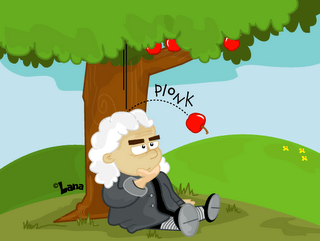
It makes objects at rest start moving.
It makes objects that are moving stop.
The force of attraction between two objects.
It pulls you into space.
11
Multiple Choice
That Jupiter’s gravitational force is much weaker than on Earth’s gravitational force.
That Jupiter’s gravitational force is much stronger than Earth’s gravitational force.
That Jupiter’s and Earth’s gravitational forces are equal.
Mass has no effect on the gravitational force between two objects
Show answer
Auto Play
Slide 1 / 11
SLIDE
Similar Resources on Wayground

9 questions
Mutation vs. Adaptation vs. Variations
Presentation
•
6th - 8th Grade
9 questions
Geologic Time Scale
Presentation
•
6th - 8th Grade
7 questions
solving proportions
Presentation
•
6th - 8th Grade
7 questions
Triple beam balance
Presentation
•
6th - 8th Grade
12 questions
Bill Nye the Science Guy: Rock and Soil
Presentation
•
6th - 8th Grade
7 questions
Invasive species
Presentation
•
7th - 8th Grade
10 questions
Types of Energy
Presentation
•
6th - 8th Grade
11 questions
Maps for Science
Presentation
•
6th - 8th Grade
Popular Resources on Wayground
21 questions
Continents and Oceans

Quiz
•
6th Grade
20 questions
Parts of Speech
Quiz
•
5th Grade
16 questions
Subject & Predicate
Quiz
•
5th Grade
25 questions
Multiplication Facts
Quiz
•
5th Grade
12 questions
Map Skills
Quiz
•
3rd Grade
22 questions
Continents and Oceans
Quiz
•
5th Grade
15 questions
Rounding Decimals
Quiz
•
5th Grade
20 questions
Brand Labels
Quiz
•
5th - 12th Grade
Discover more resources for Science
20 questions
Newton's Laws of Motion
Quiz
•
8th Grade
20 questions
Elements, compounds, and mixtures
Quiz
•
6th Grade
17 questions
7.6D Aqueous Solutions
Quiz
•
7th Grade
20 questions
Scientific Method and Variables
Quiz
•
8th Grade
20 questions
Scientific method and variables
Quiz
•
8th Grade
10 questions
6.6D - Relative Density Review
Quiz
•
6th Grade
20 questions
Claim, Evidence and Reasoning (CER)
Quiz
•
6th - 8th Grade
21 questions
Newton's Laws of Motion
Quiz
•
8th Grade