
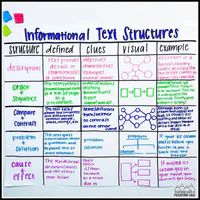
Informational Text Structure Test

Presentation
•
English
•
5th Grade
•
Practice Problem
•
Medium
+12
Standards-aligned

MICHAEL LOVELL
Used 8+ times
FREE Resource
2 Slides • 6 Questions
1
Sherman’s Act
The 1800s were a time of great change in the United States. Settlers flocked to the West. The country became larger. At the same time, people were dealing with changes brought on by the Civil War. Business and trade in the country grew at a rapid pace as America became industrialized.
The country changed for the better in some ways, but there were also problems. Certain business owners made decisions that created a large problem. They realized they might be able to make money from buying and controlling a lot of the same kinds of businesses. Then, the owners realized if they worked together, they could gain power. They would buy several of the same types of businesses. Owners of the businesses could work together and charge high prices for an item or service. Then the business owners could make more money.
Some business owners took advantage of this situation so that they grew wealthier and wealthier. As a result, many Americans grew frustrated when they saw that important industries, like railroads, were controlled by just a few owners. Soon, citizens and politicians began to think that such control was dangerous. Some business owners lowered what they paid workers. They set high prices, causing both workers and customers to suffer.
One concerned American was John Sherman. He was a senator from Ohio who knew a lot about trade and business. He believed that there should be limits to what businesses could do. He wrote a law that helped to limit how much power business owners could have. Sherman’s plan prevented businesses from scaring away competitors or forming groups to set prices.
The law was passed in 1890. It became known as the Sherman Antitrust Act. It took some time for business owners to accept the act and follow it. After all, it was designed to limit how large businesses could grow. However, customers and workers were able to breathe a sigh of relief.
2
Multiple Choice
What overall text structure does the author use to organize this selection?
Chronological
Cause and effect
Question and answer
Compare and contrast
3
Multiple Choice
What text structure does the author use in paragraphs 2 and 3 to describe the relationship among business, citizens, and government?
Cause and effect
Time order of events
Problem and solution
Compare and contrast
4
Multiple Choice
Which detail found in paragraph 5 of “Sherman’s Act” best summarizes the purpose of the Sherman Antitrust Act?
The law was passed in 1890.
It took some time for business owners to accept the act and follow it.
After all, it was designed to limit how large businesses could grow.
It became known as the Sherman Antitrust Act.
5
Hoop Games
Every day, children can be found playing games at recess. The history of some games may be unknown, but we know the story ofhoop games, which started long ago.
Thousands of years ago, ancient Greeks and Romans used hoops for fun and exercise. These early hoops were made out of metal. Artwork from that time shows children and adults rolling hoops. In these games, people would hit a hoop with a stick to get it rolling,and then they would run after it, trying to the keep the hoop going.
In the 1400s, hoop rolling was popular in England. In fact, it was so popular that the colonists brought the game with them to America,and children in colonial times would have hoop contests. They would play to see how far and fast they could push the hoop withsticks. Some children would play a game called “graces,” in whicha child would hold a hoop on two crossed sticks, then toss thehoop to another person. This person would try to catch it with oneof the sticks.
In the 1800s, hoop rolling became more popular than ever. Many paintings of children from this time include hoops. Childrenbegan to play some different games, such as trying to knockobjects over with the rolling hoops and using the hoops forskipping. Many of these games were played on city streets. Thehoops were made from both metal and wood, but wooden hoopswere more popular.
In the late 1800s and early 1900s, children continued to playsimilar hoop games. However, city streets started to become morecrowded, and the children were in the way of other people. Thepopularity of hoop rolling games came to an end. Today, people still play with hoops, but in different ways
6
Multiple Choice
What is the overall structure of this selection?
Chronological
Cause and effect
Problem and solution
Compare and contrast
7
Multiple Choice
Which detail from the selection gives clues about the overall structure?
In the 1400s, hoop rolling was popular
how far and fast they could push the hoop
hoop rolling became more popular
children were in the way
8
Multiple Choice
What do most Greek and Roman hoop games have in common with English andAmerican ones?
The hoops were made of metal.
The games needed sticks to play.
They knocked objects over with the hoops.
They brought the games with them to the colonies.
Sherman’s Act
The 1800s were a time of great change in the United States. Settlers flocked to the West. The country became larger. At the same time, people were dealing with changes brought on by the Civil War. Business and trade in the country grew at a rapid pace as America became industrialized.
The country changed for the better in some ways, but there were also problems. Certain business owners made decisions that created a large problem. They realized they might be able to make money from buying and controlling a lot of the same kinds of businesses. Then, the owners realized if they worked together, they could gain power. They would buy several of the same types of businesses. Owners of the businesses could work together and charge high prices for an item or service. Then the business owners could make more money.
Some business owners took advantage of this situation so that they grew wealthier and wealthier. As a result, many Americans grew frustrated when they saw that important industries, like railroads, were controlled by just a few owners. Soon, citizens and politicians began to think that such control was dangerous. Some business owners lowered what they paid workers. They set high prices, causing both workers and customers to suffer.
One concerned American was John Sherman. He was a senator from Ohio who knew a lot about trade and business. He believed that there should be limits to what businesses could do. He wrote a law that helped to limit how much power business owners could have. Sherman’s plan prevented businesses from scaring away competitors or forming groups to set prices.
The law was passed in 1890. It became known as the Sherman Antitrust Act. It took some time for business owners to accept the act and follow it. After all, it was designed to limit how large businesses could grow. However, customers and workers were able to breathe a sigh of relief.
Show answer
Auto Play
Slide 1 / 8
SLIDE
Similar Resources on Wayground

6 questions
Picture Composition
Presentation
•
4th Grade
6 questions
We Can 2 : Wild Animals - Words in Action
Presentation
•
5th Grade
6 questions
G5 Language Board Perfect Verb Tenses Day 1
Presentation
•
5th Grade
6 questions
Author's Perspective
Presentation
•
4th Grade
7 questions
Multiple Meaning Words
Presentation
•
5th Grade
7 questions
COMMANDS
Presentation
•
5th Grade
9 questions
Four Kinds of Sentences
Presentation
•
5th Grade
8 questions
Intro to Poetry
Presentation
•
5th Grade
Popular Resources on Wayground
21 questions
Continents and Oceans

Quiz
•
6th Grade
20 questions
Parts of Speech
Quiz
•
5th Grade
16 questions
Subject & Predicate
Quiz
•
5th Grade
25 questions
Multiplication Facts
Quiz
•
5th Grade
12 questions
Map Skills
Quiz
•
3rd Grade
22 questions
Continents and Oceans
Quiz
•
5th Grade
15 questions
Rounding Decimals
Quiz
•
5th Grade
20 questions
Brand Labels
Quiz
•
5th - 12th Grade
Discover more resources for English
20 questions
Parts of Speech
Quiz
•
5th Grade
16 questions
Subject & Predicate
Quiz
•
5th Grade
15 questions
Central Idea
Quiz
•
5th Grade
20 questions
Inferences
Quiz
•
5th Grade
12 questions
Figurative Language Review

Interactive video
•
5th Grade
20 questions
4 Types of Sentences
Quiz
•
4th - 5th Grade
20 questions
Main Idea and Details
Quiz
•
5th Grade
20 questions
Simple, Compound, and Complex Sentences
Quiz
•
5th Grade