
Mesoamerica Game Project

Presentation
•
Social Studies
•
6th Grade
•
Easy

Vanessa C
Used 2+ times
FREE Resource
8 Slides • 20 Questions
1
Maya Achievements in science and math were very important. The Maya built observatories to study astronomy. Mayan astronomers figured out a year is about 365 days long. Based on their discovery, Maya developed a calendar that was more accurate than the calendar used in Europe at the time. To go along with their calendars, the Maya created a number system that included some new concepts in math. Like the Gupta empire in India, the Maya were among the first people with a symbol for zero. They used their number system to record important dates in their history.
2
Multiple Choice
What accomplishments in math did both the Indians and the Maya create?
Created geometry to improve building techniques
Created a symbol for nothing, zero
Created the pythagorean theorem used to find angles in triangles
Developed algebraic equations.
3
Multiple Choice
What did the Inca system of roads and bridges accomplish?
It helped the empire spread onto new continents
It prevented cultural diffusion from taking place
It kept the Inca people isolated from others.
It allowed the government to control a large territory.
4
Multiple Choice
One way in which the ancient Inca Empire and the Roman Empire are similar is that both
Fought rivals for control of the sea
Adopted Christianity as the state religion
Traded with other civilizations along the Silk Road
Built a system of roadways throughout their empires
5
The ancient Aztecs believed in many gods, and each god had a job. For example, the sun god brought up the sun. If the sun god was unhappy, he would refuse to bring out the sun and all the crops would die. The Aztecs spent an enormous amount of time making sure that all their gods were happy; time they could have spent gathering food or making needed goods. The priests believed the only way to keep so many gods happy all at once was to offer the gods human sacrifice. Aztec warriors spent their time capturing people from neighboring tribes to be sacrificed.
Appeasing the gods
6
Multiple Choice
According to the passage, what connection was there between Aztec ceremonial sacrifice and agriculture?
Human sacrifice was not practiced for fear of famine
Aztecs believed human sacrifice would lead to high crop growth
The Aztecs did not believe in any gods
Conquistadors forced the Aztecs to sacrifice humans for high crop growth
7
As the Inca gained wealth and power they began to build a vast network of roads. Only government officials and the military were allowed to use the roads. As the network of roads expanded, it made movement of armies more efficient. The roads connected all parts of the empire and gave the Incas easier access to neighboring regions they sought to conquer.
8
Multiple Choice
How was the Inca government affected by the system of roads that were built?
The government was able to gain more power and expand as they could move their army to conquer neighboring regions.
The government lost power and declined as neighboring armies used the roads to invade.
The roads were only used by citizens to travel the empire and buy and sell goods.
The roads were only used by the armies to travel the empire and buy and sell goods
9
Multiple Choice
How were Mayan kings similar to Egyptian pharaohs?
The rulers were believed to be gods.
The rulers were elected to lead by the people.
The rulers were selected by the Senate to control the territory.
The rulers inherited their power from their mother’s side of the family.
10
In the Mayan civilization kings held the highest position in society. Like the Greeks, each of the major city-states, or political units, had its own ruling elite that held all political, religious, and economic power. This was different from both the Incas and Aztecs who had unified empires.
11
Multiple Choice
How were the Mayan city-states similar to the Greek city-states?
They fought with Persia to gain their independence
They had no centralized government or single ruler.
They valued philosophers and education
They were run as a direct democracy
12
Multiple Choice
How was the structure of the Maya government different from the structure of the Inca Government?
The Maya had a strong central government, while the Inca had no central government and were run by different kings.
The Inca had a strong central government, while the Maya had no central government and were run by different kings.
The Inca and the Maya governments were both run by kings
They were both direct democracies where everyone had a vote.
13
Multiple Choice
Based on the graph and details provided, how did the Conquistadors impact the export of gold and silver from the New World to Spain?
Sending gold and silver to Spain from the New World decreased once conquistadors conquered the natives' land.
Sending gold and silver to Spain from the New World increased once conquistadors conquered the natives' land.
Exporting gold and silver stayed the same after the conquistadors conquered the natives' land.
The conquistadors did not find any Gold or silver in the New World
14
Multiple Choice
How did the mita impact the economic development in the Inca empire?
All Incas were expected to contribute to the empire through the labor tax and the government distributed goods based on need.
The mita was the currency used in the Inca empire and helped them to buy and sell goods.
All Incas were expected to contribute to the empire through the labor tax and the king kept all of the goods to benefit himself.
Only farmers were expected to contribute to the empire through the labor tax and the government would distribute their food.
15
With a core population recently estimated at 5 to 6 million people, the Aztec Empire was a loosely structured and unstable conquest state that witnessed frequent rebellions by its subject peoples. Conquered peoples and cities were required to regularly deliver to their Aztec rulers impressive quantities of textiles and clothing, military supplies, jewelry, and other luxuries, various foodstuffs, animal products, building materials, rubber balls, paper, and more. The process was overseen by local imperial tribute collectors, who sent the required goods on to Tenochtitlan, a metropolis of 150,000 to 200,000 people, where they were meticulously recorded.” Secondary
16
Multiple Choice
According to this passage, how did the Aztecs strengthen their economy?
Invented new weapons
Produced luxury goods
Conflict among neighbors
Collected goods (tax collection)
17
Multiple Choice
. How did Tenochtitlan’s geography allow them to protect their territory?
Tenochtitlan is surrounded by deserts to prevent invasion
Tenochtitlan is surrounded by a lake that makes it difficult to reach
Tenochtitlan is surrounded by a sea with access to other civilizations
Tenochtitlan is surrounded by mountains that provide easy access to other civilizations
18
Multiple Choice
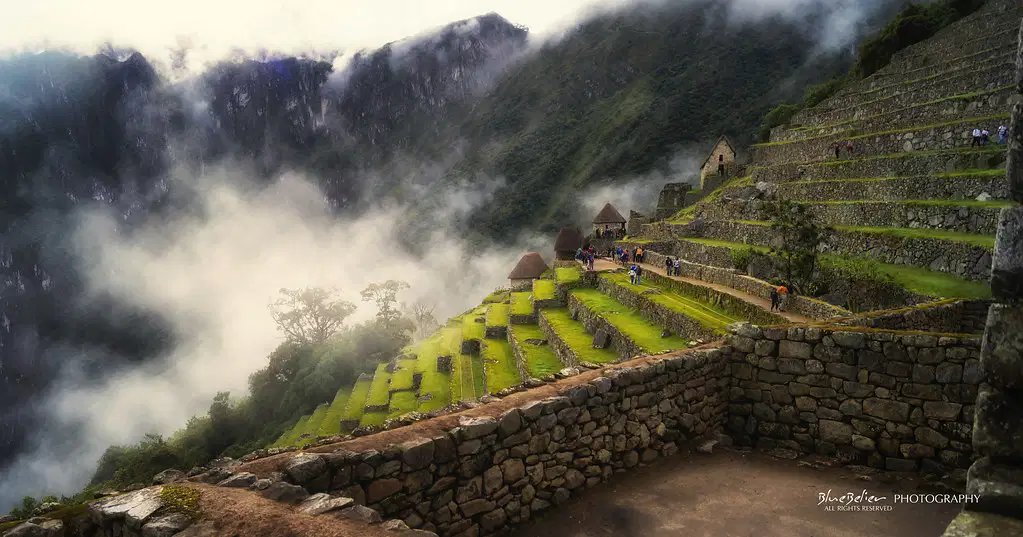
According to the images above, how did the Inca adapt to their environment in order to farm?
Used basins to hold rainwater for farming
Used irrigation systems to bring water from nearby rivers
Built terraces into mountains to create more usable farmland
Built chinampas to create more farmland in a swamp
19
Multiple Choice
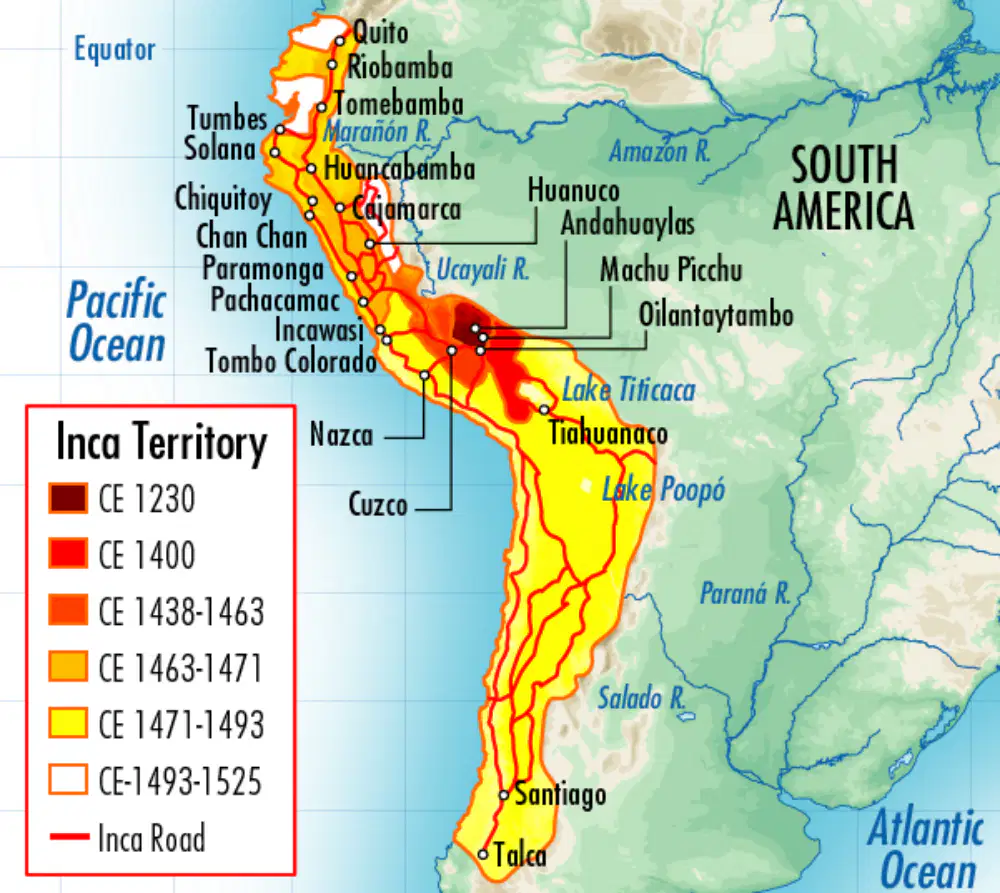
According to the map, what can you determine about the Incan Empire from 1230 CE to 1525 CE
The Inca Empire was able to expand due to a large network of roads
The Inca Empire collapsed because each city was isolated.
The Inca Empire was the smallest between 1471-1493.
The Inca Empire was the largest in 1230 CE
20
Multiple Choice
What type of architecture from the Maya was similar to the Mesopotamians and the Sumerians?
They built step pyramids as a place to honor their gods.
They built terraces for farming
They built castles surrounded by walls for protection
They built an extensive network of roads
21
The Maya civilization developed in Mesoamerica. Thick forest covered most of the land, so the Maya had to clear wooded areas for farmland. They used slash and burn techniques to clear the forest to clear out trees and create farmable land. Although the thick forest made farming hard, they provided valuable resources. Forest animals such as deer and monkeys were a source of food. Also, trees and plants made good building materials. For example, the Maya used wood poles and vines, along with mud, to build their houses.
22
Multiple Choice
. How did the Maya successfully adapt to their environment?
The forest provided animals such as deer and monkeys as a source of food.
They cleared wooded areas for farmland using innovative techniques.
They used wood poles and vines, along with mud, to build their houses.
They hunted exclusively as fertile farmland could not be created.
23
When Atahualpa ruled the Inca empire a group of Spaniards, led by Francisco Pizzarro came to Peru. Atahualpa agreed to meet Pizarro. At that meeting, Spaniards told Atahualpa to convert to Christianity. When he refused, they attacked. They captured Atahualpa and killed thousands of Inca soldiers. To win his freedom, Atahualpa asked his people to fill a room with gold and silver for Pizzaro. The people rushed to bring the Spaniards gold, but they killed Atahualpa anyway. Even though some Incas fought back, the Spaniards finally defeated the last of the Incas in 1537 and gained control over the region.
24
Multiple Choice
How did the arrival of the Spanish affect the Inca civilization?
The arrival of the Inca brought an end to the Spanish Empire.
The arrival of the Spanish brought an end to the Inca Empire.
The Spanish were able to live peacefully with the Inca Empire.
The arrival of the Spanish brought an end to the Mayan Empire.
25
Multiple Choice
What belief shaped who had power and authority in the Maya civilization?
The Mayan rulers were equal to all others in society
Mayan rulers had less power than most citizens in society
Rulers in Mayan society were expected to do everyday tasks
Mayan rulers had divine right and were viewed as gods
26
At Tenochtitlán, the Aztecs perfected an unusual method of farming. They built huge rafts, covered them with earth, and floated them on the lake. On these chinampas, or “floating islands,” they grew enough maize and vegetables to feed their expanding population comfortably. Eventually, roots from the tree rafts attached themselves to the bottom of the shallow lake to become permanent foundations for buildings — Lois Athey
27
Multiple Choice
How did the Aztecs adapt to their environment?
Terrace farming was used by the Aztecs
Large plantations were used to grow crops by the Aztecs
The Aztecs were limited to subsistence farming
They used chinampas to create more farmable land
28
Multiple Choice
How was the Mayan social structure similar to other civilizations you have studied?
It was a pyramid hierarchy where people at the top had more power and wealth
It was a pyramid hierarchy where people at the bottom had more power and wealth
All people in the merchant class collected taxes and revenue for the King
Everyone had one vote and people
Maya Achievements in science and math were very important. The Maya built observatories to study astronomy. Mayan astronomers figured out a year is about 365 days long. Based on their discovery, Maya developed a calendar that was more accurate than the calendar used in Europe at the time. To go along with their calendars, the Maya created a number system that included some new concepts in math. Like the Gupta empire in India, the Maya were among the first people with a symbol for zero. They used their number system to record important dates in their history.
Show answer
Auto Play
Slide 1 / 28
SLIDE
Similar Resources on Wayground

21 questions
The Puritans
Presentation
•
6th Grade
24 questions
Aryans and Caste System
Presentation
•
6th Grade
19 questions
Impact of Geography on Latin America
Presentation
•
6th Grade
24 questions
Ancient Indian Achievements
Presentation
•
6th Grade
22 questions
01/14 The Rule of Pericles and Athenian Life
Presentation
•
6th Grade
20 questions
Geography and the Early Settlement of China
Presentation
•
6th Grade
20 questions
Chapter 4 Section 1
Presentation
•
6th Grade
20 questions
Ancient India (Hinduism)
Presentation
•
6th Grade
Popular Resources on Wayground
20 questions
Math Review

Quiz
•
3rd Grade
15 questions
Fast food
Quiz
•
7th Grade
20 questions
Context Clues
Quiz
•
6th Grade
20 questions
Inferences
Quiz
•
4th Grade
19 questions
Classifying Quadrilaterals
Quiz
•
3rd Grade
20 questions
Figurative Language Review
Quiz
•
6th Grade
20 questions
Equivalent Fractions
Quiz
•
3rd Grade
10 questions
Identify Fractions, Mixed Numbers & Improper Fractions
Quiz
•
3rd - 4th Grade
Discover more resources for Social Studies
56 questions
Civics & Econ Practice SOL #1
Quiz
•
6th - 8th Grade
50 questions
The 50 states of the U.S.A.
Quiz
•
6th Grade
56 questions
Civics & Econ Practice SOL #1
Quiz
•
6th - 8th Grade
20 questions
The United States 1800s-1900s
Quiz
•
6th - 8th Grade
22 questions
Unit 10 Oceania
Quiz
•
6th Grade
38 questions
Civil War Review
Quiz
•
6th - 8th Grade