

Topic 8 Lesson 11 - A Christian Europe

Presentation
•
History
•
6th - 8th Grade
•
Practice Problem
•
Medium

William Jernigan
Used 2+ times
FREE Resource
27 Slides • 15 Questions
1
The Rise of Christianity

A Christian Europe
2
The Roman Catholic Church was based in Rome, the capital of the Western Roman Empire. The church was led by the very powerful pope. As the Western Roman Empire declined, the Christian church of Rome survived. At the same time, the Roman Empire in the east, which soon became known as the Byzantine Empire, thrived. The Byzantines developed their own Christian church. Their church reflected their Greek heritage. This church became known as the Eastern Orthodox Church.
3

4
The emperor of the Byzantine Empire and the officials of the Eastern Orthodox Church worked closely together. The Byzantines believed their emperor was God's representative on Earth. Beginning in the a.d. 400s, emperors were crowned in a religious ceremony. They also took an oath to defend Eastern Orthodox Christianity. They believed it was their duty to unite the empire under one Christian faith. Thus, the emperors controlled the Eastern Orthodox Church. Emperors appointed church leaders and defined how people would worship. They also controlled the wealth of the church and helped settle disputes about church beliefs.
5
Both Byzantine clergy and the Byzantine people discussed and often argued about religious matters. These arguments frequently became political issues and led to fights and riots.
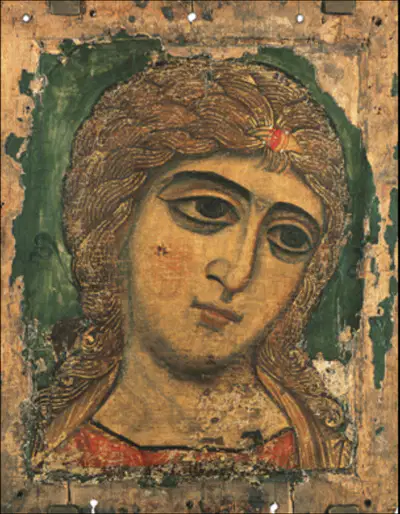
In the a.d. 700s, a heated dispute about icons divided the Eastern Orthodox Church. Icons are paintings of Jesus, Mary (the mother of Jesus), and the saints, or Christian holy people. Many Byzantines displayed icons in their homes. They also covered the walls of their churches with them.
6
People who displayed icons claimed that these images symbolized the presence of God in their lives. They also believed that the images helped people understand Christian teachings. The thinker John of Damascus was the leading defender of icons.
Some Byzantines, however, did not approve of the use of icons. They thought it was a form of idol worship forbidden by God. In a.d. 726, Emperor Leo III ordered that all icons be removed from the churches. Government officials who carried out his orders were called iconoclasts, or image breakers. Today, this word refers to someone who criticizes traditional beliefs or practices.
Most Byzantines, many church leaders, and even the pope in Rome disapproved of Emperor Leo's actions. The dispute over icons severely damaged the relationship between the Roman Catholic Church and the Eastern Orthodox Church. Over the next century, the argument became less heated, and icons were used once again. They are still important today.
7
8

9
Icons were only one of the issues that divided the eastern and western Christian churches. The most serious disagreement was about church authority. The pope claimed to be head of all Christian churches. He believed he was a successor, or person who follows another person, to Peter, disciple of Jesus. Peter was the first bishop of Rome. The Byzantines rejected the claim of the pope. They believed the patriarch of Constantinople and other bishops were equal to the pope.
10
Military events also damaged the relationship between the pope and the patriarch of Constantinople. In the late a.d. 700s, Italy was invaded. The pope appealed to the Byzantine emperor for help, but the emperor refused. The pope then asked the Franks to help defend Rome. The Franks were a Germanic people that supported the pope as head of the Christian church.
The Franks successfully defended Italy against the invaders. To show his gratitude, the pope crowned the Frankish king, Charlemagne, emperor in a.d. 800. The pope's actions upset the Byzantines. They believed their ruler was the only Roman emperor.
The eastern and western churches also viewed their roles in government differently. In the Byzantine Empire, the emperor controlled both church and government. Byzantine church leaders supported the decisions of the emperor. In the West, the pope claimed he had religious and political authority over all of Europe. He often quarreled with kings about church and government affairs.
11


12
Finally, in a.d. 1054, after centuries of bitterness, the patriarch of Constantinople and the pope excommunicated each other. To excommunicate means to declare that a person or group no longer belongs to the church. This created a schism, or separation, between the two major churches of Christianity. The split between the Eastern Orthodox Church and the Roman Catholic Church still exists today.
13


14
After the fall of the Western Roman Empire, people in many parts of Europe faced disorder and violence. Many looked to the Christian church for help. They hoped that Christianity would bring peace, order, and unity.
15

16
During the a.d. 300s, devout Christians in the Eastern Roman Empire formed religious communities called monasteries. In the monasteries, men called monks lived apart from the world. At the same time, they performed good deeds and modeled how Christians should live.
Christian women established religious communities of their own. These women were called nuns, and they lived in convents. During this time, one of the best known nuns was a Roman widow named Paula. In the early a.d. 400s, Paula helped a scholar named Jerome translate the Christian Bible into Latin.
17
The Greek bishop Basil created a list of rules for monks and nuns. Known as the Basilian Rule, this list told people how to live and pray in Eastern Orthodox monasteries and convents.
In the West, religious communities followed another set of regulations called the Benedictine Rule. An Italian monk named Benedict wrote these rules about a.d. 529. Benedictines gave up material goods. They devoted their days to work and prayer. One of their major duties was to serve as missionaries. Missionaries teach their religion to those who are not followers.
In addition, the Rule stated that monks were to welcome outsiders who were in need of food and shelter:
Monks and nuns had important roles in Christian Europe. They helped the poor and ran hospitals and schools. They also helped preserve ancient Greek and Roman writings.
18

19

20

21
The Byzantines wanted to bring their religion and culture to groups who lived north of their empire. Two brothers, Cyril and Methodius, were among the most dedicated Byzantine missionaries. Their mission was to deliver the Christian message to the Slavs, a people in Eastern Europe.
Cyril and Methodius believed that the Slavs would be more interested in Christianity if they heard about it in their own languages. About a.d. 863, Cyril invented an alphabet for the Slavic languages. It is known today as the Cyrillic alphabet in honor of its inventor. The Cyrillic alphabet was based on Greek letters. It is still used today by Russians, Ukrainians, Serbs, and Bulgarians.
22


23

24

25
In Western Europe, Christian missionaries sought to convert the peoples of Britain and Ireland to Christianity. Roman soldiers were stationed there also. In the a.d. 300s, Roman soldiers left Britain to defend the empire against Germanic invaders.
Beginning in the a.d. 400s, Germanic tribes from presentday Germany and Denmark invaded much of Britain. Over time, these groups united to become known as the Anglo- Saxons. They built farming villages and founded several small kingdoms. Southern Britain soon became known as Angleland, or England. The people became known as the English.
26
In Britain, the Anglo-Saxons pushed aside the Celts, the people already living there. Some Celts fled to remote, mountainous areas of Britain. Others crossed the sea to Ireland. In the a.d. 400s, a priest named Patrick brought Christianity to Ireland. He set up churches and monasteries where monks helped preserve Christian and Roman learning.
In a.d. 597, Pope Gregory I sent about 40 monks from Rome to bring Christianity to the Anglo-Saxons of Britain. They converted King Ethelbert of Kent to Christianity. Ethelbert allowed the missionaries to build a church in his capital city of Canterbury. In about 100 years, most of England had accepted the Christian faith. Monasteries were built throughout England. As in Ireland, they became centers of religion and culture.
27


28
Fill in the Blanks
The Byzantine Church reflected its
Type answer...
29
Fill in the Blanks
Unlike the Roman Catholic Church, the ___________ ________ believed their emperor should control the church and appoint church leaders.
Type answer...
30
Fill in the Blanks
The Roman Empire in the east became known as the
Type answer...
31
Fill in the Blanks
Type answer...
32
Multiple Choice
Which of the following was the most serious issue that divided the Eastern and Western Christian churches?
whether the pope in Rome had more authority than the patriarch of Constantinople
whether a Roman emperor could also be head of the Christian church
whether Christians could serve in the army
whether women could be priests
33
Multiple Choice
Why did the pope choose Charlemagne, a Frankish king, to be emperor?
because Charlemagne was the most powerful king in Europe
because Charlemagne threatened to destroy Rome if he wasn't crowned emperor
because Charlemagne had defended Rome against invaders
because the Byzantine patriarch wanted Charlemagne to be emperor
34
Multiple Choice
Which of the following was a major reason for the spread of Christianity in Europe?
the missionary work of monks and nuns
the decline of the Roman Empire
the healing of the split between the Eastern and Western Christian churches
the schism between the Roman Catholic and Eastern Orthodox Churches
35
Multiple Choice
Christian missionaries focused on converting the people of which two countries in Western Europe?
France and Spain
Italy and Germany
Britain and Ireland
Ireland and Denmark
36
Match
Peter of Galilee
Sermon on the Mount
excommunicate
iconoclasts
Jerome
considered “the rock” of the Christian Church because of his strong leadership role
a famous religious speech that served as a summarization of Jesus’s teachings
to declare that a person or group is no longer a member of the church
government officials who carried out Emperor Leo’s orders to remove all icons from churches
with help from Paula, a nun, he translated the Christian Bible into Latin
considered “the rock” of the Christian Church because of his strong leadership role
a famous religious speech that served as a summarization of Jesus’s teachings
to declare that a person or group is no longer a member of the church
government officials who carried out Emperor Leo’s orders to remove all icons from churches
with help from Paula, a nun, he translated the Christian Bible into Latin
37
Fill in the Blanks
The Byzantines believed the
Type answer...
38
Fill in the Blanks
Germanic tribes who invaded much of England later united and became known as the ________ - _______.
Type answer...
39
Fill in the Blanks
After the Franks successfully defended Italy against invaders, the pope crowned the Frankish king
Type answer...
40
Fill in the Blanks
The pope _________ __, was a former monk and excellent administrator who tried to bring about reforms in the church.
Type answer...
41
Match
Match the following terms with definitions.
icon
display
iconoclast
reject
excommunicate
a representation of an object of worship
to place an object where people can view it
originally: a person who destroys icons; today: a person who criticizes traditional beliefs
to refuse to accept
to declare that a person or group is no longer a member of the church
a representation of an object of worship
to place an object where people can view it
originally: a person who destroys icons; today: a person who criticizes traditional beliefs
to refuse to accept
to declare that a person or group is no longer a member of the church
42
Match
Match the following terms with thier definitions.
monastery
Basilian Rule
Cyrillic Alphabet
Anglo-Saxons
Celts
a religious community
list told people how to live and pray in Eastern Orthodox monasteries and convents.
an alphabet for the Slavic languages.
a Germanic inhabitant of England between the 5th century and the Norman Conquest.
a collection of Indo-European peoples in Europe and Anatolia identified by their language
a religious community
list told people how to live and pray in Eastern Orthodox monasteries and convents.
an alphabet for the Slavic languages.
a Germanic inhabitant of England between the 5th century and the Norman Conquest.
a collection of Indo-European peoples in Europe and Anatolia identified by their language
The Rise of Christianity
A Christian Europe
Show answer
Auto Play
Slide 1 / 42
SLIDE
Similar Resources on Wayground

40 questions
Writing a multiple-paragraph argumentative essay
Presentation
•
6th - 8th Grade
37 questions
Genetic Engineering
Presentation
•
6th - 7th Grade
34 questions
WED Notes
Presentation
•
6th - 8th Grade
34 questions
RACE Strategy
Presentation
•
6th - 8th Grade
36 questions
Layers of the Earth
Presentation
•
6th - 8th Grade
38 questions
Appositives
Presentation
•
6th - 8th Grade
35 questions
Plate Tectonics
Presentation
•
6th - 8th Grade
35 questions
Using Commas
Presentation
•
6th - 8th Grade
Popular Resources on Wayground
10 questions
Safety Day 2026 – Student Review

Quiz
•
9th Grade
21 questions
Continents and Oceans
Quiz
•
6th Grade
20 questions
Parts of Speech
Quiz
•
5th Grade
16 questions
Subject & Predicate
Quiz
•
5th Grade
25 questions
Multiplication Facts
Quiz
•
5th Grade
12 questions
Map Skills
Quiz
•
3rd Grade
22 questions
Continents and Oceans
Quiz
•
5th Grade
15 questions
Rounding Decimals
Quiz
•
5th Grade
Discover more resources for History
15 questions
Unit 3 - Part 1 Road to Revolution
Quiz
•
8th Grade
25 questions
WWII Assessment
Quiz
•
8th Grade
25 questions
The American Revolution
Quiz
•
7th - 10th Grade
15 questions
The Bill of Rights
Quiz
•
8th - 12th Grade
18 questions
American Revolution Review
Quiz
•
8th Grade
14 questions
Weekly Wrap Up #3: CE.1a/e -Fundamental Principles
Quiz
•
8th Grade
6 questions
District Assessment Review #1
Quiz
•
6th Grade
30 questions
Foundations of Gov. Test Review
Quiz
•
7th Grade