
- Resource Library
- Science
- Biology
- Natural Selection
- 2023 Tci Adaptations Lesson 4: Observing Natural Selection...

2023 TCi Adaptations Lesson 4: Observing Natural Selection...

Presentation
•
Science
•
6th - 8th Grade
•
Medium
+9
Standards-aligned

Ken Balcom
Used 63+ times
FREE Resource
12 Slides • 20 Questions
1


Lesson 4 - Observing Natural Selection
2
Multiple Choice
What is Darwin famous for studying?
Penguins
Beagles
Fishes
Finches
3
Multiple Choice
How do the finches of the Galapagos illustrate natural selection?
Birds on every island have beaks uniquely suited to their food source
The birds that were afraid of humans survived and reproduced
The finches have adapted to building their nests of discarded plastic
4
Multiple Choice
Which set of Islands had a strong influence on Darwins ideas?
Hawaii
Galapagos
Samoa
Florida Keys
5


Observing Natural Selection in Action
6
Multiple Choice
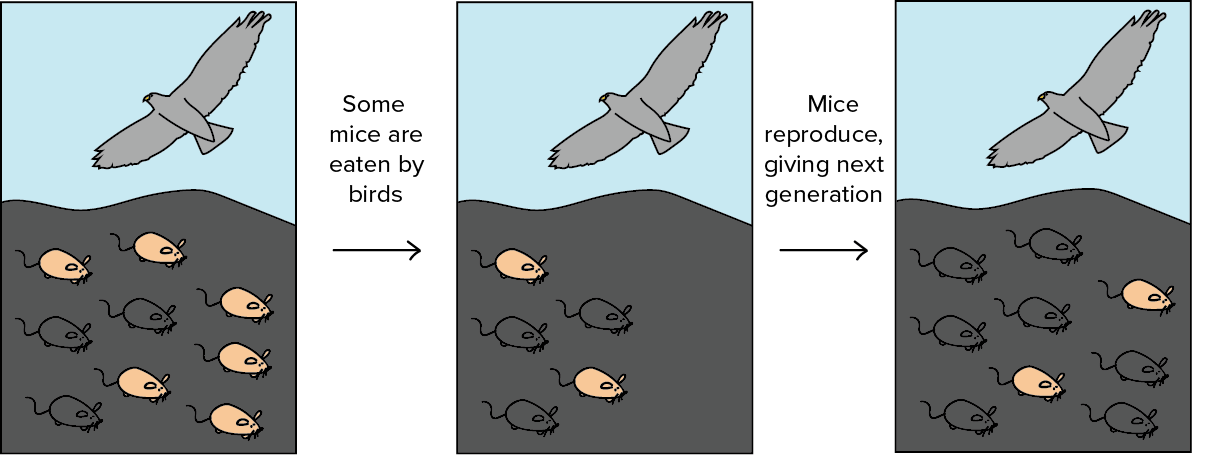
The light mice can reproduce more successfully than the dark mice
The hawks eat more dark mice than light mice because the dark mice taste better
The hawks eat more light mice than dark mice because they can see the light mice more easily
The hawks eat more dark mice than light mice because they can see the dark mice more easily
7
Multiple Choice

Variation
Natural Selection
Selective Breeding
Homeostasis
8
Multiple Choice
"Organisms that are better adapted to the environment survive to pass traits to their offspring" is the definition of
Natural Selection
Evolution
Selective Breeding
Artificial Selection
9


1. Natural Selection for Survival
-Scientists have seen evidence of natural selection for traits that improve survival
Examples: flat-tailed horned lizards vs loggerhead shrikes
Prey - flat-tailed horned lizards small spiked lizard...trait Variation in spike length
Predator - loggerhead shrikes (Bird) Prefers lizards with short spikes for food…
Natural Selection favors longer spikes and lizards pass on this trait more often to their offspring.
10
Multiple Choice
scales
spines
feathers
hair
11


2. Natural Selection for Reproduction
Organisms need to reproduce to pass on traits.
-natural selection favors traits that help organisms find and attract mates and reproduce successfully
(even if they may decrease the chances of survival)
-Examples: Male peacocks tail feathers, bighorn sheep male horns, fireflies glowing
12


2. Natural Selection for Reproduction (cont.)
Other traits help living things successfully raise young.
-Natural selection favors the survival of young, this is
important to passing on traits
-Examples: mammeles provide milk, bird bring food
(sometimes predigested), seahorse males keep eggs
in pouch
The process in action - Male widowbirds birds have long
tails females don't...females prefer males with long tails so
the trait is exaggerated...tails will keep getting longer until
there's more selection against tail length then for lengthy
tails.
13
Multiple Choice
What does sexual selection mean?
Mating is not random
Organisms mate based on attractiveness
Organisms have the ability to compete for a mate
All of these are true
14


3. Natural Selection in a Changing Environment
How do organism change when the
environment changes:
-Organism change when the environment
changes (if they have enough time and a
successful variation - other wise
extinction)
-Example: Peppered moths in Great Britain
two varieties, white and black...the white
was a lot more common...then the
industrial revolution started and the black
moth became more common...the trees
got darker and the white could not
camouflage - after pollution laws the
numbers of white/black moths reversed
again
15
Multiple Choice
Why did the number of white peppered moths decrease so much by 1895?
they did not blend in with the trees and birds ate them
they tasted better to the birds than the black moths
they were easier to reach on the trees
white moths flew away to find better trees to blend in with
16
Multiple Choice
Predators were able to easily see their prey.
People hunted lighter colored moths
White moths were killed by the smoke from the factories
Moths mood changed to sad, causing them to become dark
17


3. Natural Selection in a Changing Environment (cont.)
How do organism change when
the environment changes:
-Scientist looked at several possible
reason...but experiments continue to
point toward camouflage/pollution
scenario as the reason for the
change.
-Traits that supported successful
survival and reproduction in the new
environment became more common.
Traits that did not became less
common.
18


Natural Selection in Populations
Sketch the diagram
19
Multiple Choice
Which of the following is the correct way to summarize natural selection?
overproduction, variations, selection, adaptations
(survive and reproduce)
survive and reproduce, variations, competition
competition, fitness, survive and reproduce
survive, variations, competition, and reproduce
20
Multiple Choice

What is the process in which populations CHANGE gradually over time?
evolution
species
variation
competition
21


4. Managing Insecticide Resistance in Mosquitoes
Mosquitoes carry diseases (like Malaria) and are a
pest
Insecticides are used to reduce their
population...over time they develop (evolve)
resistance to the pesticide
Insecticides and Insecticide Resistance
Insects reproduce quickly and as result develop
resistance to insecticides over a short time frame
Combining Different Insecticides
One solution is to rotate insecticides to prevent the
development of effective resistance
22
Multiple Choice
Why are advantageous traits more likely to be passed onto offspring?
Because organisms with those traits are more likely to survive and reproduce.
Because they come from recessive alleles.
Because they come from dominant alleles.
Because the trait is an acquired (learned) phenotype.
23


5. Natural Selection and Coevolution
Sometime organisms evolve together
for better or worse!!!
Interaction Between a Plant and a Bat
Hardwicke’s woolly bat and Pitcher plants developed
a beneficial relationship - the bat gets shelter the
pitcher plant gets nutrients from bat droppings...
24
Multiple Choice
Hummingbirds have a beak just the right length to reach the nectar in a cardinal flower and as they feed their foreheads bump into the pollen structure. Cardinal flowers are red which hummingbirds can see but bees can’t. Cardinal flower’s pollen structure is just the right length for the hummingbird to pick up pollen as it feeds...this is called
Random Luck
Artificial Selection
Coevolution
Extinction
25
Multiple Choice

The bird on the right is better adapted to get the worm. It will probably survive and reproduce. This is known as_____.
Atomic distribution
Natural Selection
Population
26


5. Natural Selection and Coevolution
Interaction Between a Snake and a Newt
Rough-skinned newt and its predator, the common garter snake have been developing toxins and toxin
resistance with each other...in area with garter snakes the newts are more poisonous and the snakes
have greater resistance..this is a negative relationship (predator/prey arms race)
27
Multiple Choice
natural selection
artificial selection
speciation
adaptation
28
Match
Natural Selection
Adaptation
Coevolution
Diversity
Species
Process where traits and organisms that are best adapted to the environment survive and reproduce.
A variation in a plant or animal that increases it chance of survival in its environment.
the evolution of two species in response to each other, resulting in “matching” adaptation
The variation of life forms present in different ecosystems.
Organisms that can reproduce, have similar characteristics, and have a common gene pool.
Process where traits and organisms that are best adapted to the environment survive and reproduce.
A variation in a plant or animal that increases it chance of survival in its environment.
the evolution of two species in response to each other, resulting in “matching” adaptation
The variation of life forms present in different ecosystems.
Organisms that can reproduce, have similar characteristics, and have a common gene pool.
29
Multiple Choice

What do you call a characteristic that allows an organism to survive in an environment?
variation
adaptation
selection
overproduction
30
Multiple Select

Select ALL the parts of Natural Selection (Hint: it's more than 1).
overproduction
evolution
variation
selection
competition
31
Hotspot
Select the snails that are most likely to survive and reproduce.
32

Lesson 4 - Observing Natural Selection
Show answer
Auto Play
Slide 1 / 32
SLIDE
Similar Resources on Wayground

24 questions
Circulatory and Respiratory Systems
Presentation
•
6th - 8th Grade
24 questions
Digestive System
Presentation
•
6th - 8th Grade
23 questions
Lesson 2 Lunar Phases
Presentation
•
6th - 8th Grade
23 questions
Human Body Systems
Presentation
•
6th - 8th Grade
23 questions
Heat and Matter
Presentation
•
6th - 8th Grade
22 questions
Force and Motion
Presentation
•
6th - 8th Grade
26 questions
The Hydrologic/Water Cycle Lesson
Presentation
•
6th - 8th Grade
26 questions
Ecosystems
Presentation
•
6th - 8th Grade
Popular Resources on Wayground
21 questions
Continents and Oceans

Quiz
•
6th Grade
20 questions
Parts of Speech
Quiz
•
5th Grade
16 questions
Subject & Predicate
Quiz
•
5th Grade
25 questions
Multiplication Facts
Quiz
•
5th Grade
12 questions
Map Skills
Quiz
•
3rd Grade
22 questions
Continents and Oceans
Quiz
•
5th Grade
15 questions
Rounding Decimals
Quiz
•
5th Grade
20 questions
Brand Labels
Quiz
•
5th - 12th Grade
Discover more resources for Science
20 questions
Newton's Laws of Motion
Quiz
•
8th Grade
20 questions
Elements, compounds, and mixtures
Quiz
•
6th Grade
17 questions
7.6D Aqueous Solutions
Quiz
•
7th Grade
20 questions
Scientific Method and Variables
Quiz
•
8th Grade
20 questions
Scientific method and variables
Quiz
•
8th Grade
10 questions
6.6D - Relative Density Review
Quiz
•
6th Grade
20 questions
Claim, Evidence and Reasoning (CER)
Quiz
•
6th - 8th Grade
21 questions
Newton's Laws of Motion
Quiz
•
8th Grade