
11.11.6

Presentation
•
History
•
11th Grade
•
Practice Problem
•
Easy

Andrew Lara
Used 8+ times
FREE Resource
8 Slides • 7 Questions
1
2
Open Ended
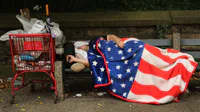
Is poverty in the United States still an issue to this day?
¿La pobreza en los Estados Unidos sigue siendo un problema hasta el día de hoy?
3

Nationwide poverty has been an issue since the Great Depression.
The poverty line is the minimum level of income (money) to live an adequate life.
Poverty Rates in the UNiteD States
1. La pobreza en todo el país ha sido un problema desde la Gran Depresión.
2. La línea de pobreza es el nivel mínimo de ingresos (dinero) para vivir una vida adecuada.
4

During the 1960s the United States had about 20 percent of the population living under the poverty line.
The "War on Poverty" was a federal program that include job programs and direct assistance.
Johnson's "War on Poverty" dropped poverty to 11 percent by 1973.

1, Durante la década de 1960, Estados Unidos tenía alrededor del 20 por ciento de la población viviendo por debajo del umbral de pobreza.
2, La "Guerra contra la Pobreza" fue un programa federal que incluye programas de empleo y asistencia directa.
3, La "Guerra contra la Pobreza" de Johnson redujo la pobreza al 11 por ciento en 1973.
5
Multiple Choice
President's Johnson effort to end the issue of poverty was known as___
The War on Crime
The Big Tax Cut
The War on Poverty
The Great Relief
6

The 1980s saw increase in poverty levels. Rose up to 15% in 1983.
Reagan began to cut many welfare programs.
Believe that Welfare drained the economy.
President Reagan

En el decenio de 1980 aumentaron los niveles de pobreza. Aumentó hasta un 15% en 1983.
Reagan comenzó a recortar muchos programas de asistencia social.
Creen que drenaron la economía.
7
Multiple Choice
How did Reagan respond to the rise of poverty during the 1980s?
Increased welfare programs and benefits.
Kept the welfare programs the same.
Cut welfare programs and benefits.
Ignored the problem.
8

President Clinton passed the Welfare Reform Act in 1996.
The Welfare Reform Act set limits on how long people could receive welfare benefits.
The consequence of the reform was that government support was no longer guaranteed.
President Clinton

El Presidente Clinton aprobó la Ley de Reforma de la Asistencia Social en 1996.
La Ley de Reforma de la Asistencia Social estableció límites sobre el tiempo que las personas podían recibir beneficios de asistencia social.
La consecuencia de la reforma fue que el apoyo del gobierno ya no estaba garantizado.
9
Multiple Choice
This Act ended the guarantee of government assistance to the poor.
The Immigration Reform Act
The Welfare Reform Act
The Glass Ceiling Act
The Immigration Reform and Immigrant Responisbility Act
10

President George W. Bush emphasized private charity as a way to help the poor.
Bush passed massive tax cuts to try and reduce the levels of poverty and welfare.
President George W. Bush

El presidente George W. Bush enfatizó la caridad privada como una forma de ayudar a los pobres.
Bush aprobó recortes masivos de impuestos para tratar de reducir los niveles de pobreza y bienestar.
11
Multiple Choice
Which President focused on private charity to deal with poverty
Clinton
Reagan
Johnson
Bush
12
Modern Day Poverty
In 1993, Hilary Clinton led a commission to make healthcare affordable. Many low-income families did not have access to affordable healthcare. This caused more debt.
In 2010, it was recorded that more than 15 percent of all Americans were without health insurance.
In 1999, more than 32 million people lived under the poverty line.
1. En 1993, Hilary Clinton dirigió una comisión para hacer que la atención médica fuera asequible. Muchas familias de bajos ingresos no tenían acceso a atención médica asequible.
Esto causó más deuda. En 2010, se registró que más del 15 por ciento de todos los estadounidenses carecían de seguro de salud.
En 1999, más de 32 millones de personas vivían por debajo del umbral de pobreza.
13
Multiple Choice
Hilary Clinton attempted to make affordable healthcare in the United States.
True
False
14
What does poverty in the U.S looks like?
The consistent indicator of poverty is education level. Improving education was an attempt to decrease poverty.
The rate of children in the United States under the poverty line is the highest compared to other industrialized countries.
More than 20% of African-American and Hispanics live in poverty.
El indicador constante de la pobreza es el nivel de educación. La mejora de la educación es un intento de reducir la pobreza.
La tasa de niños en los Estados Unidos por debajo de la línea de pobreza es la más alta en comparación con otros países industrializados.
Más del 20% de los afroamericanos e hispanos viven en la pobreza.
15
Open Ended
How can education lift a person out of poverty?
Cómo puede la educación sacar a una persona de la pobreza?
Show answer
Auto Play
Slide 1 / 15
SLIDE
Similar Resources on Wayground

12 questions
Political Machine Introduction
Presentation
•
11th Grade
13 questions
The Atomic Bomb
Presentation
•
11th Grade
11 questions
Nazi Control Quiz
Presentation
•
10th Grade
11 questions
Renewable and Nonrenewable Resources
Presentation
•
11th Grade
11 questions
IPDI 1 (Clash of Civilization)
Presentation
•
KG
12 questions
Cultura General
Presentation
•
11th Grade
12 questions
The Executive Branch
Presentation
•
11th Grade
12 questions
Geografia
Presentation
•
11th Grade
Popular Resources on Wayground
10 questions
How much do you know about our Portrait of an Eagle?

Quiz
•
10th Grade
10 questions
Fast Food Slogans
Quiz
•
6th - 8th Grade
21 questions
Continents and Oceans
Quiz
•
6th Grade
20 questions
Parts of Speech
Quiz
•
5th Grade
16 questions
Subject & Predicate
Quiz
•
5th Grade
25 questions
Multiplication Facts
Quiz
•
5th Grade
12 questions
Map Skills
Quiz
•
3rd Grade
22 questions
Continents and Oceans
Quiz
•
5th Grade
Discover more resources for History
20 questions
The Early Colonies
Quiz
•
7th - 11th Grade
16 questions
Government Unit 2
Quiz
•
7th - 11th Grade
16 questions
Students of Civics Unit 2: The Constitution
Quiz
•
7th - 11th Grade
28 questions
US History QSE MP1 Review
Quiz
•
9th - 12th Grade
1 questions
Q1 PMA Review
Quiz
•
11th Grade
10 questions
The Punic Wars and the Rise of the Roman Republic

Interactive video
•
6th - 12th Grade
13 questions
Unit 4.1, 4.2, & 4.3 Quiz Review
Quiz
•
11th Grade
40 questions
Units 2&3 Vocab. Review

Flashcard
•
11th Grade