

Don't Feed the Phish

Presentation
•
Instructional Technology
•
5th Grade
•
Practice Problem
•
Easy

Stacy Bowers
Used 2+ times
FREE Resource
6 Slides • 13 Questions
1

commonsense.org/education
Shareable with attribution for noncommercial use. Remixing is permitted.
Don't Feed
the Phish
DIGITAL CITIZENSHIP
2
Open Ended
What's something you own that someone else might want to steal? Why? What would they do with it?
3
Poll
What do you think the word PHISHING means?
catching fish
feeding fish
identity theft
a personalized message asking you to provide private information
4
Watch the Edpuzzle video on the following slide to learn more about phishing.
5

Edpuzzle
You can open this webpage in a new tab.
6


commonsense.org/education
Shareable with attribution for noncommercial use. Remixing is permitted.
KEY VOCABULARY
Phishing
When someone poses as an institution, like a bank or a
school, and sends you a personalized message asking
you to provide private information
7
Match
Match the following ideas to the definitions
A type of crime in which your private information is stolen and used for criminal activity
Information that can be used to identify you because it is unique to you (e.g., your full name or your address)
When someone poses as an institution, like a bank or a school, and sends you a personalized message asking you to provide private information
A web address that has been condensed and that could potentially mislead a user into going into a risky website
Identity Theft
Private Information
Phishing
shortened URL
Identity Theft
Private Information
Phishing
shortened URL
8
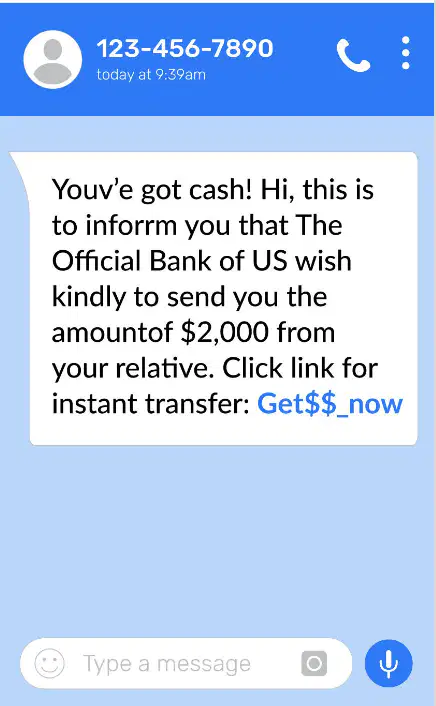
Sense of urgency: When the sender says you only have a limited time to respond.
Spelling and grammar errors: A real company does not send out messages with such errors.
Alert! Alert!: The message sounds urgent, making you worry that something is wrong with
your account."Friend" in trouble: You see a photo of someone you know, but the message isn't really
from them.Shortened URL: A web address that has been condensed and that could mislead a user into going into a risky website.
Too good to be true: Identity thieves often offer easy chances to win free money or prizes.
Generic or missing greeting: Real companies send messages that address customers by name.
Read the clues that can alert you to a phishing scam and use them to help you UNDERLINE or HIGHLIGHT the clues you find on the following slides. You can always GO BACK to read these clues again!
9
Draw
Underline the clues that alert you this is a phishing scam.
10
Draw
Underline the clues that alert you this is a phishing scam.
11
Draw
Underline the clues that alert you this is a phishing scam.
12
Multiple Choice

Would you click this link?
CLICK IT
SKIP IT
13
Multiple Choice

Would you click this link?
CLICK IT
SKIP IT
14
Multiple Choice
Would you click this link?
CLICK IT
SKIP IT
15
Multiple Choice

Would you click this link?
CLICK IT
SKIP IT
16
Multiple Choice
WHAT WOULD YOU TELL ZACK?
Zack sees an online contest. He could win $10,000 instantly! On the sign-up form he enters his name and email address. He is also asked to enter his nickname, the name of any pets, and his mom's maiden name. Should he do it?
DO IT. The questions are silly, but it's worth it to win $10,000!
DON'T! Identity thieves use such "clues" to figure out people's passwords.
17
Multiple Choice
WHAT WOULD YOU TELL LEW TO DO?
Lew gets a notice from Apple. Because of new security rules, he must submit his Social Security Number (SSN) right away or he will lose all his photos. He knows where Mom keeps the SSN card. Should he do it?
DO IT. It's an official notice from a company and if he waits, he could lose everything.
DON'T! Real companies don't do this. Thieves use such information to create false identities.
18
Multiple Choice
WHAT WOULD YOU TELL DANA TO DO?
Dana sees $200 wireless headphones on sale for just $5! She doesn't recognize the website. It only takes credit cards, not PayPal, and it asks for more detail than most sites do. She could use the credit card her parents gave her for emergencies. Should she do it?
DO IT. As long as she pays her parents back right away, it should be all right.
DON'T! Identity thieves can charge people's accounts for fake sales. Ask Mom and Dad FIRST.
19
Now click submit and head back to the STREAM to play the breakoutedu game: Don't Fall for the Phish!
commonsense.org/education
Shareable with attribution for noncommercial use. Remixing is permitted.
Don't Feed
the Phish
DIGITAL CITIZENSHIP
Show answer
Auto Play
Slide 1 / 19
SLIDE
Similar Resources on Wayground

14 questions
Pronoun & Antecedent
Presentation
•
5th Grade
14 questions
Circuits and Electricity
Presentation
•
5th Grade
13 questions
Argument Reading - Claims, Reasons, Evidence, Bias
Presentation
•
5th Grade
13 questions
Newton's First Law
Presentation
•
5th Grade
13 questions
Least common multiple
Presentation
•
5th Grade
15 questions
Story of Snow
Presentation
•
5th Grade
15 questions
Personification
Presentation
•
5th Grade
14 questions
Punctuating Dialogue
Presentation
•
5th Grade
Popular Resources on Wayground
10 questions
Safety Day 2026 – Student Review

Quiz
•
9th Grade
21 questions
Continents and Oceans
Quiz
•
6th Grade
20 questions
Parts of Speech
Quiz
•
5th Grade
16 questions
Subject & Predicate
Quiz
•
5th Grade
25 questions
Multiplication Facts
Quiz
•
5th Grade
12 questions
Map Skills
Quiz
•
3rd Grade
22 questions
Continents and Oceans
Quiz
•
5th Grade
15 questions
Rounding Decimals
Quiz
•
5th Grade
Discover more resources for Instructional Technology
20 questions
Parts of Speech
Quiz
•
5th Grade
16 questions
Subject & Predicate
Quiz
•
5th Grade
25 questions
Multiplication Facts
Quiz
•
5th Grade
22 questions
Continents and Oceans
Quiz
•
5th Grade
15 questions
Rounding Decimals
Quiz
•
5th Grade
10 questions
Columbus Day and Indigenous People's Day

Interactive video
•
5th - 8th Grade
20 questions
Mixtures and Solutions Practice
Quiz
•
5th Grade
15 questions
Mastering Multiplication Facts 1-10
Quiz
•
5th Grade