Central America Modern
Presentation
•
Geography
•
6th - 8th Grade
•
Easy
Christina Baldwin
Used 2+ times
FREE Resource
82 Slides • 54 Questions
1
Most of the largest cities in Central American countries are in the highland areas.
Due to being near the equator, the climate is tropical and very hot. The higher elevations or altitudes make it a more tolerable climate.
Panama is the exception to this - most people live near the Panama Canal because of the job opportunities.
2
Haiti- Racing Against Time
3
4
Multiple Select
Why do some people in Mexico and Central America migrate to other places?
poverty
violence
job opportunites
crime
5
6
7
Multiple Choice
To which continent do most people in the Caribbean region trace their roots?
Africa
South America
Europe
North America
8
Diaspora - movement of people from their homeland to other places.
Many immigrants leave their homelands in search of jobs to provide a better life for their families. Some take their families to new places for safety or to escape corrupt governments.
9
Drag and Drop
10
11
12
Multiple Choice
What causes cultural diffusion?
People moving from one place to another, bringing their traditions with them
People staying in their home country and focusing on their traditions
13
Dropdown
14
15
Extending Map Skills
16
Cultural diffusion - the spread of cultural traits.
When people move from other lands to new places, they bring their culture with them. This can create blended cultures. Mexico's culture combines elements from Spanish and Mexican Indian cultures.
17
Multiple Choice
What are the four largest independent nations in the Caribbean?
Cuba, Jamaica, Haiti, the Dominican Republic
Cuba, the Bahamas, St. Kitts, Jamaica
Jamaica, Turks and Caicos, Haiti, Belize
Mexico, Venezuela, Colombia, Cuba
18
Open Ended
19
Multiple Select
Which two large Caribbean nations share the same island?
Haiti
Jamaica
the Dominican Republic
Puerto Rico
20
Most people in Mexico speak Spanish, but many speak Nahuatl or other Native American languages as well. This reflects the blending of their two cultures (Spain and Native Americans like the Aztec).
Central American countries mainly speak Spanish with the exception of Belize, which was a British colony. Most Guatemalans speak a Mayan language at home, but learn Spanish in school.
21
22
23
24
Multiple Choice
The most commonly practiced religion in Mexico and Central America is...
Protestant Christianity
Judaism
Buddhism
Roman Catholic Christianity
25
26
27
28
Most people practice the Roman Catholic faith (which is also the most common in Spain), a few are beginning to practice Protestant Christianity. Many also blend pre-Christian traditions with their religion.
For example - The Day of the Dead, or el dia de los muertos, a Mexican holiday.
29
Drag and Drop
30
31
32
Multiple Select
Cultural diffusion can be seen in
art
food
language
clothing
33
Dropdown
34
35
36
Introducing Central America
37
38
39
Drag and Drop
40
Question:
How many countries are in Central America?
41
Dropdown
42
43
44
Multiple Choice
How many countries are in Central America?
10
5
7
12
45
Drag and Drop
46
47
Dropdown
48
Takeover:
● Central America was conquered by the Spanish 500 years
ago
● Many people are mixed Spanish and Native American
descent.
● Each country has its own mix of peoples.
○ Those of Native American descent
○ Those of European descent
○ Those of African descent (mostly along the Caribbean
coast)
49
50
51
Drag and Drop
52
The Mayan People
●
The Maya had a powerful empire around AD 200-900
●
They built great cities
●
Their empire covered most of…
○
Guatemala
○
Belize
○
Mexico
○
Honduras
○
El Salvador
○
“Ruined cities can still be found in the jungles of Guatemala.
“The Maya are no longer powerful, but they still make up nearly half of
Guatemala’s population” (Doherty 20).
53
54
55
56
The Mayan People
57
Multiple Select
Where do Caribbean storytellers get their stories?
African folktales
European folktales
current events
Greek mythology
58
Poll
59
60
Multiple Choice
How do the Maya farmers know when to plant their crops?
The sun and the sky tell them.
The moon and the stars tell them.
Their ancient ancestors tell them.
The elder of the village tells them
61
Multiple Select
Which two North American sports are popular in the Caribbean?
baseball
basketball
soccer
football
62
63
Multiple Choice
What are some of the words that represent who the Maya people are?
sun, mother, land, corn
stars, moon, ocean, valley
father, mother, water, horizon
fire, water, earth, rubies
64
65
Multiple Choice
Why are some of these foundational words similar in sound in all of the Mayan languages?
They don't
They are all the same language
They all come from the same language of origin
They all come from Latin
66
Poll
67
The Soccer War
“Central America has suffered from decades of civil wars and conflict between countries.
One war broke out between El Salvador and Honduras in 1969, after they had played soccer
against each other in the World Cup. The real reasons, however, were disagreements over
land, trade, and Salvadorean refugees in Honduras” (Doherty 21).
68
69
Multiple Choice
What were some of the reasons behind the Soccer War?
arguments between Honduras and El Salvador over land
arguments between Honduras and El Salvador over trade
arguments between Honduras and El Salvador over refugees
All of the answers are correct
70
71
The Panama Canal
● “A channel of water 65km (40 miles) long that cuts through
the Pacific Ocean.
● “Each vessel that uses the canal must pay a fee according to
its weight.
○ This means that while ships pay thousands of dollars,
Richard Halliburton, who swam through the canal in
1928, only paid 36 cents” (Doherty 21).
72
Poll
73
The Panama Canal (Video Posted in 2013)
74
75
Multiple Choice
What is the fee for traveling the Panama Canal based on?
income
weight
status
reason for the voyage
76
77
Worry Dolls
“Children in Central America sometimes make tiny, bright dolls
called worry dolls. There is a legend that if they tell the dolls
their worries at night and then place them under their pillows, by
morning all their worries will have disappeared” (Doherty 21).
78
79
Multiple Choice
What are Worry Dolls usually made out of?
Sticks and yarn
Pipe cleaners
Felt
Spoons, yarn, and glue
80
81
Rainforest Life
“A large area of Central America is covered by rainforest, which is home to a
huge variety of plants and animals. But the rainforest is being devastated and
many plants and animals may die out as trees are cut down to make timber
for export, and to clear land for farming” (Doherty 21).
82
83
Tropical Rainforests
84
85
Multiple Choice
What type of rainforest is found in Central America?
Temperate
Tropical
86
87
Multiple Choice
How much rain falls each year in a rainforest?
100 inches
100 feet
100 yards
100 meters
88
89
Multiple Choice
Why are rainforests described as the “lungs of the earth”?
They "inhale" carbon dioxide and "exhale" oxygen
They move in and out like lungs
They are shaped like lungs
They breathe so that we don't have to
90
Open Ended
91
The Columbian Exchange Lesson
92
Multiple Choice
A
B
C
93
DO NOW
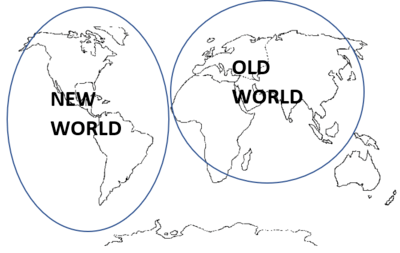
Use the map and passage below to answer the following questions.
94
95
Multiple Select
Use the map above and identify the continents included in the “Old World.”
Asia
Africa
North America
South America
Europe
96
Open Ended
97
Columbian Exchange
By the end of this lesson you will be able to analyze the Colombian Exchange as an example of cultural diffusion, colonization, and immigration.
98
Multiple Choice
A
B
C
99
https://web.microsoftstream.com/video/835d906e-776d-454d-87f2-57192bf96362
100
101
Open Ended
After watching the video identify at least three items that were exchanged during the Columbian Exchange.
Three items that were exchanged during the Columbian Exchange was...
102
Multiple Choice
The beach
Flattened buildings
Airplanes
103
Open Ended
Before 1492, there was already an exchange of food, animals, and plants among Europe, Africa, and Asia. Europe and Asia were connected by land, and Africa was a short sail away. But not many people thought there was any reason to sail across the Atlantic Ocean, because few people believed that there were more continents there. This kept the Americas apart from everyone else for a long time.
Identify the barrier that was preventing cultural diffusion prior (before) to 1492.
Sentence Stem: The barrier that was preventing cultural diffusion prior to 1492 was…
104
105
Multiple Choice
Before 1492, there was already an exchange of food, animals, and plants among Europe, Africa, and Asia. Europe and Asia were connected by land, and Africa was a short sail away. But not many people thought there was any reason to sail across the Atlantic Ocean, because few people believed that there were more continents there. This kept the Americas apart from everyone else for a long time.
Before 1492, the Americas were _____.
connected
isolated
106
Open Ended
107
Open Ended
This introduction of new plants and animals to Europe and America is called the Columbian Exchange. It's called Columbian because it started with Columbus, and exchange because people traded, or exchanged, things with each other. The Columbian Exchange changed life on both sides of the Atlantic Ocean.
The Columbian Exchange included many plants and animals. Corn, cocoa, peanuts, potatoes and tomatoes went from the Americas to Europe, and later to Africa and Asia. Chickens, wheat, and cows went from Europe to the Americas.
Throughout the world, the variety of food that people could grow and eat increased greatly. Europeans brought horses and this changed life in the Americas. Not only did it allow people to travel distances more quickly, but it also changed the ways they hunted and
fought. For example, horses made hunting easier for the Indians of the North
American plains.
Identify some items that diffused (spread) from the Americas to Europe:
Some items that were diffused from Americas to Europe are…
108
109
Open Ended
This introduction of new plants and animals to Europe and America is called the Columbian Exchange. It's called Columbian because it started with Columbus, and exchange because people traded, or exchanged, things with each other. The Columbian Exchange changed life on both sides of the Atlantic Ocean.
The Columbian Exchange included many plants and animals. Corn, cocoa, peanuts, potatoes and tomatoes went from the Americas to Europe, and later to Africa and Asia. Chickens, wheat, and cows went from Europe to the Americas.
Throughout the world, the variety of food that people could grow and eat increased greatly. Europeans brought horses and this changed life in the Americas. Not only did it allow people to travel distances more quickly, but it also changed the ways they hunted and
fought. For example, horses made hunting easier for the Indians of the North
American plains.
Identify some items that diffused (spread) from Europe to the Americas:
Some items that were diffused from Europe to Americas are…
110
Open Ended
111
Open Ended
Not every part of the Columbian Exchange was positive. European people also brought diseases, like smallpox, to the Americas. Because they were separated from the rest of the world, Native Americans had no prior contact with smallpox and other deadly diseases. This made the diseases more dangerous than they were for the Europeans. Native Americans who caught these diseases died from them because they had no immunity—their bodies did not know how to fight off the germs. As many as 80 percent of the Native American population died from European diseases between 1492 and 1650. These diseases included measles, smallpox, and influenza.
Describe what happened to the population of Native American after the Columbian Exchange.
Sentence Stem: During the Columbian Exchange the population of Native Americas...
112
113
114
Open Ended
115
116
117
118
119
Multiple Choice
Who were the first people to settle in Central America?
Natives
Africans
Spanish
Dutch
120
121
Fill in the Blanks
122
123
Drag and Drop
124
125
Multiple Select
Why do Central American governments want farmers to grow more than one or two crops?
because weather might destroy crops
because disease might destroy crops
because there would be an economic disaster if there were no other crops
126
127
Drag and Drop
128
129
Multiple Choice
How did coffee growers get so much land?
They used profits from coffee to buy land from poor farmers.
They forced the poor farmers off their land.
They enslaved the poor farmers to work the land.
They co-own the large estates with the poor farmers.
130
131
Multiple Select
What are examples of new industries in Central America?
manufacturing paper
building furniture
technology advancements
food processing
132
133
Why is it important to diversify an economy?
134
135
136
Most of the largest cities in Central American countries are in the highland areas.
Due to being near the equator, the climate is tropical and very hot. The higher elevations or altitudes make it a more tolerable climate.
Panama is the exception to this - most people live near the Panama Canal because of the job opportunities.
Show answer
Auto Play
Slide 1 / 136
SLIDE

Similar Resources on Wayground
133 questions
Untitled Presentation
Presentation
•
7th Grade
132 questions
latihan soal up
Presentation
•
6th Grade
135 questions
FCE E2 1-5
Presentation
•
6th Grade
129 questions
The Rise and Fall of Imperial Japan
Presentation
•
6th - 9th Grade
127 questions
Sight Words
Presentation
•
KG
126 questions
Unit 3 REVIEW Ratios, Proportions, Percent, Interest With Help
Presentation
•
7th Grade
131 questions
Spanish: Subject pronouns
Presentation
•
6th - 8th Grade
132 questions
Buen Viaje Ch 8
Presentation
•
6th - 8th Grade
Popular Resources on Wayground
15 questions
Grade 3 Simulation Assessment 1
Quiz
•
3rd Grade
22 questions
HCS Grade 4 Simulation Assessment_1 2526sy
Quiz
•
4th Grade
16 questions
Grade 3 Simulation Assessment 2
Quiz
•
3rd Grade
19 questions
HCS Grade 5 Simulation Assessment_1 2526sy
Quiz
•
5th Grade
17 questions
HCS Grade 4 Simulation Assessment_2 2526sy
Quiz
•
4th Grade
20 questions
Equivalent Fractions
Quiz
•
3rd Grade
24 questions
HCS Grade 5 Simulation Assessment_2 2526sy
Quiz
•
5th Grade
20 questions
Math Review
Quiz
•
3rd Grade
Discover more resources for Geography
15 questions
SS8H1 Test Prep
Quiz
•
8th Grade
27 questions
Geo #2 Regions
Quiz
•
8th Grade
15 questions
Australia Geography
Quiz
•
6th Grade
25 questions
SS8G1 GMAS PREP
Quiz
•
8th Grade
16 questions
GC 6 - Local Gov't
Quiz
•
8th Grade
50 questions
50 States Quiz
Quiz
•
8th Grade
12 questions
SS6G12 Australia Location Climate Natural Resources
Quiz
•
6th Grade
10 questions
Seasons and Earth's Tilt
Quiz
•
7th Grade