- Resource Library
- Science
- Earth & Space Science
- Atmospheric Pressure
- Air Pressure Adn Weather Notes And Questions
Air Pressure adn Weather Notes and Questions
Presentation
•
Science
•
6th - 8th Grade
•
Medium
+4
Standards-aligned
Christine Warden
Used 6+ times
FREE Resource
19 Slides • 25 Questions
1
Air
Pressure
and
Weather
2
What is air pressure?
●
The weight of the air pushing down on the earth
●
Air has mass, so it affected by gravity
○
meaning the air/atmosphere is pulled down towards the earth
●
The surface (sea level) has the most air pressure -
○
it decrease as you increase in altitude
3
4
Why does air pressure matter?
● Changes in air pressure are driving force behind
changes in weather!
● Air moves from areas of higher pressure to areas of
lower pressure
● Movement of air creates changes in weather
5
Why don’t we ‘feel’ the pressure?
● Air pressure at sea level is about 14.5 pounds per square inch
● We don’t feel it because air in our body is exerting the same
amount of pressure outward - creating balance
● We CAN feel when pressure changes
6
What causes changes in air pressure?
●Warmer air is less dense and rises
○this creates areas of lower pressure
●
Cooler air is more dense and sinks
○
creating areas of higher pressure
●
Air near the ground heats and rises, then cools as it increases in
altitude and then sinks
●
This pattern creates convection currents in the air
7
Multiple Choice
the weight of all the air above pressing down
water vapor in the atmosphere
greenhouse gases
solar radiation
8
Multiple Choice
Gases that surround the Earth is called:
Weather
Atmosphere
Air Pressure
Climate
9
Multiple Choice
Air pressure________________ as altitude increases, due to the lower density of air molecules.
stays the same
increases
never changes
decreases
10
Multiple Choice
MORE dense air is found at:
sea level
higher altitudes
11
Multiple Choice
More dense air has ________ air pressure.
LOW
HIGH
12
Convection currents
13
14
Reorder
Reorder the following to demonstrate convection currents correctly. Start with the air being heated.
Hot less dense air rises.
New air moves in to replace the air that has moved out.
Air cools as it moves further up
Dense cool air returns to surface.
15
Weather is caused by...
● Uneven heating of the earth’s surface by the sun
● This unequal heating causes changes in how the atmosphere
‘behaves’ - it changes air pressure!
● There are many things that can cause uneven heating
16
The angle that the light hits the surface of the earth causes uneven solar energy distribution. Due to the amount of light per surface area increasing at the equator and decreasing at the poles.
This helps to drive our convection currents in the atmosphere.
17
18
Multiple Choice
Sunlight hits the Earth at an angle. As a result of the tilt of the Earth, some areas of the Earth receive more direct sunlight than others, which means they receive more solar energy.
Which statement correctly describes how solar energy changes as latitude changes?
The equator receives the least solar energy compared to any other latitude.
The poles receive the most solar energy of all places on the Earth.
Oceans and lakes receive more solar energy than land masses.
Lower latitudes receive more solar energy than higher latitudes.
19
Match
Arrow 1
Type of pressure?
Arrow 3
Type of pressure?
Arrow 1
Air Temp.
Arrow 3
Air Temp.
Low Pressure
High Pressure
Warm Air
Cold Air
Low Pressure
High Pressure
Warm Air
Cold Air
20
Things that affect heating: Albedo
Surface
type
Albedo
Measurement
Percentage
reflected (avg.)
Ice
35-50%
Forest
10-25%
Desert
28%
Water
5%
Urban
25%
Crops
20%
Clouds
50-70%
Snow
60-80%
Albedo: The amount of radiation reflected from different earth surfaces
21
Multiple Choice
What type of surfaces tends to reflect the most light radiation?
Urban
Water
Snow
Forest
22
Multiple Choice
What type of surfaces tends to absorb the most light radiation (not reflect)?
Urban
Water
Snow
Forest
23
Open Ended
How do you think a higher albedo has an effect on average temperatures for an area?
24
Audio Response
Look at the data table showing the difference in temperature on a cloudy day and a clear day. Make 2 conclusions about cloud cover and temperature based on the data

25
Audio Response
Look at the data table showing the difference in temperature on land (soil) and over water. Make 2 conclusions about how surface type (land vs. water) affects temperature based on the data.

26
High and Low pressure systems and weather
High-pressure areas are shown with an
Low-pressure areas are shown with an
27
High Pressure Systems
●
As air COOLS it becomes more dense and sinks -
exerting more pressure at the surface (HIGH)
●
High pressure systems are sinking air
○
generally cooler than the surrounding air
●
Associated with ‘nice’ weather
○
sunny and dry
●
Air moves outward from the high pressure center
28
Low pressure
● As air warms, air molecules spread out and rise
○ This exerts less pressure (LOW)
● Warmer air can hold MORE moisture
● Low pressure systems associated with rain, cloudy
weather, but usually warmer air (compared to
surrounding air masses)
● Air moves IN towards the center of the low
29
30
Multiple Choice
High pressure is
cool sinking air
warm rising air
31
Multiple Choice
High
Low
32
Multiple Choice
Low pressure is
cool sinking air
warm rising air
33
Multiple Choice
Which pressure system is associated with clear skies?
High Pressure
Low Pressure
34
Multiple Choice
Cloudy/Overcast Weather
Cold Weather
Warm Weather
Fair Weather
35
Multiple Choice
Precipitation and storms occur ____.
in high-pressure systems
in polar zones
in low-pressure systems
at fronts
36
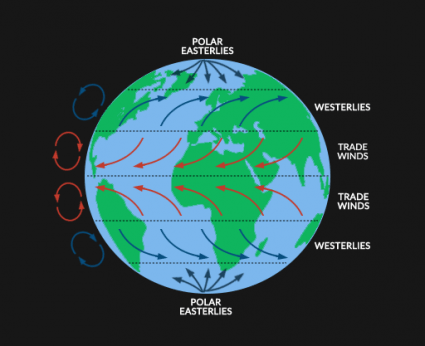
Air Pressure and Wind
● Air moves from areas of high pressure to low pressure
● Moving air is WIND
● Watch this video
37
38
39
Multiple Choice
Which statement best describes the general movement of air masses?
They move from areas of high altitude to areas of low altitude.
B.They move from areas of high pressure to areas of low pressure.
They move from areas of high humidity to areas of low humidity
They move from areas of low temperature to areas of high temperature.
40
Multiple Choice
The Coriolis Effect is caused by what?
The wind blowing
Earth's gravity pulling things down
The rotation of the Earth
The pull of the Moon
41
Multiple Choice
Winds blow from areas of what to what?
High temperature to high pressure
Low temperature to high pressure
High pressure to low temperature
Low temperature to high temperature
42
Multiple Choice
what is the coriolis effect?
change in location of warm and cold surface water every 2-7 years
tendency of objects moving large distances on Earth’s surface to bend to the right in the northern hemisphere & to the left in the southern hemisphere
winds in northern Indian ocean that blow from the southwest in the summer & from the northeast in winter
two layers of horizontal winds moving in opposite directions
43
Multiple Choice
Which statement best describes the movement of winds?
Winds blow from low-pressure to high-pressure regions.
Winds blow from high-pressure to low-pressure regions.
Winds blow from north to south.
Winds blow from east to west.
44
Video Response
Describe the role that convection currents, albedo (reflectiveness) and air pressure play in causing our weather.

Air
Pressure
and
Weather
Show answer
Auto Play
Slide 1 / 44
SLIDE

Similar Resources on Wayground
35 questions
Magnetic Force
Presentation
•
6th - 8th Grade
38 questions
Science 7 Year End Review - Unit B
Presentation
•
7th Grade
35 questions
Sexual and Asexual Reproduction
Presentation
•
6th - 8th Grade
39 questions
Test Term 2 Review (2021)
Presentation
•
6th - 8th Grade
37 questions
Turgor Pressure Tropisms and Homeostasis
Presentation
•
7th Grade
39 questions
1.3 What is Gravity
Presentation
•
6th - 8th Grade
38 questions
Topographic Maps
Presentation
•
6th - 8th Grade
35 questions
Balanced and Unbalanced Forces
Presentation
•
6th - 8th Grade
Popular Resources on Wayground
10 questions
5.P.1.3 Distance/Time Graphs
Quiz
•
5th Grade
10 questions
Fire Drill
Quiz
•
2nd - 5th Grade
20 questions
Equivalent Fractions
Quiz
•
3rd Grade
15 questions
Hargrett House Quiz: Community & Service
Quiz
•
5th Grade
20 questions
Main Idea and Details
Quiz
•
5th Grade
20 questions
Context Clues
Quiz
•
6th Grade
20 questions
Inferences
Quiz
•
4th Grade
15 questions
Equivalent Fractions
Quiz
•
4th Grade
Discover more resources for Science
20 questions
Recognizing Violence and Being an Upstander
Quiz
•
8th Grade
20 questions
Rocks and The Rock Cycle
Quiz
•
6th Grade
19 questions
Introduction to Properties of Waves
Presentation
•
6th - 8th Grade
16 questions
Interactions within Ecosystems
Presentation
•
6th - 8th Grade
10 questions
Exploring the Layers of the Earth
Interactive video
•
6th - 10th Grade
20 questions
Electricity and Circuits
Quiz
•
7th Grade
20 questions
Newton's Laws of Motion
Quiz
•
8th Grade
16 questions
Photosynthesis and Cellular Respiration Review
Quiz
•
7th Grade