

constructive destructive time waist

Presentation
•
Mathematics
•
3rd Grade
•
Medium
+12
Standards-aligned

robert Carter
Used 1+ times
FREE Resource
30 Slides • 29 Questions
1

Science
5th Grade
Unit 6:
Constructive and Destructive Forces
2
Welcome
Mrs. Allen, our principal and Mr. Dyer, our Superintendent who are observing us during what is supposed to be 5th grade spirit week.
Though this is obviously irregular, I hope this is a positive visit and not one that will have to be revisited and or debated.
Isaiah 54:17
3
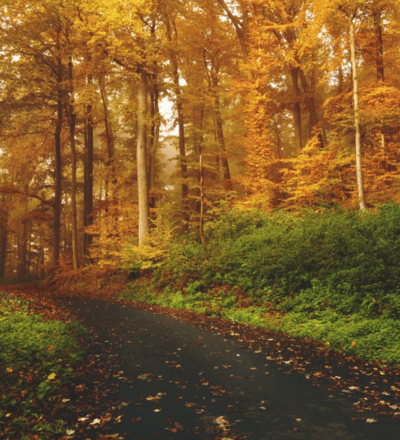
S5E1. Obtain, evaluate, and communicate information to identify surface features on the Earth caused by constructive and destructive processes.
b. Develop simple interactive models to collect data that illustrate how changes in surface features are/were caused by constructive and/or destructive processes.
4
Open Ended
What are some examples of constructive and destructive forces?
5
PBO
SWBAT analyze constructive and destructive processes IOT construct an argument about the cause of changes in the Earth’s surface features.
Bergozza video
6
Match
Constructive processes
Destructive processes
Slow change
rapid change
Weathering
forces that build up mountains and land masses on the Earth’s surface
forces that slowly wear away mountains and other features on the surface of Earth
Change that happens to the environment over a long period of time
Change to Earth’s surface that occurs in a short period of time
The breakdown of rock into smaller particles from the effects of wind, water, and ice
forces that build up mountains and land masses on the Earth’s surface
forces that slowly wear away mountains and other features on the surface of Earth
Change that happens to the environment over a long period of time
Change to Earth’s surface that occurs in a short period of time
The breakdown of rock into smaller particles from the effects of wind, water, and ice
7
Match
Match the following
Volcanoe
Deposition
Erosion
Vegetation
A mixture of hot rocks, ash, and gases that blows through a crack in Earth’s surface
The build-up of land by depositing sediment and soil in a new location
The movement of weathered material on Earth's surface by wind, water, or ice
Plants, or all the plants found in a particular area
A mixture of hot rocks, ash, and gases that blows through a crack in Earth’s surface
The build-up of land by depositing sediment and soil in a new location
The movement of weathered material on Earth's surface by wind, water, or ice
Plants, or all the plants found in a particular area
8

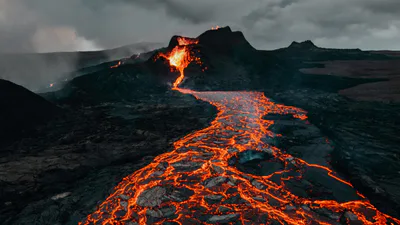
Destructive Forces: processes that destroy landforms.
2 types: Slow (weathering) and Fast (Erosion) –
Ex. landslides, volcanic eruptions, earthquakes, floods
Constructive forces: forces that build up an existing landform or create a new one.
Caused by: water, gravity, wind and glaciers.
Ex: deposition, landslides, volcanic eruptions, floods
Two Types of Forces
9

10

Here are some examples of
constructive landforms. Sanddunes,
volcano
11

Deposition is the laying down of sediments after erosion has occurred.
It is a constructive process because it is how layers of sediment are built up and land masses are formed.
Deposition
12

Riverbanks
Beaches
Lakes
Deltas
Valleys
What places can you think of where deposition happens?
13

Deposition is the adding of sediment in an area and creates new landforms.
14

1. Sand dunes are formed by sediments carried by the wind.
Places formed by deposition
15
2. River deltas are formed where rivers meet oceans by sediments carried by rivers. The sediments come from erosion upriver.
Places formed by deposition

16
3. Beaches are formed where oceans meet land. The sediments carried by the ocean. The sediments come from the erosion of coral reefs and rocks.
Places formed by deposition

17
4. Moraines are formed when glaciers made of collected sediments are carried by ice.
The sediments come from the erosion of hills and mountains.
Places formed by deposition

18
Multiple Choice
Deposition is the ________ down of sediments after erosion has occurred.
Weathering
Laying
Sinking
Eroding
19
Multiple Choice
Deposition is a destructive process.
True
False
20
Multiple Choice
__________ are formed when glaciers made of collected sediments are carried by ice.
Moraines
Beaches
Sand dunes
Snow
21
Multiple Choice
Sand dunes are formed by sediments carried by the _______.
Water
Ice
Wind
Gravity
22
Multiple Choice
Beaches are formed where ocean meets _______.
Land
Water
the River
the Delta
23
Multiple Choice

destroying land forms
land forms from volcanoes
creating new land forms by sediment
creating rocks and dirt
24
Multiple Choice

What kind of constructive process is this?
Volcano
Delta
Weathering
Mountain
25
Multiple Choice

What kind of constructive process is this?
Volcano
Mountain
Sand Dune
Delta
26

Earthquakes can also be a constructive force as well!
27
EARTHQUAKE
The entire earth is covered with several massive plates of rocks.
These plates are called Tectonic Plates.
It is filled with extremely hot magma.
The heat produced inside the earth moves the tectonic plates.
The plates slowly glide and collide with each other, which causes earthquakes.
The intensity of earthquakes is measured by Richter Scale developed by Charles F. Richter in 1935.
Earthquakes of 7 Richter or more are very powerful.
It can damage buildings, roads, bridges.
28
Some of the places that are highly prone to earthquake
Srinagar
Shillong
Guwahati
Aizawal
Kolkata
Gandhidham
Delhi
Ahmedabad
29
Multiple Choice
THE ENTIRE EARTH IS COVERED WITH MASSIVE PLATES OF ROCKS CALLED
TECTONIC PLATES
EARTHQUAKE
PLATES
PLATELETS
30
Multiple Choice
TECTONIC PLATES ARE FILLED WITH
VOLCANO
HOT MAGMA
FIRE
ICE
31
Multiple Choice
EARTHQUAKE ABOVE __ RICHTER OR MORE ARE REALLY POWERFUL
8
1
7
32
Multiple Choice
WHO INVENTED RICHTER SCALE
F.CHARLES
ISSAC NEWTON
EINSTEIN
F.RICHTER
33

34
Multiple Choice

What is a major destructive force. It can also be constructive as it creates mounds of rocks.
dirt
food
volcanoes
the sun
35
Multiple Choice
A natural process that destroys land
A natural process that creates land
A natural process where areas that are normally dry is covered in water
36

37
THE POWER OR EROSION
Erosion is constantly changing, creating, and erasing features on Earth's surface.
Erosion happens through wind, water, and glaciers.

38
EROSION CAN BE SLOW
Erosion can take hundreds of thousands - even millions - of years.
Rainwater can change a hillside.
Wind can slowly scrape the rocks off a mountain.
Millions of tons of rock and gravel can be picked up and moved by icy glaciers.

39
EROSION CAN BE SUDDEN
Strong winds and large waves from hurricanes can make beaches disappear.
Floods can wash away soil from hill sides and change the path rivers follow.

40
EROSION CAN BE HELPFUL
Soil is made from weathered rocks.
Erosion helps move soil from one place to another.
Wind erosion deposited silt on the Great Plains. Silt helps make excellent soil for planting crops.
Water erosion carries sediments to river deltas, creating rich farmland.

41
SOMETIMES HUMANS DON'T HELP
People have sped up erosion in some places.
Farming can cause soil erosion because of poor farming methods.
Cutting down trees cause erosion.
Tree roots help hold soil in place, but without trees, rainwater can wash soil away.

42
THE SILENT PROBLEM - Soil Erosion
Overgrazing of land by cattle can even cause erosion.
Exposed soil can get carried away by the wind.
Rich soil takes thousands of years to form.
Soil is being lost faster than nature can replace it.

43
Multiple Select
How does erosion happen? Select all answers that apply.
Wind
Water
Glaciers
Earthquakes
44
Multiple Choice
Wind can slowly scrape rocks off a mountain .
True
False
45
Multiple Choice
What can cause beaches to disappear?
Volcanoes
Hurricanes
Cutting down trees
Glaciers
46
Multiple Choice
What can speed up erosion?
Rivers
Glaciers
People
Plate tectonics
47

48

What is weathering?
49
What is Weathering?
The natural breakdown of Earth's surface
Physical or Chemical

50
Physical (Mechanical) Weathering
Substance breakdown
Does not effect chemical composition

51
Chemical Weathering
Chemical reactions between rocks, the air, and water.
Water is able to dissolve most minerals.
Rocks can take YEARS to CHEMICALLY weather!

52
Multiple Choice
What is Weathering?
When it rains or snows.
The movement of rocks or dust.
Any natural process that changes Earth's surface.
I have no clue.
53
Multiple Select
What types of weathering are there?
Mental
Physical
Astronomical
Chemical
The rainy type
54
Multiple Choice
If a rock were to physically weather, what would it do?
Breaks down over time.
Grows bigger.
Turns into ash.
Becomes invisible.
55
Multiple Choice
If a rock weathers chemically, what is really happening?
The rock flies.
The rock rolls.
It dissolves.
It Becomes a liquid.
56
Multiple Choice
a type of climate
the movement of rock pieces from one place to another
the breaking down of rock into smaller pieces
a force that pulls pieces of rock downhill
57
Multiple Choice

earthquake
erosion
tornadoes
volcanoes
58
Multiple Choice

The picture here shows a landslide. What can you infer from the picture? Remember to look at the picture!
Landslides are a destructive process that break apart the surface of the earth.
Landslides are a constructive process that build new mountains on the surface of the earth.
Landslides are caused by volcanic eruptions,
Landslides are helpful to road crews.
59
Open Ended
1. How are constructive and destructive forces alike?
2. How are they different?
*Take your time to create a well written sentence.
Science
5th Grade
Unit 6:
Constructive and Destructive Forces
Show answer
Auto Play
Slide 1 / 59
SLIDE
Similar Resources on Wayground

52 questions
Bài thuyết trình chưa có tiêu đề
Presentation
•
3rd Grade
51 questions
Module 5 Lesson Eureka
Presentation
•
2nd Grade
52 questions
Choose the Operation
Presentation
•
3rd Grade
52 questions
NIK 2 - Review Unit 2&3
Presentation
•
2nd - 3rd Grade
57 questions
Telling Time to 5 Minutes
Presentation
•
3rd Grade
55 questions
Feeding Relationships
Presentation
•
3rd Grade
58 questions
Text Structures
Presentation
•
4th Grade
56 questions
The Stuff in Space
Presentation
•
3rd Grade
Popular Resources on Wayground
20 questions
"What is the question asking??" Grades 3-5

Quiz
•
1st - 5th Grade
20 questions
“What is the question asking??” Grades 6-8
Quiz
•
6th - 8th Grade
10 questions
Fire Safety Quiz
Quiz
•
12th Grade
20 questions
Equivalent Fractions
Quiz
•
3rd Grade
34 questions
STAAR Review 6th - 8th grade Reading Part 1
Quiz
•
6th - 8th Grade
20 questions
“What is the question asking??” English I-II
Quiz
•
9th - 12th Grade
20 questions
Main Idea and Details
Quiz
•
5th Grade
47 questions
8th Grade Reading STAAR Ultimate Review!
Quiz
•
8th Grade
Discover more resources for Mathematics
20 questions
Equivalent Fractions
Quiz
•
3rd Grade
19 questions
Classifying Quadrilaterals
Quiz
•
3rd Grade
22 questions
fractions
Quiz
•
3rd Grade
20 questions
3rd Grade STAAR Math Review
Quiz
•
3rd Grade
15 questions
Rounding to the Nearest Ten and Hundreds
Quiz
•
3rd Grade
20 questions
Division Facts
Quiz
•
3rd Grade
17 questions
telling time to the nearest minute
Quiz
•
3rd Grade
20 questions
Classifying Quadrilaterals
Quiz
•
3rd - 4th Grade