Search Header Logo
Physical Science Final Exam Review

Physical Science Final Exam Review

Assessment

Presentation

Physics

8th Grade

Easy

Created by

Kim Carroll

Used 14+ times

FREE Resource

32 Slides • 60 Questions

1

media
media
media

Calculate Speed

2

media
media
media

If a car travels 400m in 20

seconds, how fast is it going?

3

media
media
media

Calculate Acceleration

4

media
media
media

A sprinter goes from a speed of 10m/s

to 15m/s in 2 seconds. Find

acceleration.

5

media
media
media

Newton’s 1st Law

States that balanced forces do

not change motion.

An object at rest stays at rest and an
object in motion stays in motion with the
same speed and in the same direction
unless acted upon by an unbalanced
force.

6

media
media

Newton’s 2nd Law

States that unbalanced forces

do change motion.

States that the acceleration of an object is dependent upon two
variables - the net force acting upon the object and the mass of
the object.

7

media
media

For every action, there is an equal and opposite reaction.

The statement means that in every interaction, there is a pair
of forces acting on the two interacting objects.

Newton’s 3rd Law

8

media
media

Contact

9

media
media
media
media

Types of Frictions

10

media
media

Mass Vs Weight

11

media
media

Simple Machines

12

media
media

How does mass and distance between the masses affect gravitational force?

13

media
media
media

Free Body Diagram Net Force

14

media
media
media

Pascal’s Principle

Pressure - the amount of force acting on a

given area.

15

media
media

16

Multiple Choice

Pressure = what

1

Force / Area

2

Work x Time

3

Density X Time

4

Distance / Power

17

Multiple Choice

The SI unit for pressure is what?

1

Pascal

2

Watt

3

Joule

4

Newton

18

media
media
media

Bernoulli’s Principle - states that the speed of a fluid
(air, in this case) determines the amount of pressure that a fluid can exert.

19

Multiple Choice

Air travels  ______________ over the top of a wing.
1

faster

2

slower 

3

doesn't move at all

4

the same speed as

20

Multiple Choice

What is the best depiction of Bernoulli's principle below?

1

As the pressure of a fluid decreases, the speed increases

2

As the pressure of a fluid increases, the speed increases

3

As the pressure of a fluid decreases, the speed decreases

21

Multiple Choice

Bernoulli's principle creates ___ in airplanes
1

Drag

2

Lift

3

Weight

4

Friction

22

media
media
media

Charles’s Law - gases tend to expand when heated

23

Multiple Choice

The relationship of which two variables are compared in Charles’s Law?
1

pressure & volume

2

volume & temperature

3

temperature & pressure

4

volume & moles (amount of gas)

24

Multiple Choice

When the temperature of the gas in closed container is increased, the pressure increases.

1

True

2

False

25

media
media
media

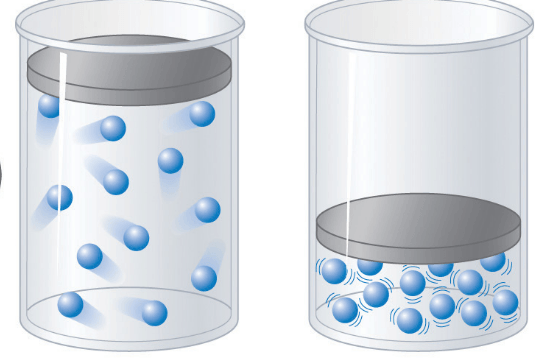
Boyle’s Laws -gas pressure and volume are inversely proportional

26

Multiple Choice

Question image
Which container will have a lower pressure?
1

left

2

right

3

they both have the same pressure

4

I don't know

27

media
media

Energy Transformation

28

Multiple Choice

Question image

A lamp that plugs into a wall socket draws energy, which flows through a thin wire in the bulb, causing it to heat up until it glows. What energy transformations are taking place?

1

Chemical → light → electrical

2

Mechanical → sound → light

3

Thermal → solar → electrical

4

Electrical → thermal → light

29

Multiple Choice

The law of conservation of energy states ___.

1

electrical energy can be transformed into other forms

2

energy can be created and destroyed

3

energy is never created nor destroyed

4

what goes up must come down

30

Multiple Choice

Question image

What type of energy is stored in a battery?

1

electrical

2

thermal

3

radiant

4

chemical

31

media
media

Kinetic and Potential Energy

32

Multiple Choice

Potential energy is the energy of...

1

motion

2

stored energy

3

gravity

4

the time

33

Multiple Choice

A kite stuck in a tree has ______ energy due to its position.

1

potential

2

kinetic

3

chemical

4

thermal

34

Multiple Choice

Moving a book to a lower shelf ________ its potential energy.

1

increaes

2

decreases

35

media
media

Elements Compounds Mixtures

A substance that
cannot be broken
down into other

substances.

A substance formed
when two or more

chemical elements are

chemically bonded

together.

Combination of two or
more pure substances

in which each pure
substance retains its
individual chemical

properties.

36

Multiple Choice

KCl2

1

Compound

2

Element

3

Mixture

37

Multiple Choice

Question image

Lucky Charms Cereal

1

Compound

2

Element

3

Mixture

38

Multiple Choice

Fe2

1

Compound

2

Element

3

Mixture

39

Multiple Choice

Question image

Salt (NaCl)

1

Compound

2

Element

3

Mixture

40

Multiple Choice

Question image

Koolaid

1

Compound

2

Element

3

Mixture

41

media
media

Chemical vs Physical

Properties and Changes

42

Multiple Choice

Melting Cheese

1

physical change

2

chemical change

43

Multiple Choice

Burning Wood

1

physical change

2

chemical change

44

media
media

Heating Curve

45

Multiple Choice

Question image

The melting point of the sample is

1

-60 ºC

2

20 ºC

3

60 ºC

4

100 ºC

46

Multiple Choice

Question image

Which letter indicates where water is in both the solid and liquid phase at the same time?

1

A

2

B

3

C

4

D

5

E

47

Multiple Choice

Question image

In which region(s) does temperature increase?

1

Region C only

2

Regions B and D

3

Regions A, C, and E

4

Regions A and B

48

Multiple Choice

Question image

Describe the substance at letter A.

1

Solid

2

Liquid

3

Melting

4

Evaporating

49

Multiple Choice

Question image

Describe the substance at letters D.

1

Gas

2

Liquid

3

Melting

4

Evaporating

50

media
media

Phase Change Diagram

51

Multiple Choice

Question image
What state of matter is X?
1

solid 

2

liquid

3

gas

4

supercritical fluid

52

Multiple Choice

Question image
What state of matter is Z?
1

solid 

2

liquid

3

gas

4

supercritical fluid

53

Multiple Choice

Question image
What change occurs from E to C?
1

sublimation

2

freezing

3

melting

4

boiling

54

Multiple Choice

Question image
What change occurs from F to E?
1

sublimation

2

deposition

3

melting

4

condensation

55

media
media

Solubility Curve

How many grams of NaNO3 are
required to make a saturated
solution in 100g H2O at 30 degree
C?

What kind of solution do you have
if 80g KlO3 are dissolved in 100g
H2O at 70 degree C?

56

Multiple Choice

Question image

How many grams of K2Cr2O7, are soluble in 100 g of water at 95 ºC?

1

83 grams

2

75 grams

3

40 grams

4

12 grams

57

Multiple Choice

Question image

Which substance is MOST soluble at 0 ºC?

1

KI

2

NaNO3

3

NaCl

4

Ce2(SO4)3

58

Multiple Choice

Question image
When 20 grams of potassium chlorate, KClO3, is dissolved in 100 grams of water at 80 ºC, the solution can be correctly described as:
1

supersaturated

2

saturated

3

unsaturated

59

media
media
media

Atomic Structure

+
0
-

Nucleus
Nucleus
Electron Cloud

1
1
0

Protons = Electrons
Different Number of Neutrons, Carbon -14
Charge due to amount of Electrons

60

Multiple Choice

Which of the following parts of an atom are positively charged?

1

neutron

2

proton

3

electron

4

nucleus

61

Multiple Choice

A charged atom is called a(n)...

1

electron.

2

ion.

3

proton.

4

acid.

62

Multiple Choice

Question image
What is the name of the pictured isotope?
1

Chlorine-Schmorine

2

Chlorine-17

3

Chlorine-35

4

Chlorine-18

63

media
media

Radioactive Decay

64

Multiple Choice

How is the alpha particle written in a nuclear equation?

1

42He

2

24He

3

0-1e

4

00γ

65

Multiple Choice

How is the negative beta particle written in a nuclear equation?

1

42He

2

0+1e

3

0-1e

4

00γ

66

Multiple Choice

22087Fr —› 42He + ____

1

22089Ac

2

22490Th

3

21685At

4

21688Ra

67

media
media
media
media
media

Periodic Table

68

Multiple Choice

Question image
What is the atomic number?
1

The number of protons in an element

2

The number of neutrons in an element

3

The number of protons and neutrons.

4

The number of protons and electrons.

69

Multiple Choice

Question image
What is found in the nucleus of atoms?
1

Protons and electrons.

2

Protons, neutrons, and electrons.

3

Protons and neutrons.

4

Neutrons and electrons.

70

Multiple Choice

Each row in the periodic table is called a 
1

group

2

period

3

cluster

4

unit

71

Multiple Choice

Question image
Which is an electron?
1

A

2

B

3

C

72

media
media

73

Multiple Choice

Question image
What element is represented in this Bohr Model? 
1

Carbon

2

Hydrogen

3

Aluminum

4

Lithium

74

Multiple Choice

How many valence electrons does Sodium (Na) have?
1

1

2

2

3

3

4

4

75

Multiple Choice

According to the octet rule most elements need _______ valence electrons.
1

2

2

8

3

6

4

18

76

Multiple Choice

Which of these is incorrect?

1
2

77

media
media
media

Ionic vs Covalent Bonds

Non-Metal + Metal

Transfer electrons

Positive and negative charges

Non-Metal + Non-Metal

Sharing electrons

No charges

78

Multiple Choice

Question image

According to the diagram below, how many bonds will this atom be able to make?

1

1

2

2

3

3

4

4

79

Multiple Choice

A covalent bond is
1

a bond that shares electrons metallicaly

2

A bond that shares electrons with non metals

3

Metalloids bonding

4

metals and nonmetals bonding

80

Multiple Choice

Valence electrons are transferred

1

Ionic bonds

2

Covalent bonds

81

Multiple Choice

The chemical bond between a metal and a non-metal will be a _____ bond.

1

metal

2

ionic

3

covalent

4

polar

82

Multiple Choice

The chemical bond between a non-metal and another non-metal will be a ________ bond.

1

metal

2

ionic

3

covalent

4

polar

83

media
media

Law of Conservation of Mass

Mass is neither created nor

destroyed in chemical reactions.

84

Multiple Choice

Question image

The Law of Conservation of Mass states Matter is NEITHER created nor destroyed.

1

True

2

False

85

Multiple Choice

Question image

How many oxygen atoms are in this chemical formula?

1

6 oxygen atoms

2

2 oxygen atoms

3

3 oxygen atoms

4

4 oxygen atoms

86

Multiple Choice

24 g of magnesium reacts with 38 g of fluorine to produce _____ g magnesium fluoride
1

62 

2

38

3

24

4

14

87

Multiple Choice

Is this balanced?
2HgO → 2Hg + O2
1

Yes

2

No

88

media
media

Type of Chemical Reactions

89

Multiple Choice

The reaction AB + XY ⟶ XB + AY is an example of ______.

1

synthesis

2

decomposition

3

single replacement

4

double replacement

90

Multiple Choice

What class of reaction best describes the equation below?

MgCO3 ⟶ MgO + CO2

1

Synthesis

2

Decomposition

3

Single Replacement

4

Double Replacement

5

Combustion

91

Multiple Choice

The reaction AB + X ⟶ XB + A is classified as a _____ reaction.

1

synthesis

2

decomposition

3

single replacement

4

double replacement

92

Multiple Choice

The reaction XY ⟶ X + Y is an example of _____.

1

synthesis

2

decomposition

3

single replacement

4

double replacement

media
media
media

Calculate Speed

Show answer

Auto Play

Slide 1 / 92

SLIDE