

1. Georgia's Geographic Regions

Presentation
•
Social Studies
•
8th Grade
•
Practice Problem
•
Medium

Justin Barlow
Used 47+ times
FREE Resource
59 Slides • 16 Questions
1

2


3


4

5

6

7

8

9

10

11

© Brain Wrinkles
Georgia’s
12

© Brain Wrinkles
Coastal Plain
Piedmont
Blue Ridge
Ridge &
Valley
Appalachian
Plateau
13

•
Georgia is a geographically diverse state that is
divided into five regions.
•
The first three regions (Appalachian Plateau,
Ridge & Valley, and Blue Ridge) are in the
mountains and foothills of the state and form
part of the Appalachian Mountain range.
•
The other two (Piedmont and Coastal Plain)
include coastal and farming areas, as well as
some of the large cities in the middle of the
state.
© Brain Wrinkles
14
15

•
The Appalachian Plateau is the state’s
smallest region.
•
It’s located in the very northwest corner
of Georgia and encompasses Dade County.
•
The region features a long, narrow valley
with Sand Mountain on one side and
Lookout Mountain on the other.
© Brain Wrinkles
16

© Brain Wrinkles
Appalachian
Plateau
17

© Brain Wrinkles
View from Lookout Mountain
18

•
The region contains two waterfalls, many
underground caves, and it is covered in
forests.
•
It is not a good area for farming because
of the sandy soil; however, it was once a
profitable area for mining coal and iron
ore.
© Brain Wrinkles
19

© Brain Wrinkles
20

•
The average summer temperature is 70
degrees, and the average winter
temperature is just above 40 degrees.
© Brain Wrinkles
21
22

•
The Blue Ridge region is in the northeast
corner of Georgia, and it is made up of
the Blue Ridge Mountains.
•
This area contains the southern point of
the Appalachian Mountains (which run up
to Maine).
•
The region is also home to Georgia’s
highest peak, Brasstown Bald (4,784 feet).
© Brain Wrinkles
23

© Brain Wrinkles
24

© Brain Wrinkles
Brasstown Bald
25

•
The tallest waterfall east of the
Mississippi River, Amicalola Falls, is in this
region.
•
Also, Tallulah Gorge, which is two miles long
and 1,000 feet deep, is located here.
•
Aside from apples, grapes, and some
vegetables, not much agriculture is grown
here.
© Brain Wrinkles
26

© Brain Wrinkles
Amicalola
Falls
Tallulah Gorge
27


28

• The Blue Ridge region receives the most
rainfall in Georgia.
• The average summer temperature is 69
degrees, while the average winter
temperature is 45 degrees.
• The area attracts thousands of tourists
each year due to its beautiful scenery,
outdoor activities, and slightly cooler
climate.
© Brain Wrinkles
29

© Brain Wrinkles
30
31

•
The Ridge and Valley region is located in
northwest Georgia, east of the Appalachian
Plateau.
•
The region consists of several high, narrow
mountain ridges and the valleys between them.
•
The elevation of the region ranges from 700 to
1,600 feet.
•
The region’s climate is similar to the Blue Ridge
region, with slightly less rainfall.
© Brain Wrinkles
32

© Brain Wrinkles
33

© Brain Wrinkles
34

• Mining and farming are the region’s main
industries.
• The soil is rich and agricultural products
include corn, soybeans, wheat, cotton, and
apples.
• Beef cattle are raised on pastures in the
valleys.
© Brain Wrinkles
35

© Brain Wrinkles
36

37

38
39

•
The Piedmont region is in the central area of
Georgia, and makes up roughly 30% of the
state’s land area.
•
The name means “foot of the mountains”,
as it is made up of low rolling hills that slope
towards the south.
•
The elevation ranges from 500 feet at its
southern border (called the Fall Line) to
1700 feet at its northern border.
© Brain Wrinkles
40

© Brain Wrinkles
41

© Brain Wrinkles
Athens, GA
42

• The Piedmont region has large amounts of
granite and marble, enabling Georgia to be
the nation’s leading producer of both.
• It is also known for its red clay, which is
rich in iron minerals.
• The region is important for agriculture,
with large amounts of corn, peaches,
wheat, soybeans, cattle, and poultry being
produced.
© Brain Wrinkles
43

© Brain Wrinkles
Granite Quarry in Georgia
44

© Brain Wrinkles
Georgia’s Red Clay
45

• Nearly 50% of Georgia’s population lives in
this region, thanks to cities like Atlanta,
Athens, Macon, Columbus, Augusta, and
Milledgeville.
• There are a lot of businesses in this region,
and it features the bulk of Georgia’s
industry.
© Brain Wrinkles
46

© Brain Wrinkles
Atlanta, Georgia
47
48

• The Coastal Plain is the largest region,
covering roughly 60% of the state.
• It begins at the Fall Line and extends to
Georgia’s southern border with Florida.
• It stretches from the barrier islands off
of Georgia’s eastern coast to Alabama.
© Brain Wrinkles
49

© Brain Wrinkles
50

© Brain Wrinkles
Vidalia Onions
51

• The Coastal Plain has good farmland and
produces the majority of the state’s crops.
• Peanuts, onions, pecans, corn, and other
agricultural products are grown here.
• The region has 100 miles of coast, which
attracts large numbers of tourists each
year.
© Brain Wrinkles
52

© Brain Wrinkles
53

• The Coastal Plain and Piedmont regions are
more humid and tropical than the other
regions because they are between the
warm waters of the Gulf of Mexico and
the Atlantic Ocean.
• Summer tends to be long and hot, while
the winter is mild compared to the rest of
the state.
© Brain Wrinkles
54

© Brain Wrinkles
55
© Brain Wrinkles
Coastal Plain
Piedmont
Blue Ridge
Ridge &
Valley
Appalachian
Plateau
56

57
58
59

60
Multiple Choice
How many physical/physiographic regions does Georgia have?
1
7
4
5
61
Multiple Choice

On a US map, Georgia is located in the ____________ and ___________ regions.
North and West
North and East
South and West
South and East
62
Multiple Choice

Which state borders Georgia?
California
Alabama
Louisiana
Virginia
63
Multiple Choice

On the globe, Georgia is located __________ of the equator.
East
West
North
South
64
Multiple Choice

Georgia is located in the __________ regions of the world
Northern and Western
Northern and Eastern
Southern and Western
Southern and Eastern
65
Multiple Choice
Georgia is located on what continent?
United States
North American
Southeast
Asia
66
Multiple Choice
All of the states border Georgia EXCEPT for _______________.
Mississippi
Alabama
Florida
Tennessee
67
Multiple Choice
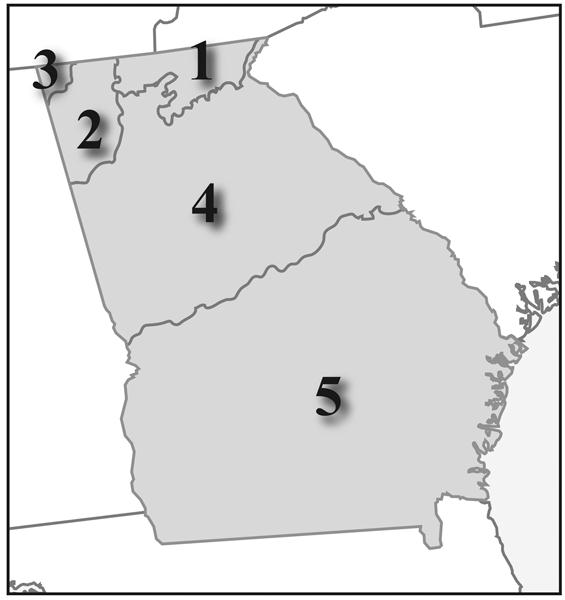
Ridge and Valley
Piedmont
Coastal Plain
Appalachian Plateau
68
Multiple Choice
What region is number 2?
Ridge and Valley
Piedmont
Coastal Plain
Appalachian Plateau
69
Multiple Choice
What region is number 4?
Ridge and Valley
Piedmont
Coastal Plain
Appalachian Plateau
70
Multiple Choice
What region is number 5?
Ridge and Valley
Piedmont
Coastal Plain
Appalachian Plateau
71
Multiple Choice
What region is number 1?
Ridge and Valley
Blue Ridge
Coastal Plain
Appalachian Plateau
72
Multiple Choice
Which region is the smallest and contains Dade County, part of Walker County and Lookout Mountain?
Ridge and Valley
Blue Ridge
Appalachian Plateau
Blue Ridge
73
Multiple Choice
What is the highest peak in Georgia?
Brasstown Bald
Stone Mountain
Lookout Mountain
Signal Moutain
74
Multiple Choice
Because of its warm weather and sunny beaches, beachgoers would most likely be attracted to which physiographic region?
Coastal Plain
Ridge and Valley
Appalachian Plateau
Blue Ridge
75
Multiple Choice
Population heart, Industrial Heart (cars and planes built here)
2nd largest physiographic region
Coastal Plain
Blue Ridge
Ridge and Valley
Piedmont
Show answer
Auto Play
Slide 1 / 75
SLIDE
Similar Resources on Wayground

68 questions
Week 8 AH
Presentation
•
8th Grade
71 questions
2nd Law of Motion Quizizz Lesson
Presentation
•
8th Grade
69 questions
Lesson 3: Nature & Background of Futsal
Presentation
•
8th Grade
66 questions
Unit 7A: Abolitionists, Sectionalism and Civil War
Presentation
•
8th Grade
69 questions
La creatividad en mi vida Part A
Presentation
•
8th Grade
70 questions
Thanksgiving Break!
Presentation
•
8th Grade
72 questions
World War 2
Presentation
•
9th Grade
67 questions
Stratigraphy and Dating Rocks
Presentation
•
8th Grade
Popular Resources on Wayground
10 questions
How much do you know about our Portrait of an Eagle?

Quiz
•
10th Grade
10 questions
Fast Food Slogans
Quiz
•
6th - 8th Grade
21 questions
Continents and Oceans
Quiz
•
6th Grade
20 questions
Parts of Speech
Quiz
•
5th Grade
16 questions
Subject & Predicate
Quiz
•
5th Grade
25 questions
Multiplication Facts
Quiz
•
5th Grade
12 questions
Map Skills
Quiz
•
3rd Grade
22 questions
Continents and Oceans
Quiz
•
5th Grade
Discover more resources for Social Studies
10 questions
Exploring the Age of Exploration: Key Events and Figures

Interactive video
•
6th - 10th Grade
13 questions
13 Colonies Map Quiz
Quiz
•
6th - 8th Grade
20 questions
13 original colonies
Quiz
•
8th Grade
10 questions
Causes of the American Revolution
Quiz
•
8th Grade
10 questions
Pillars of Free Enterprise
Quiz
•
6th - 8th Grade
26 questions
QA 1 Review
Quiz
•
6th - 8th Grade
10 questions
Exploring the 13 Colonies Regions
Interactive video
•
6th - 10th Grade
3 questions
Unit 3 Road to Revolution Vocabulary
Quiz
•
8th Grade