
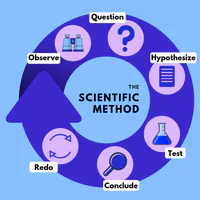
The Scientific Method

Presentation
•
Science
•
8th Grade
•
Easy
+6
Standards-aligned

Jawara Senghor
Used 92+ times
FREE Resource
10 Slides • 6 Questions
1

The "How To" manual for doing Science.
2

The "Scientific Method" is a process or set of steps taken to produce reliable results to answer a specific question in a scientific investigation.
3

Ask a question - The question you ask should also be measurable and answerable through experimentation.
Perform research - Conduct preliminary background research to prepare yourself for the experiment.
Establish a hypothesis - Make a prediction that you can measure through experimentation and research.
Test your hypothesis - Your experiment is a way to quantifiably test your predictions and should be able to be repeated by another scientist.
Steps of the Scientific Method
4

Make an observation - Collect and record data and observations during the experiment. After completing the experiment, repeat it to ensure accurate results.
Analyze results/draw a conclusion - Take your findings and analyze them to determine if they support your hypothesis.
Present the findings - Usually done in a lab report, display all information about experiment. This is done to other scientists can review and replicate your scientific investigation.
Steps of the Scientific Method
5
Identify Variables
Form a Hypothesis
Recording Data
Graphing Data

6

The best experiments begin with correctly identifying variables. There are 3 types of variables.
~ Independent or Manipulated variable: The variable that is changed
~ Dependent or Responding variable: The variable that is measured
~ Controls or constants: All of the other variables that are kept the same
7
A strong hypothesis is a testable prediction based on a well-researched question. A great "hypothesis hack" is to clearly identify your variables and add them to your hypothesis. The independent variable follows the "if" and the dependent variable would follow the "then".

8

There are different types of data an experimenter can collect. For a scientific investigation, quantitative data is most likely to yield a reliable result. By the way, the exact data you need is in your hypothesis.
Record data
9
There are different graphs you can use to represent your data; like pie charts, bar graphs and line graphs . You also need to know where data goes on your graph. The independent variable is placed on the x-axis, while the dependent variable is placed on the y-axis.


10

The Scientific Method is a dynamic, open-ended process to investigate questions. The basic process involves making an observation, forming a hypothesis, making a prediction, conducting an experiment and finally analyzing the results.
11
Multiple Choice
scientific method
recipe
data collection
metric system
12
Multiple Choice
Make observation
Form a theory
Collect data
Form a hypothesis
13
Multiple Choice
dependent variable
independent variable
data
control group
14
Multiple Choice
data
theory
hypothesis
fact
15
Multiple Choice
Why do scientists use graphs?
They are pretty.
It makes an extra step.
They show trends.
They like to use them.
16
Multiple Choice
X
Y
The "How To" manual for doing Science.
Show answer
Auto Play
Slide 1 / 16
SLIDE
Similar Resources on Wayground

13 questions
Speed v. Velocity
Presentation
•
8th Grade
13 questions
Day 7 STAAR Review
Presentation
•
8th Grade
15 questions
Ecosystems Review
Presentation
•
8th Grade
13 questions
Resource Extraction & Land Use Mitigation
Presentation
•
8th Grade
11 questions
Photosynthesis
Presentation
•
7th Grade
12 questions
Human Biotechnology
Presentation
•
8th Grade
13 questions
Big Bang Theory
Presentation
•
8th Grade
14 questions
Relative Dating & Ordering of Rock Layers
Presentation
•
8th Grade
Popular Resources on Wayground
10 questions
How much do you know about our Portrait of an Eagle?

Quiz
•
10th Grade
10 questions
Fast Food Slogans
Quiz
•
6th - 8th Grade
21 questions
Continents and Oceans
Quiz
•
6th Grade
20 questions
Parts of Speech
Quiz
•
5th Grade
16 questions
Subject & Predicate
Quiz
•
5th Grade
25 questions
Multiplication Facts
Quiz
•
5th Grade
12 questions
Map Skills
Quiz
•
3rd Grade
22 questions
Continents and Oceans
Quiz
•
5th Grade
Discover more resources for Science
20 questions
Scientific Method and Variables
Quiz
•
8th Grade
20 questions
Scientific method and variables
Quiz
•
8th Grade
27 questions
Counting Atoms - Subscripts
Quiz
•
8th Grade
20 questions
Claim, Evidence and Reasoning (CER)
Quiz
•
6th - 8th Grade
18 questions
Counting Atoms
Quiz
•
7th - 8th Grade
20 questions
Elements, Compounds and Mixtures
Quiz
•
8th Grade
10 questions
Exploring Chemical and Physical Changes

Interactive video
•
6th - 10th Grade
10 questions
Decoding the Periodic Table of Elements
Interactive video
•
6th - 10th Grade