

Le Chatelier's Principle (which direction does reaction shift)

Presentation
•
Chemistry
•
9th - 12th Grade
•
Practice Problem
•
Hard

Quincy Adams
FREE Resource
24 Slides • 3 Questions
1

2
define Le Chatelier's principle
predict the qualitative effect of changing either temperature, concentration, or pressure on the position of equilibrium in a reversible reaction.
3
Le Chatelier's Principle
Le Chatelier's principle states that if a dynamic equilibrium is disturbed by changing the conditions, the position of equilibrium shifts to counteract the change to reestablish an equilibrium.
4
Qualitative - measuring by the quality of something rather than its quantity
Equilibrium - a state of calm physical balance
Principle - generally accepted scientific truths
Catalyst - increases the rate of reaction without being consumed.
5

In this tutorial, we're going to be talking about
Le Chatelier's Principle.
What it is and how it can help you to determine which way the reaction will shift.
Because just as Sir Isaac Newton's 3rd law of motion states: "for every action, there is an equal and opposite reaction."
Also, we'll be going through several problems together.
6
Le Chatelier's
Principle
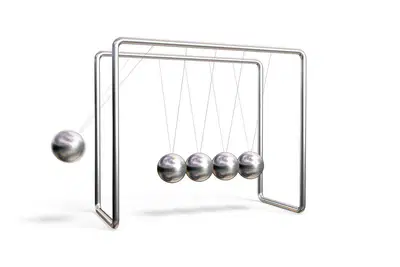
You currently have a reaction that is at equilibrium. Then some stress or change occurs that kicks the system out of equilibrium. This principle can help you determine which way the reaction will shift towards the product or towards the reactants to re-establish equilibrium. Remember, the GOAL is to RE-ESTABLISH EQUILIBRIUM. Newton's 3rd law of motion goes hand in hand with Le Chatelier's. It's also a great way to describe the U.S.' current state of politics over former Pres. Donald Trump ha ha ha
7

8
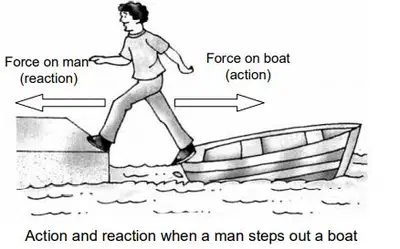
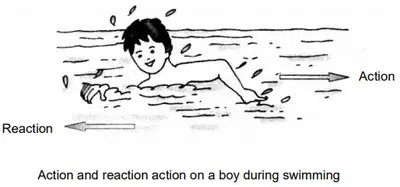



9
Multiple Choice

What will be the result of action
He will get stuck
He will not be able to move
He will be able to cut the grass
10
Multiple Choice
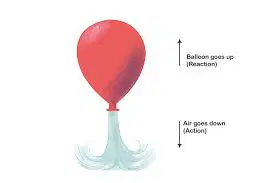
What will be the result of action
The balloon will fall flat
The balloon will go very fast everywhere
The balloon will go straight up then back down
11
Multiple Choice
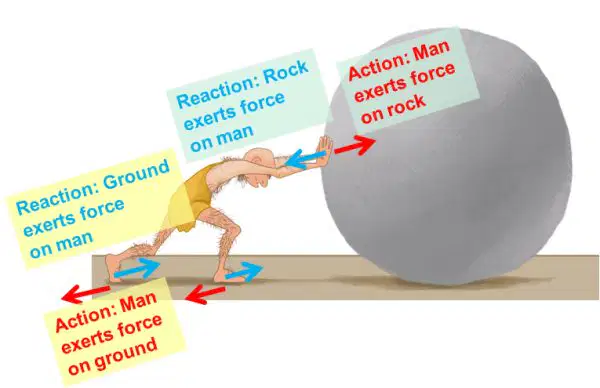
What will be the result of action
The boulder will not move
He needs big muscles
He needs shoes
all of these answers are correct
12
The way a reaction will shift (as we just saw via Newton's 3rd law of motion), will depend on the type of stress that is induced.
13
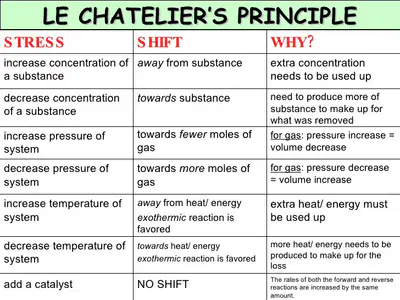
Here I have a list of stresses and the guidelines in terms of which way the reaction will shift. There's a lot here, I think it's probably best at this point to just take a look at the example problem and see how that, the result of action, applies.
14

This question reads: "IN WHICH DIRECTION will the position of the equilibrium of this react balanced chemical reaction be shifted when each of these CHANGES occur?" As a reminder, I've added the periodic table to the next slide.
add or remove a solid NO SHIFT
add an inert gas NO SHIFT
15

H = hydrogen
I = iodine
AR = argon
G = hypothetical state

16
Part (a) is where adding H2 [2 hydrogens]. If we're adding H2, you can see that whenever we increase the concentration of something that it SHIFTS AWAY from that side. So, if we add some H2, and since H2 is on the PRODUCT side, the REACTION will SHIFT to the LEFT. So it will go to the reactant side, Why? We want to offset the change if we're adding more products then we're going to want to shift away from the product side to get rid of some of those products and make more reactants
add or remove a solid NO SHIFT
add an inert gas NO SHIFT


17
Part (b) is where i2 gas [2 iodine's] is removed. That would be decreasing the concentration of the i2 and whenever you decrease the concentration of a substance, it'll move TOWARDS the side that contains a substance. So since we're decreasing the amount of i2, the REACTION is going to SHIFT to the RIGHT to make some more i2 and decrease the amount of reactants
add or remove a solid NO SHIFT
add an inert gas NO SHIFT


18
Part (c) hi gas [hydrogen + iodine] is removed. So once again, we're removing a substance and this time we're REMOVING THE REACTANTS which means that the REACTION will SHIFT TOWARDS the REACTANTS. Whenever you remove something, it'll shift to that side so, it'll be going to the LEFT.
add or remove a solid NO SHIFT
add an inert gas NO SHIFT


19
Part (d) in a rigid container, some argon gas is added. That falls under the category of adding an "INERT GAS". Inert simply means the gas is UNREACTIVE. We know that ARGON is a NOBLE GAS so if we add argon, that's not going to affect the amount of hi, h2, or i2 because argons NOT going to REACT to any of them. Since we're adding a noble gas, it's not affecting the reactant products there's going to be NO SHIFT here. The reactions going to STAY at EQUILIBRIUM
add or remove a solid NO SHIFT
add an inert gas NO SHIFT


20
Part (e)1: the volume of the container is doubled. So, when you DOUBLE (increase the volume) of a container, you're essentially DECREASING the PRESSURE. So, what we're doing in part e is we're decreasing the TOTAL PRESSURE OF THE SYSTEM and when we decrease the pressure of a system, the REACTIONS gonna wanna move TOWARDS the side with MORE MOLES of GAS to RE-INCREAE the PRESSURE. So we have 2 moles of pressure on the LEFT because of COEFFICIENT of 2 here and then we also have 2 moles of gas on the RIGHT because we have 1 + 1. Since we have EQUAL numbers of moles of gas on both sides, there's not going to be any shifts
add or remove a solid NO SHIFT
add an inert gas NO SHIFT
21
Part (e)2 HYPOTHETICAL If, however, there happened to be a coefficient of 2 for example, we'll have 2 moles on the left and then 3 moles on the right. Then the reactions shift to the right because there's more moles of gas on the right than the left
add or remove a solid NO SHIFT
add an inert gas NO SHIFT
22
Part (f) The temperature is decreased and the reaction is exothermic. It's important to know whether the reaction is endothermic or exothermic because that will determine how the reactions shift when temperature changes. If a reaction is exothermic, that means heat is on the product side because heat is being released and if the reactions endothermic, it means heat is being absorbed, so heat is on the reactant side. We know its an exothermic reaction so we can go ahead and add heat on the product side. And, it says that the temperature is Decreased
add or remove a solid NO SHIFT
add an inert gas NO SHIFT
Exothermic: heat is on product side
Endothermic: heat is on the reactant side


+ heat on the product side
23
Part (f) Cont... you can think of decreasing the temperature as the same thing as removing heat. Since we're removing some products, the reactional shift will be to the product side because it will be trying to make up some of the heat that was lost to establish equilibrium. That means that the reaction is going to be shifting to the RIGHT in part f. That covers most of the changes but there's a couple that we haven't talked about.
add or remove a solid NO SHIFT
add an inert gas NO SHIFT
Exothermic: heat is on product side
Endothermic: heat is on the reactant side
24
We talked about increasing and decreasing concentrations
We talked about how the system will respond when there's an increase and decrease in pressure
We talked about how it will respond with a change in temperature
add or remove a solid NO SHIFT
add an inert gas NO SHIFT
Exothermic: heat is on product side
Endothermic: heat is on the reactant side


25
What we didn't talk about is when you add a catalyst. When you add a catalyst there's not going to be any shift because a catalyst just lowers the activation energy to help you to reach equilibrium faster but, if a reactions already at equilibrium, and then you add a catalyst, nothings going to happen because it's already at equilibrium.
add or remove a solid NO SHIFT
add an inert gas NO SHIFT
Exothermic: heat is on product side
Endothermic: heat is on the reactant side

26
The last thing I want to talk about is, that whenever you are adding or removing a solid, there's not going to be any shifts because... remember the equilibrium constant does not depend on the amount of solid present! so, whenever we change the amount of solid, it's not going to affect the equilibrium. It's the same for inert gases as well. They are non-reactive remember?
add or remove a solid NO SHIFT
add an inert gas NO SHIFT
Exothermic: heat is on product side
Endothermic: heat is on the reactant side
27

And there you have it. That's how you would use LE CHATELIER PRINCIPLE to help you predict which way the reaction will shift
THIS IS IT
Show answer
Auto Play
Slide 1 / 27
SLIDE
Similar Resources on Wayground

20 questions
Atomic Structure Review
Presentation
•
9th - 12th Grade
20 questions
Water, Solubility, Solutions, Molarity
Presentation
•
9th - 12th Grade
20 questions
DLD Performance Final
Presentation
•
9th - 12th Grade
24 questions
History of the Periodic Table
Presentation
•
9th - 12th Grade
19 questions
8.01: Introduction to Chemical Reactions
Presentation
•
9th - 12th Grade
20 questions
Electromagnetic vs. Mechanical Waves Review Lesson
Presentation
•
9th - 12th Grade
20 questions
Physical Education
Presentation
•
9th - 12th Grade
20 questions
Theme
Presentation
•
9th - 12th Grade
Popular Resources on Wayground
10 questions
Safety Day 2026 – Student Review

Quiz
•
9th Grade
21 questions
Continents and Oceans
Quiz
•
6th Grade
20 questions
Parts of Speech
Quiz
•
5th Grade
16 questions
Subject & Predicate
Quiz
•
5th Grade
25 questions
Multiplication Facts
Quiz
•
5th Grade
12 questions
Map Skills
Quiz
•
3rd Grade
22 questions
Continents and Oceans
Quiz
•
5th Grade
15 questions
Rounding Decimals
Quiz
•
5th Grade
Discover more resources for Chemistry
20 questions
electron configurations and orbital notation
Quiz
•
9th - 12th Grade
20 questions
Periodic Table Trends
Quiz
•
11th Grade
25 questions
Writing and Naming Binary Ionic compounds
Quiz
•
10th Grade
20 questions
COUNTING ATOMS
Quiz
•
10th Grade
50 questions
Unit 3: Atomic Assault Summative Review
Quiz
•
11th Grade
20 questions
Physical or Chemical Change/Phases
Quiz
•
8th Grade - University
15 questions
Periodicity Module Exam Practice Quiz
Quiz
•
9th - 12th Grade
20 questions
Naming Ionic Compounds
Quiz
•
10th Grade