Search Header Logo
Unit 1 Review: Evolution & Natural Selection

Unit 1 Review: Evolution & Natural Selection

Assessment

Presentation

Biology

9th Grade

Hard

Created by

Christine Ruberti

FREE Resource

25 Slides • 75 Questions

1

Evolution & Natural Selection

media

2

Multiple Choice

The formation of new and distinct species in the course of evolution

1

artificial selection

2

speciation

3

breeding

4

non-random mating

3

4

media

Evidence of Evolution

Know the different evidences of evolution and how
they showed that evolution may have occurred.
Evidence of Evolution:

- Fossil Record
- Biogeography
- DNA Evidence
- Homologous Structures
- Embryology

5

media

Evidence of Evolution

Know how to look at DNA similarities and structure
similarities to determine how organisms are related to
each other.
Know how to read a

cladogram

and phylogentic tree:

6

Match

Match the following

Analogous Structure

Homologous Structure

Comparative Embryology

Biochemical Evidence

Vestigial Structures

Same function different structure

Same structure different function

Comparing embryological development of different species

Comparing DNA and amino acid sequences of different species

Structures in the body of an organism that no longer work.

7

Multiple Choice

Question image

Based on the cladogram the ancestral species most likely had-

1

A vertebral column

2

A vertebral column and hair

3

Sharp teeth and retractable claws

4

The abily to purr

8

Multiple Choice

Question image

The opossum, which is native to North America, and the Kangaroo, which is native to Australia, are both marsupials.

The fact that both of these mammals incubate their young in a pouch provides evidence that they-

1

belong to the same species

2

must range great distances to eat

3

have very similar skeletal structures

4

are descended from a common ancestor

9

Multiple Choice

Genome maps provide the DNA sequence of chromosomes. Some scientists have compared the genome maps of hedgehogs and sloths. What do these genome maps allow the scientists to determine?

1

The color patterns of the offspring of each species

2

How much the size ranges of the two species differ

3

The methods of protein synthesis that each species uses

4

How closely related the two species are to each other

10

media

Natural Selection

Understand that in natural selection, those that are
most fit for their environment will be able to survive
and pass those traits on to the next generation.
Know that adaptations are traits that help an
organism survive. Those organisms with favorable
adaptations will be naturally selected to continue to
survive.
Mutations (DNA changes) in organisms lead to
variations (differences) in populations.

11

media

Natural Selection

Know that speciation (creation of a new species)
occurs when populations are separated in some way
(geographical, behavioral, temporal), evolve
differently, and no longer can reproduce with each
other.
Remember that an organism is apart of the same
species if they can successfully reproduce with each
other.
If organisms can no longer adapt to their environment
it can lead to extinction.

12

Match

Match the following

Natural Selection

Adaptation

Development

Variation

Species

Process where traits and organisms that are best adapted to the environment survive and reproduce.

A variation in a plant or animal that increases it chance of survival in its environment.

The process by which animals and plants grow and develop.

Differences among organisms

Organisms that can reproduce, have similar characteristics, and have a common gene pool.

13

Multiple Choice

Some organisms have genes that improve their ability to survive and reproduce. If the genes also help their offspring survive and reproduce, then which of the following will most likely increase?

1

The frequency of the genes in one individual

2

The frequency of the genes in the population

3

The number of genes in one chromosome

4

The number of genes in the species

14

Multiple Choice

Question image

In Madagascar scientists have discovered a moth, Xanthopan morganii praedicta, that has a 30.5 cm proboscis and feeds from and pollinates Darwin’s orchid, Angraecum sesquipedale. The orchid has a nectar-producing tube that is 27.9 cm long.


How is the moth’s proboscis size an adaptation for its environment?

1

The moth can avoid larger animals.

2

The moth can pollinate other flowers.

3

The moth has little competition for food.

4

The moth has time to feed during the day.

15

Multiple Choice

Why are advantageous traits more likely to be passed onto offspring?
1

Because they are more likely to survive and reproduce.

2

Because they come from dominant alleles.

3

Because they come from recessive alleles.

4

Because the trait is an acquired phenotype.

16

Multiple Choice

Question image

What is most likely to happen to moth populations in the picture shown?

1

Light moths--hunted easily, dark moths--population increase

2

Dark moths--hunted easily, dark moths--population increase

3

Light moths--hunted easily, light moths--population increase

4

Lights moths will change their color to match dark moths.

17

Multiple Choice

Do organisms "decide" to evolve and change?
1

Yes, they know they need to change to survive 

2

No, they change because of natural selection

18

19

Multiple Choice

Homologous Structures are evidence of what?

1

nothing

2

a common ancestor

3

natural selection

20

Multiple Choice

Homologous structures are

1

same structure, different function

2

same function, different structure

21

Multiple Choice

Butterfly wings and bird wings are

1

analogous structures

2

homologous structures

22

Multiple Choice

Human arm and a dog leg are

1

analogous structures

2

homologous structures

23

24

Multiple Choice

When a structure no longer serves a purpose it is considered

1

analogous

2

homologous

3

vestigial

25

Multiple Select

Which of the following are considered vestigial structures?

1

human arm

2

human appendix

3

hip bones on whales

4

wisdom teeth

5

human toes

26

media
media
media

1.

Embryos from different vertebrates are very similar
during early stages of development.

2.

The longer they are similar during development the
more closely related they are.

Embryonic
Structure

27

Multiple Choice

Question image
In stage one (top row) of these embryos, most of the embryos________
1

look very similar.

2

have very different features.

3

show different stages of development.

4

have only a tail if they are non-human.

28

Multiple Choice

Question image
In the the third embryonic stage (bottom row), mammal embryos _____
1

have more characteristics in common with each other than with reptiles or birds.

2

are still hard to tell from reptiles and birds.

3

have the same features as fish, reptiles, and birds.

4

do not have tails.

29

media
media

All organisms share the same
genetic material.

The more alike two organisms are,
the more alike their DNA base
sequence, the more amino
acids/proteins they have in
common (genetic sequence).

DNA

What does this cladogram diagram tell us?

30

media
media

Mutations

These are changes, through everyday

wear and tear, to the DNA.

Most mutations have no effect.

Sometimes it can cause a new

characteristic.

31

media
media

Mutations

Very occasionally it can give an

organism a better chance of
survival – longer fur, longer
legs

Overtime, time these useful

mutation can help a species
adapt to an environment –
and eventually lead to the
evolution of a completely
new species.

32

Multiple Choice

Question image
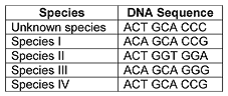
According to this data, the unknown bacterial species is most closely related to: 
1

Species I

2

Species II

3

Species III

4

Species IV

33

Multiple Choice

If two organisms have similar traits of DNA they are probably
1

share a common ancestor

2

share a common environment

3

share a common population

4

speciation

34

Multiple Choice

Question image
Which species’ DNA is most similar to the DNA of the toothed whale? 
1

Hippopotamus 

2

Baleen Whale

3

Grazing Mammals

4

Camels

35

Multiple Choice

Question image

What number is the common ancestor of C and D

1

1

2

2

3

3

4

4

36

Match

Match the following

Analogous Structure

Homologous Structure

Comparative Embryology

Biochemical Evidence

Vestigial Structures

Same function different structure

Same structure different function

Comparing embryological development of different species

Comparing DNA and amino acid sequences of different species

Structures in the body of an organism that no longer work.

37

Multiple Choice

Question image
Two organisms that are closely related would have
1

very similar DNA sequence

2

exactly the same DNA sequences

3

no proteins in common

4

completely different DNA sequence

38

Multiple Choice

Question image

The cave fish and minnow are related to each other but the cave fish is blind and only has the remnants of an eye. What type of structure is this?

1

vestigial

2

analogous

39

Domains and Kingdoms of Life

Domain Archaea and Domain Bacteria

media

40

There are 6 kingdoms of life.

  • Kingdom Archaebacteria

  • Kingdom Eubacteria

  • Kingdom Protista

  • Kingdom Fungi

  • Kingdom Plantae

  • Kingdom Animalia

41

Each organism is either an autotroph or heterotroph.

  • Autotroph means that the organism makes its own food for nutrition.

  • Heterotroph means that the organisms must eat in order to get their nutrition.

42

Multiple Choice

A bacterium is a type of ____ cell.

1

eukaryotic

2

prokaryotic

43

Fill in the Blanks

44

Kingdom Archaebacteria

  • Archae means Primitive

  • Known as the "extreme bacteria"

  • ALWAYS prokaryotic

  • Unicellular organisms

  • Lives in harsh and extreme habitats

  • Some are an autotroph and others are heterotroph

media

45

Kingdom Eubacteria

  • Eu means True

  • Also known as the "true bacteria"

  • ALWAYS prokaryotic

  • Unicellular organisms

  • Most common and found almost everywhere!

  • Some are an autotroph and others are heterotroph

media

46

Multiple Select

What characteristics do organisms in both kingdoms share? Select all that apply.

1

They're both unicellular.

2

They're both multicellular.

3

They are eukaryotic.

4

They are prokaryotic.

5

They are found everywhere.

47

Multiple Choice

Which domain does Archaebacteria belong to?

1

Eukarya

2

Bacteria

3

Archaea

48

Multiple Choice

Which domain does Eubacteria belong to?

1

Eukarya

2

Bacteria

3

Archaea

49

media

50

Multiple Choice

Which is not a kingdom for an organism in the Eukarya domain?

1

Plantae

2

Animalia

3

Eubacteria

4

Protista

5

Fungi

51

media

52

Multiple Choice

All members of the Animalia kingdom are multicellular.

1

true

2

false

53

media

54

Multiple Choice

All members of the Plantae kingdom are multicellular.

1

true

2

false

55

Multiple Choice

All members of the Fungi kingdom are multicellular.

1

true

2

false

56

media

57

Multiple Select

Kingdom Archae facts that are true!!! (CHOOSE 3)

1

Prokaryotic

2

Eukaryotic

3

Autotrophic and heterotrophic

4

Unicellular

5

Multicellular

58

Multiple Select

The Kingdom Eubacteria facts that are true are .... (choose 2)

1

unicellular

2

multicellular

3

prokaryotic

4

eukaryotic

5

reproduce sexually

59

Multiple Select

The Kingdom Plantae facts that are true are ... (choose 2)

1

Multicellular

2

Unicellular

3

Photoautotrophic

4

Autotrophic

5

Cells have cell walls

60

Multiple Select

The Domain Eukarya has 4 domains, they are ....

1

Fungi

2

Archaea

3

Animalia

4

Protista

5

Plantae

61

Multiple Choice

Question image

Kingdom Plantae organisms are Photoautotrophic, they use photosynthesis to make food. .

1

True

2

False

62

Multiple Choice

Question image

Kingdom Eubacteria organisms are prokaryotic.

1

True

2

False

63

Multiple Choice

Question image

Kingdom Fungi organisms are Eukaryotic and unicellular.

1

True

2

False

64

Multiple Choice

Question image

Kingdom Archaea organisms are multicellular.

1

True

2

False

65

Multiple Choice

There are ___ domains and ___ kingdoms.

1

4, 5

2

6, 3

3

3, 6

4

5, 4

66

Fill in the Blanks

67

Fill in the Blanks

68

Multiple Choice

Question image

Organisms that make their own food are called __________, while organisms that must eat other living things for energy are called _______________.

1

proterotrophs, eutotrophs

2

heterotrophs, autotrophs

3

autotrophs, heterotrophs

4

eutotrops, proterotrophs

69

Multiple Choice

Question image

The cells that have no nucleus are called ____________, while cells that have a nucleus and membrane bound organelles are called _____________.

1

eukaryotes, prokaryotes

2

prokaryotes, eukaryotes

3

dokaryotes, nokaryotes

4

nokaryotes, dokaryotes

70

Multiple Choice

Question image

Organisms come in many forms. They can be either ____________, consisting of one cell, or they can be ____________, consisting of many cells.

1

unicellular, multicellular

2

singlecellular, multiplecellular

3

multicellular, unicellular

4

multiple cellular, singlecellular

71

media

72

Multiple Choice

Viruses are bacteria.

1

True

2

False

73

Multiple Choice

Viruses are made up of cells.

1

True

2

False

74

Multiple Choice

Viruses are living.

1

True

2

False

75

media

76

media

77

media

78

Multiple Choice

Viruses only reproduce 

inside a living cell called the

1

skin

2

nose

3

environment

4

host

79

Multiple Choice

If bacteria survive an antibiotic, it becomes...

1

deadly

2

life-threatening

3

resistant

4

easier to contain

5

the antibiotic itself

80

Multiple Choice

Which of the following is true for both bacteria and viruses?

1

both contain genetic material

2

can be killed using antibiotics

3

have a cell membrane

4

have a protein coat

81

Multiple Choice

Antibiotics work to cure viruses?

1

True

2

False

82

Dropdown

Majority of bacterial infections can be treated with​

83

Multiple Choice

Which of the following is true?

1

Viruses and bacteria are both prokaryotes.

2

Bacteria are eukaryotes and viruses are prokaryotes.

3

Some bacteria are prokaryotes and some are eukaryotes.

4

All bacteria are prokaryotes.

84

Dropdown

A virus can be prevented by taking a ​

85

Multiple Choice

Question image

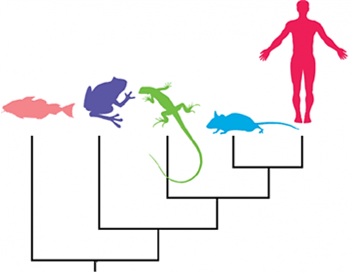
What is the human most closely related to?

1

Fish

2

mouse

3

Salamander

4

Human

86

Multiple Choice

Question image
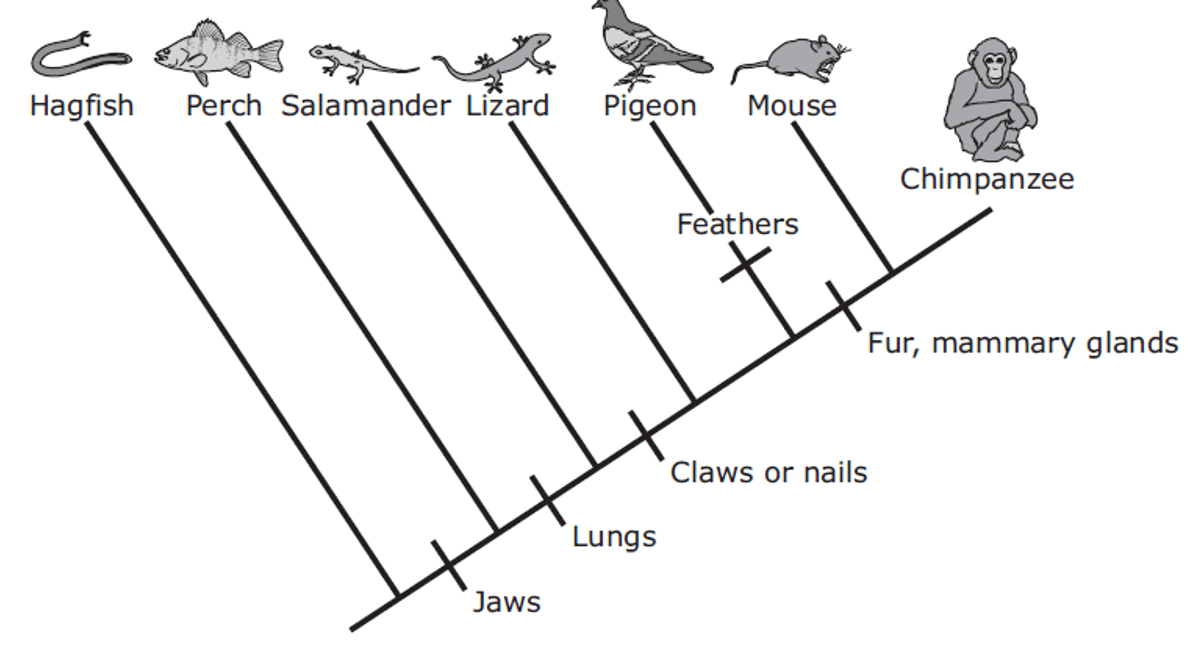
All the animals to the right of the hagfish would have the common characteristic of -
1
Fur
2
Claws or nails
3
Lungs
4
Jaws

87

Multiple Choice

Question image
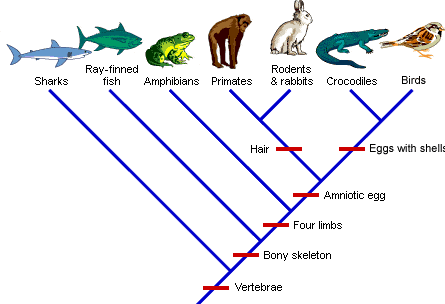
According to this cladogram, primates are most closely related to -
1
Amphibians
2
Rodents and rabbits
3
Crocodiles
4
Birds

88

Multiple Choice

Question image

Which trait should go where A is on the cladogram?

1

eyes

2

feet

3

lips

4

hat

89

Multiple Choice

A few deer wander out of their native woods into a completely new park where no deer had ever been before. They go on to create an entirely new population.
1
Genetic Drift
2
Natural Selection
3
Non-random mating
4
Mutation

90

Multiple Choice

Question image
What does the picture represent?
1
Founder Effect
2
Mutations
3
Bottleneck effect
4
Gene Flow

91

Multiple Choice

Question image
What does the image represent?
1
Founder effect
2
Bottleneck effect
3
Mutation
4
Natural Selection

92

Multiple Choice

Question image

According to the theory of natural selection, why are some individuals more likely than others to survive and reproduce?

1

Some individuals pass on to their offspring new traits they have acquired during their lifetimes.

2

Some individuals have better traits to exist in their environment than others are.

3

Some individuals do not pass on to their offspring new traits they have acquired during their lifetimes.

4

Some individuals tend to produce fewer offspring than others in the same environment.

93

Multiple Choice

Question image

The diagram shows light-and dark-colored beetles that live on a tree.


Which result is MOST LIKELY to occur to the beetle population over time due to natural selection?

1

The number of light-colored beetles will decrease.

2

The dark-colored beetles will move to a different type of tree.

3

The number of light-colored beetles in the population will increase.

4

There will be more dark-colored beetles than light-colored beetles.

94

Multiple Choice

Question image

Individuals with intermediate traits are more likely to survive and reproduce

1

stabilizing selection

2

directional selection

3

disruptive selection

95

Multiple Choice

Question image

the selection pressure favors the extreme phenotypes, dividing the population into 2 distinct groups

1

directional selection

2

stabilizing selection

3

disruptive selection

96

Multiple Choice

Question image

individuals with alleles for an extreme type are more likely to survive and reproduce

1

stabilizing selection

2

directional selection

3

disruptive selection

97

Multiple Choice

What do medications do to illnesses cause by bacteria and viruses?

1

medications, like antibiotics, can cure viral infections, but not bacterial infections

2

medications, like antibiotics, can cure bacterial infections, but not viral infections

3

medications, like antibiotics, can cure both viral and bacterial infections

4

medications, like antibiotics, can cure neither viral and bacterial infections

98

Multiple Choice

Determine which graph best depicts the situation. In a population of field mice, there are many variations of brown, ranging from a very light brown to a very dark brown. The population becomes more of a medium- brown over time, as individuals that best blend in to their surroundings are favored.

1
2
3

99

Multiple Choice

What is is the study of how and why plants and animals live where they do?

1

Evolution

2

Adaptive Radiation

3

Biogeography

4

Biogeology

100

Multiple Choice

Question image
The diagram shows fossils in different rock layers. Which of these statements about the age of these fossils is most likely correct?
1

Fossil A and C are the same age

2

Fossil B is older than fossil C

3

Fossils A is older than fossil B

4

Fossil D is older than fossil C

Evolution & Natural Selection

media

Show answer

Auto Play

Slide 1 / 100

SLIDE