
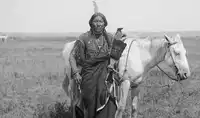
Native Peoples of Texas

Presentation
•
Geography
•
7th Grade
•
Practice Problem
•
Medium

Matthew Tharp
Used 35+ times
FREE Resource
15 Slides • 5 Questions
1
Labeling
Label the map with the following:
2
Labeling
Label the regions of Texas
3

Which Region 1 - Image quiz
You can open this webpage in a new tab.
4
Which Region 2 - Image quiz
You can open this webpage in a new tab.
5
Which Region 4 - Image quiz
You can open this webpage in a new tab.
6
Which Region 3 - Image quiz
You can open this webpage in a new tab.
7
Multiple Choice

Which region has the MOST rivers
Coastal Plains
North Central Plains
Great Plains
Mountains and Basins
8
Multiple Select

In which region(s) is the Rio Grande River
Coastal Plains
North Central Plains
Great Plains
Mountains and Basins
9
Multiple Select

In what region(s) is the Red River
Coastal Plains
North Central Plains
Great Plains
Mountains and Basins
10
Nomadic (hunter-gatherers) | Sedentary (farmers) |
|---|---|
Karankawa | Caddo |
Coahuiltecan | Jumano |
Apache | |
Comanche/Kiowa | |
| |
Native Americans of Texas
11
Nomadic Shelters
Tipis and Wigmans
Nomadic Native Americans lived in shelters that were quick and easy to put up, take down, and move to a new location as they followed animal herds.
These shelters were called tipis and wigwams (wickiups) and they were like tents.

12
Tipis and wigwams are easy to put up and take down. This makes them a perfect way to follow buffalo and other animals for food
13
Karankawa
They lived on the Gulf Coast of the Coastal Plains.
They were a hunting & gathering community.
They also fished because they lived on the Gulf
Coast.
They moved along the coast in dugout canoes,
carrying skins furs for use in camps or wickiup
shelters (temporary house).
They often decorated themselves with
elaborate tattoos, nose plugs, lip plugs,
jewelry and many feathers in their hair.

14

Coahuiltecan
●Lived in the desert land of South Texas, in the southern
part of the Coastal Plains region.
●They were a hunting and gathering community.
●Because they never stayed in one place for very long their homes were made of animal skins.
They hunted wild pigs called javelinas.

15
Apaches
Apaches
The lived in West Texas in the Great Plains AND Mountains and Basins region
They lived in tipis and wickiups (wigwams)
They lived in communities that
were nomadic during
certain times of year.They would organize large buffalo hunts that
lasted until it was time to plant crops.

16
Comanche & Kiowa
●They lived in the Great Plains
region of Texas.
●They lived in a nomadic communities
that followed buffalo herds.
●They lived in teepees.
●Both tribes were friends and allies.
●They became great horsemen after the Spanish introduced horses to North America.

17
Sedentary (farming) Shelters
Grass houses and pueblos
Sedentary Native Americans lived in permanent shelters that took ALOT of time to build.
Sedentary Native Americans lived in permanent shelters BECAUSE they were farmers.
All of their food is readily available and they did not have to constantly follow animals to hunt and eat them.

18
Houses made of adobe brick (pueblos) and grass-thatched houses were permanent structures. Perfect for keeping warm and safe in your permanent, farming settlement
19
Caddo
●Lived in East Texas in the Coastal Plains Region.
●They lived in permanent villages with homes made up of
grass huts.
●They were a farming community.
●The Caddo word “tejas” means friend or ally- this word
would become Texas.


GRASS HUTS
20

Jumano
●Pueblo tribe that lived in the Mountains and
Basins region.
●They lived in permanent homes made of adobe, called pueblos.
●They were mainly a farming community.
●Because of the dry climate they had to use a form of irrigation; dig ditches to carry water from
the Rio Grande River to their fields.
●They occasionally hunted buffalo and organized
trade with other tribes.

PUEBLOS
Label the map with the following:
Show answer
Auto Play
Slide 1 / 20
LABELING
Similar Resources on Wayground

16 questions
Slavery in Texas
Presentation
•
7th Grade
16 questions
Coordinating and Subordinating Conjunctions
Presentation
•
7th Grade
16 questions
Texas Revolution Leaders
Presentation
•
7th Grade
16 questions
Angle Relationships
Presentation
•
7th Grade
17 questions
Independent and Dependent Variables
Presentation
•
7th Grade
13 questions
The Circulatory System
Presentation
•
7th Grade
17 questions
The Road to the Texas Revolution
Presentation
•
7th Grade
17 questions
Subordinating Conjunctions
Presentation
•
7th Grade
Popular Resources on Wayground
6 questions
PRIDE Always and Everywhere
Presentation
•
12th Grade
20 questions
Lab Safety Quiz

Quiz
•
6th Grade
26 questions
KOR Review Kahoot Questions
Quiz
•
8th Grade
21 questions
Continents and Oceans
Quiz
•
6th Grade
12 questions
Unit Zero lesson 2 cafeteria
Presentation
•
9th - 12th Grade
20 questions
Parts of Speech
Quiz
•
5th Grade
10 questions
Riddles Riddles fun Riddles
Quiz
•
6th - 12th Grade
16 questions
Subject & Predicate
Quiz
•
5th Grade
Discover more resources for Geography
50 questions
U.S. 50 States Map Practice
Quiz
•
5th - 8th Grade
15 questions
AKS#34 - Monotheistic Religions of Europe and Language Families
Quiz
•
6th - 8th Grade
30 questions
42a ME Geo LT 3 Env Issues
Quiz
•
7th Grade
25 questions
50 States Quiz
Quiz
•
7th Grade
25 questions
Map Skills
Quiz
•
5th - 8th Grade
21 questions
Continents and Oceans
Quiz
•
7th Grade
10 questions
44a ethnicity and religion
Quiz
•
7th Grade
19 questions
Why People Live Where They Live (SS7G7)
Quiz
•
7th Grade