

Igneous, Metamorphic and sedimentary rocks

Presentation
•
Physics
•
8th Grade
•
Medium

Helen SMITH
Used 261+ times
FREE Resource
15 Slides • 15 Questions
1

Types of rocks & how they form.
2

Igneous rocks (from the Latin word for fire) form when hot, molten rock crystallizes and solidifies.
The rock melts deep within the Earth's crust at active plate boundaries or hot spots, and rises toward the surface.
Under the ground the molten rock is called magma - intrusive rocks are formed when magma solidifies below the surface
When the molten rock erupts it is called lava - extrusive rocks form from lava
Igneous rocks
3
As the magma or lava cools crystals form
The appearance of the rock depends on the types of minerals present in the molten rock (shown are fluorite, misolite, bismuth and quartz) and the size of the crystals
Larger crystals form when the rock cools slowly, small crystals when it cools more quickly.
Crystals


4

lava erupts at 1000 °C or more.
Since it is erupting into air (or the sea for underwater volcanoes) it cools down relatively quickly - hours to days
Therefore the minerals which crystalise as the rock cools are relatively small since they don't have time to grow bigger
For example, basalt is an extrusive rock with tiny crystals, generally only visible with a loupe (magnifying glass).
Basalt formed from underwater eruptions will generally cool quicker and have smaller crystals than basalt that cools on the ground
Extrusive rocks

5
Frothy rocks

Pumice

Scoria
violent eruptions can occur which shoot out lava filled with gases.
The lava cools quickly, while it is still in the air, and traps the gases inside, producing rocks full of holes.
Two examples of this type of rock are pumice - a pale-coloured rock which can float on water; and scoria - a darker heavier rock, which contains iron and is generally found close to the volcano crater.
6

Obsidian is a smooth, black glassy rock which forms when lava cools almost instantly.
It cools so quickly no crystals form
Very tiny air bubbles trapped in the rock can give it a coloured sheen.
Obsidian
7
Magma that doesn't make it to the surface cools very slowly underground, forming intrusive rocks, sometimes called plutonic rock (from Pluto - Roman god of the underworld)
These can be exposed when the ground surface is eroded away
Large bodies of intrusive rock are called batholiths.
Intrusive rocks can have large crystals, which are visible by eye
Intrusive rock


8

granite is a common intrusive rock made up of white, pink, grey, black and clear crystals
The 3 minerals it contains are quartz (clear to white or grey), feldspar (white or pink) and mica (black)
Granite
9
Multiple Choice

Formed by melting rock:
magma
sediments
sedimentary rock
intrusive igneous
10
Multiple Choice

Sedimentary
Metamorphic
Extrusive Igneous
Intrusive Igneous
11
Multiple Choice

Sedimentary
Metamorphic
Extrusive Igneous
Intrusive Igneous
12
Multiple Choice

sedimentary rock
metamorphic rock
intrusive igneous rock
extrusive igneous rock
13

Are rocks formed from sediments
Sediments form when weathered rock is eroded by the wind, running water, the sea or glaciers and deposited in a new location.
Sediments buried under further layers of deposition are tightly packed by compaction
Chemicals dissolved in water can seep into the sediments, crystallising and gluing them together in a process called cementation.
Many sedimentary rocks form in this way.
Sedimentary rock
14

Deposition
Compaction
& 4. Cementation
Sedimentary rock formation
15
Types of sedimentary rock


conglomerate
sandstone
siltstone and shale
Clasts move downhill due to erosion under the influence of gravity, getting smaller & smoother.
As running water slows down, larger pebbles and gravel fall out first, then sand and finally fine mud particles.
Conglomerate contains larger pebbles and cemented together with smaller grains.
Sandstone is formed from grains of sand.
Siltstone and shale from fine grains deposited from slow moving water.
16

Limestone is a sedimentary rock that is formed from deposits of the remains of sea organisms such as shellfish and corals.
Coal forms from the remains of dead plants that are covered by water before they can decay and then buried by other sediments.
The weight of the sediments above compacts the plant material
Over millions of years compacting increases the temperature of the sediment and squeezes out the water, forming coal.
Organic sediments

17

Plant and animals remains can also be deposited in sediment layers
When the organic materials are replaced by minerals, or decay leaving a void, this is called fossilisation.
Trace fossils occur when tracks and burrows are preserved
Fossils
Canowindra fish fossils

Star-shaped holes from a soft-bodied sea creature

Dinosaur trackways Winton QLD (credit: Chris Whitelaw)
18
Multiple Choice
magma
sediments
sedimentary rock
intrusive igneous
19
Multiple Choice
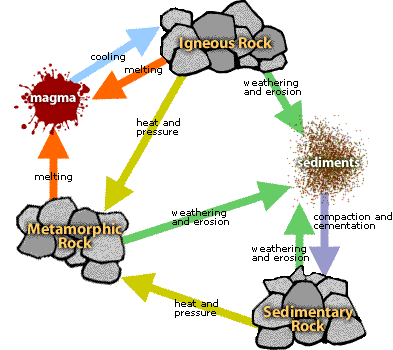
Sedimentary
Metamorphic
Extrusive Igneous
Intrusive Igneous
20
Igneous and sedimentary rocks which are buried deep below the Earth’s surface experience huge pressures from the weight of rock and sediments above them.
Temperature increases by ~25°C every kilometre below the surface, so these rocks can also experience high temperatures.
This produces changes in composition and appearance of the minerals, in a process called metamorphism and the rocks are called metamorphic rocks.
Metamorphic rock

21

Marble forms from limestone under heat and pressure.
Metamorphic rocks that are mainly the result of great pressure on the parent rock are characterised by parallel bands of different coloured minerals or flat, leaf-like layers. For example,
Slate forms from shale; because it is heavy and naturally forms a flat, smooth surface it is traditionally used in pool tables
Gneiss is formed from granite
Types of metamorphic rock


22
Multiple Choice
Scientists divide rocks into groups based on how they form. The major groups of rocks are:
sedimentary and igneous
sedimentary, igneous and metamorphic
metamorphic and sedimentary
23
Multiple Choice
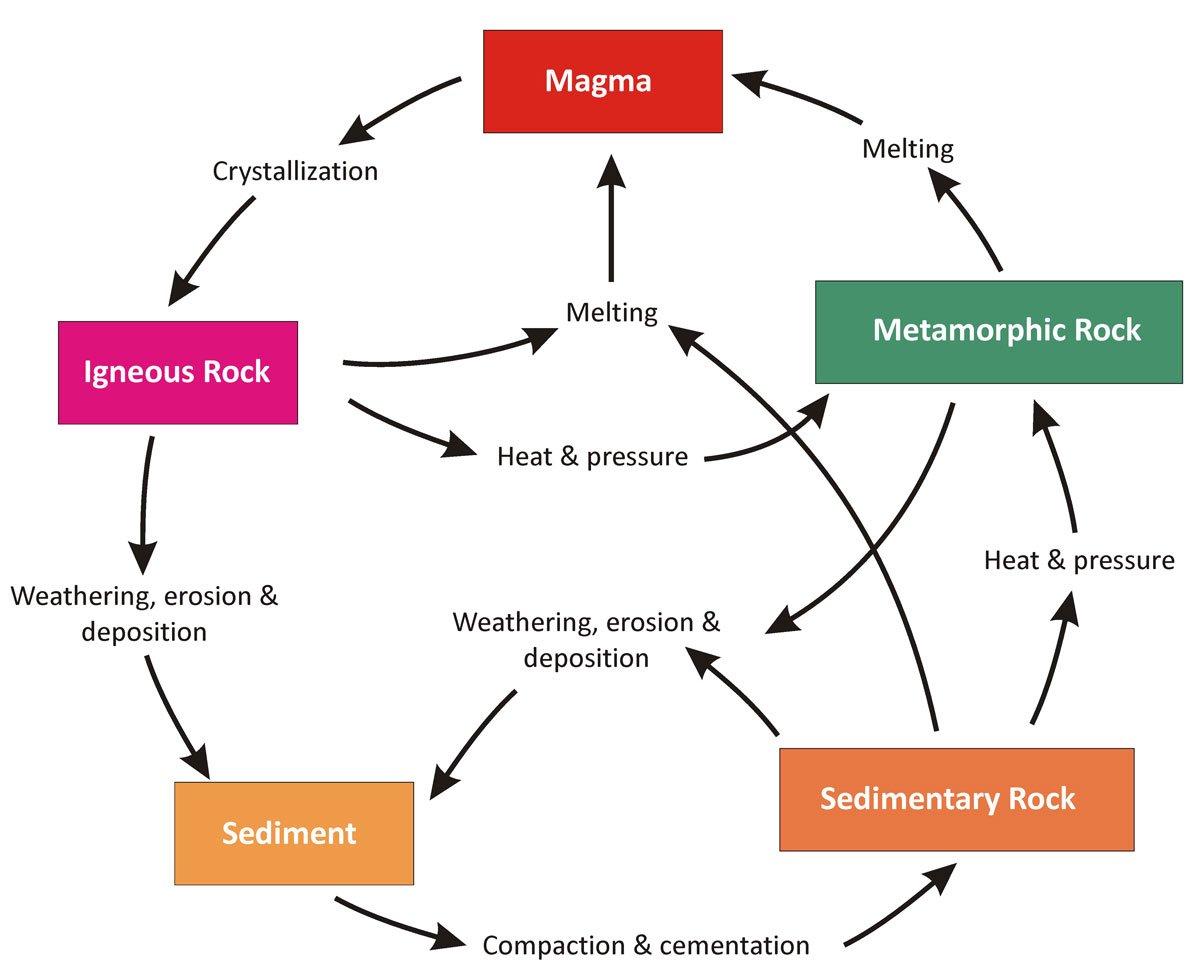
Sedimentary
Metamorphic
Extrusive Igneous
Intrusive Igneous
24
Multiple Choice

sedimentary rock
metamorphic rock
extrusive igneous rock
intrusive igneous rock
25
Multiple Choice

A fossil can be formed when
organic materials are replaced by minerals
bones are preserved in sedimentary layers
organic remains are metamorphosed by heat and pressure
lava flows over plants or animals encasing them in rock.
26
Multiple Choice

sedimentary
metamorphic
extrusive igneous
intrusive igneous
27
Multiple Choice
Metamorphic
Magma
Sedimentary
Igneous
28
Multiple Choice
Igneous rock
Sedimentary rock
Metamorphic rock
Extrusive rock
29
Dropdown

30
Labeling
The processes which form sedimentary rock are:
Types of rocks & how they form.
Show answer
Auto Play
Slide 1 / 30
SLIDE
Similar Resources on Wayground

26 questions
The Scientific Method
Presentation
•
7th - 8th Grade
22 questions
Aztec Empire Geography
Presentation
•
7th Grade
19 questions
law of superposition
Presentation
•
8th Grade
24 questions
Rock Cycle
Presentation
•
8th Grade
21 questions
The Boston Massacre
Presentation
•
8th Grade
23 questions
The Inner Planets
Presentation
•
7th - 8th Grade
21 questions
Magnetism
Presentation
•
7th - 9th Grade
Popular Resources on Wayground
6 questions
PRIDE Always and Everywhere
Presentation
•
12th Grade
20 questions
Lab Safety Quiz

Quiz
•
6th Grade
26 questions
KOR Review Kahoot Questions
Quiz
•
8th Grade
21 questions
Continents and Oceans
Quiz
•
6th Grade
12 questions
Unit Zero lesson 2 cafeteria
Presentation
•
9th - 12th Grade
20 questions
Parts of Speech
Quiz
•
5th Grade
10 questions
Riddles Riddles fun Riddles
Quiz
•
6th - 12th Grade
16 questions
Subject & Predicate
Quiz
•
5th Grade