

Ch 19

Presentation
•
Biology
•
University
•
Practice Problem
•
Easy
+1
Standards-aligned

Christina Talley
Used 9+ times
FREE Resource
30 Slides • 48 Questions
1
2
Multiple Choice
Which does NOT describe the location of the heart?
it is just posterior to the sternum and medial to lungs
rotated so left atrium and left ventricle face anteriorly
in the mediastinum
apex is slightly left of center
base points toward right shoulder
3

4
Labeling
Label the correct locations/borders of the heart:
5

6
Drag and Drop
7
Match
Match the following heart chambers to their circulation
right atrium
left atrium
right ventricle
left ventricle
receives deoxygenated blood from the body
receives oxygenated blood from the lungs
pumps deoxygenated blood into lungs
pumps oxygenated blood around the body and the heart
receives deoxygenated blood from the body
receives oxygenated blood from the lungs
pumps deoxygenated blood into lungs
pumps oxygenated blood around the body and the heart
8

9
Labeling
Label the following layers of the heart wall
10
Multiple Choice
The pericardium (pericardial sac) surronds the heart and defines the
fibrous pericardium
seroud pericardium
parietal pericardium
visceral pericardium
pericardial cavity
11
Match
Match the following sublayer with its description
fibrous pericardium
serous pericardium
parietal pericardium
visceral pericardium
pericardial fluid
tough outer layer made of dense connective tissue
delicate inner layer composed of two layers
fused to the fibrous pericardium
also known as epicardium, fused to the heart wall
fills space between parietal and visceral pericardium
tough outer layer made of dense connective tissue
delicate inner layer composed of two layers
fused to the fibrous pericardium
also known as epicardium, fused to the heart wall
fills space between parietal and visceral pericardium
12

13
Reorder
Place the heart layers in order from innermost to outermost layer
endocardium
myocardium
epicardium
14
Match
endocardium
myocardium
epicardium
consists of simple squamous epithelium and sparse areolar connective tissue
forms atria and ventricles; consists of cardiac muscle, blood vessels, and nervous tissue
exposed surface secretes pericardial fluid; covers outer surface of the heart
consists of simple squamous epithelium and sparse areolar connective tissue
forms atria and ventricles; consists of cardiac muscle, blood vessels, and nervous tissue
exposed surface secretes pericardial fluid; covers outer surface of the heart
15

16
Fill in the Blanks
Walls that divide the heart into chambers are known as
17
Multiple Choice
The atrioventricular septums are thicker than the interventricular septum due to greater pressure in the atrias.
true
false
18
Match
interatrial septum
interventricular septum
atrioventricular septum
separates the atria
separates the ventricles
between atria and ventricles
separates the atria
separates the ventricles
between atria and ventricles
19

20
Drag and Drop
21
Match
Match the following valves to their description
tricuspid
bicuspid
pulmonary
aortic
contains 3 cusps; separates right atria from right ventricle
contains 2 cusps; separates left atria from left ventricle
3 crescent cusps; separates right ventricle from pulmonary trunk
3 crescent cusps; separates left ventricle from aorta
contains 3 cusps; separates right atria from right ventricle
contains 2 cusps; separates left atria from left ventricle
3 crescent cusps; separates right ventricle from pulmonary trunk
3 crescent cusps; separates left ventricle from aorta
22

23

24
Dropdown
25
Dropdown
26

27
Match
Match the following valve disorders to their description
prolapse
regurgitation
stenosis
cusps are forced backwards by force of blood
backflow if blood
hardening/calcification of valve
cusps are forced backwards by force of blood
backflow if blood
hardening/calcification of valve
28

29
Match
Match the following parts of the coronary circuit to their descriptions
cardiomycytes
coronary arteries
coronary veins
highly active cells; require oxygen and nutirents and produce wastes
supply oxygenated blood to the myocardium; arise from aorta
drain the myocardium of deoxygenated blood and retun it to the chambers of the heart
highly active cells; require oxygen and nutirents and produce wastes
supply oxygenated blood to the myocardium; arise from aorta
drain the myocardium of deoxygenated blood and retun it to the chambers of the heart
30
Fill in the Blanks
What is one of the grooves where coronary vessels are situated?
Type answer...
31

32
Match
Match the following
RCA (right coronary artery)
marginal artery
posterior interventricular artery
supplies right atrium, portions of both ventricles, and portions of the conducting system
small; extends inferiorly from RCA
extends between ventricles on posterior side of heart
supplies right atrium, portions of both ventricles, and portions of the conducting system
small; extends inferiorly from RCA
extends between ventricles on posterior side of heart
33
Match
LCA (left coronary artery)
anterior interventricular artery
circumflex artery
supplies blood to left ventricle, left atrium and interventricular septum
extends between ventricles on anterior side of heart
wraps from anterior to posterior and ends in another marginal artery
supplies blood to left ventricle, left atrium and interventricular septum
extends between ventricles on anterior side of heart
wraps from anterior to posterior and ends in another marginal artery
34
Match
middle cardiac vein
posterior cardiac vein
great cardiac vein
small cardiac vein
coronary sinus
parallel to PIA
parallel to marginal artery (posterior)
parallel to AIA
parallel to RCA and marginal artery
all coronary veins convergee here
parallel to PIA
parallel to marginal artery (posterior)
parallel to AIA
parallel to RCA and marginal artery
all coronary veins convergee here
35

36
Multiple Select
Which of the following describes the structure of cardiac muscle fibers?
lots of mitochondria and blood vessels
shorter, branched, uninucleate
posses intercalated discs
limited repair and/or mitotic ability
cardiomyocytes are striated; have regular pattern of sarcomeres
37
Fill in the Blanks
Intercalated discs are specialized junctions that connect cells and coordinate synchronized contractions known as
38

39
Fill in the Blanks
The ability of the heart to depolarize spontaneously at a fixed rate to pace heart contractions is known as
40
Dropdown
41

42
Multiple Choice
The fastest cells of the heart set the pace.
true
false
43

44
Drag and Drop
45
Fill in the Blanks
The ___________ ___________ assures that the atria will contract at the same time.
46

47
Dropdown
48

49

50
51
Multiple Select
Which of the following are true about ECG?
it is a recording of the eletrical impulses in the heart over time
composed of ALL action potentials generated by the nodes and contractile cells at a given time
different parts of the ECG correspond to different cardiac events
also known as EKG
52

53
Match
P wave
QRS complex
T wave
depolarization of atria
depolarization of ventricles
ventricular repolarization
depolarization of atria
depolarization of ventricles
ventricular repolarization
54

55

56

57
58
Dropdown
59
Multiple Select
Which of the following are true concerning the pressure and flow during the cardiac cycle?
fluids follow pressure gradients (high to low pressure)
during diastole, blood flows passively from veins to atria and from atria to ventricles
during systole, pressure rises and blood is actively pumped
during diastole, pressure rises and blood is actively pumped
during systole, blood flows passively from veins to atria and from atria to ventricles
60

61
Dropdown
62
Multiple Select
Select the other terms for systole
contraction
depolarization
relaxation
repolarization
63
Multiple Select
Select the other terms for diastole
contraction
depolarization
relaxation
repolarization
64
Multiple Choice
After the "atrial kick" to fill the remaining area of the ventricles, what happens to the atria?
systole
diastole
contraction
ejection
65

66
Dropdown
67
Dropdown
68

69
Labeling
Label the parts of contraction and relaxation on the ECG
70
Fill in the Blanks
71
Multiple Choice
Which of the following is the best indicator of tissue perfusion?
cardiac output
stroke volume
heart rate
blood pressure
72
Drag and Drop
73
Multiple Choice
If a person has a heart rate of 110 bpm and a stroke volume of 75 mL/beat. What would the patient's cardiac output be?
35 mL/min
8,250 mL/min
825 mL/min
3,500 mL/min
74
Fill in the Blanks
75

76
Match
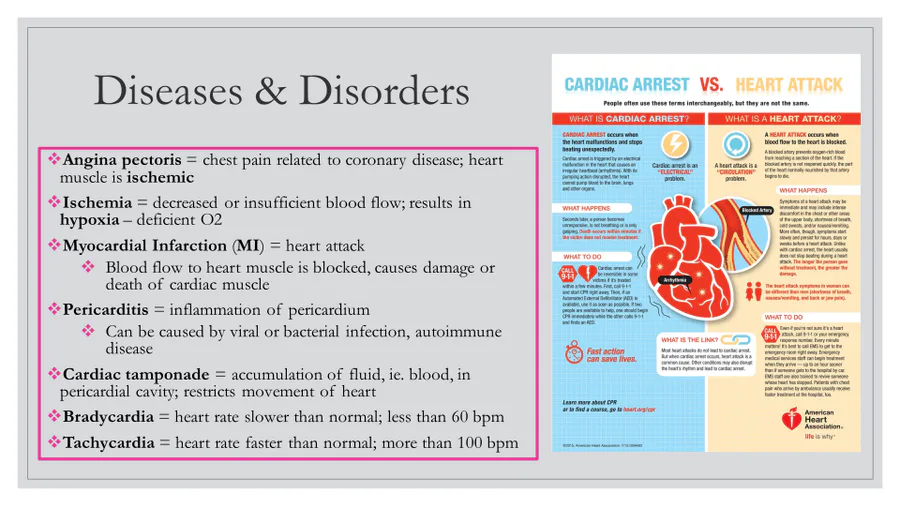
angina pectoris
ischemia
hypoxia
chest pain related to coronary disease
decreased or insufficient blood flow
defecient oxygen
chest pain related to coronary disease
decreased or insufficient blood flow
defecient oxygen
77
Match
Myocardial infarction
Pericarditis
cardiac tamponade
bradycardia
tachycardia
heart attack; blood flow to heart muscle is blocked, causes damage or death to muscle
inflammation of pericardium; caused by viral or bacterial infection, or autoimmune disease
accumulation of fluid in pericardial cavity that restricts movement to the heart
heart rate is slower than normal
heart rate is faster than normal
heart attack; blood flow to heart muscle is blocked, causes damage or death to muscle
inflammation of pericardium; caused by viral or bacterial infection, or autoimmune disease
accumulation of fluid in pericardial cavity that restricts movement to the heart
heart rate is slower than normal
heart rate is faster than normal
78
Show answer
Auto Play
Slide 1 / 78
SLIDE
Similar Resources on Wayground

73 questions
week 1
Presentation
•
KG - University
73 questions
HMFSO Module 1
Presentation
•
University
74 questions
Electrons
Presentation
•
University
74 questions
Sentences and Their Structures
Presentation
•
University
74 questions
Heart/ Diseases
Presentation
•
KG - University
74 questions
Untitled Presentation
Presentation
•
University
70 questions
Unit 4 level 3
Presentation
•
University
74 questions
CEFR Beginner
Presentation
•
University
Popular Resources on Wayground
10 questions
Safety Day 2026 – Student Review

Quiz
•
9th Grade
21 questions
Continents and Oceans
Quiz
•
6th Grade
20 questions
Parts of Speech
Quiz
•
5th Grade
16 questions
Subject & Predicate
Quiz
•
5th Grade
25 questions
Multiplication Facts
Quiz
•
5th Grade
12 questions
Map Skills
Quiz
•
3rd Grade
22 questions
Continents and Oceans
Quiz
•
5th Grade
15 questions
Rounding Decimals
Quiz
•
5th Grade