

BIO 102 Chapter 17

Presentation
•
Biology
•
University
•
Medium

SN Goebel
Used 6+ times
FREE Resource
27 Slides • 28 Questions
1
Multiple Choice
Which of the following statements about species, as defined by the biological species concept, is (are) correct?
Biological species are defined by reproductive isolation.
Biological species are the model used for grouping extinct forms of life.
The biological species is the largest unit of population in which successful reproduction is possible.
2
Biological species are defined by reproductive isolation
Biological species concept outlines the species that can interbreed with the members of the same species only.
They are "reproductively isolated", because the biological species lack interbreeding.
The fossils as well as species, which reproduce asexually, are not considered as biological species.
3
Multiple Choice
What is generally true of two sibling species?
They shared a common ancestor recently in evolutionary time.
Genes are unable to pass from one sibling species' gene pool to the other's.
They are unable to produce hybrid offspring upon interbreeding.
Their reproductive isolation from each other is complete.
4
They shared a common ancestor in evolutionary time.
Two sibling species generally share a common ancestor in evolutionary time.
This means that they have diverged from a common ancestral population relatively recently.
As a result, they are more closely related to each other compared to other species.
5
The shared ancestry is reflected in their genetic makeup, as they still retain many similar genes and genetic traits.
Over time, these sibling species have undergone separate evolutionary paths and accumulated genetic differences that distinguish them from each other.
Despite these differences, there is still some degree of genetic similarity between the two sibling species due to their recent common ancestry.
6
Multiple Choice
Which of the various species concepts identifies species based on the degree of genetic exchange between their gene pools?
phylogenetic
ecological
biological
morphological
7
The biological species concept identifies species based on the degree of genetic exchange between their gene pools.
A species is defined as a group of organisms that can interbreed and produce fertile offspring in nature.
If two populations cannot interbreed or if they do not produce viable and fertile offspring, they are considered to be separate species.
This concept focuses on reproductive isolation as the key factor in defining species boundaries.
8
Multiple Select
For which two species concepts are anatomical features the primary criterion for determining species identities? CHOOSE TWO ANSWERS!
biological
ecological
morphological
phylogenetic
paleontological
9
Multiple Choice
A biologist discovers two populations of wolf spiders whose members appear identical. Members of one population are found in the leaf litter deep within a woods. Members of the other population are found in the grass at the edge of the woods. The biologist decides to designate the members of the two populations as two separate species. Which species concept is this biologist most closely utilizing?
ecological
biological
morphological
phylogenetic
10
The biologist is using the ecological species concept, which defines species based on their ecological roles and habitats.
The biologist is designating the two populations as separate species based on their different habitats within the woods (leaf litter vs grass at the edge).
This concept focuses on how organisms interact with their environment and occupy different niches.
11
Multiple Choice
Which of the following must occur during a period of geographic isolation in order for two sibling species to remain genetically distinct following their geographic reunion in the same home range?
prezygotic barriers
postzygotic barriers
ecological isolation
reproductive isolation
12
Reproductive isolation is defined as the situation in which two different species live in the same area, but characteristics of individuals prevent them from interbreeding

13
Reproductive isolation is preventing gene flow between two species for a new species to evolve from an existing and sexually reproducing species.

14


geographic Isolation
behavioral isolation
temporal isolation
15
Multiple Choice
Use the options below to answer the following questions. For each description of reproductive isolation, select the option that best describes it. Options may be used once, more than once, or not at all.
Two species of orchids with different floral anatomy
gametic
temporal
behavioral
habitat
mechanical
16
Multiple Choice
Use the options below to answer the following questions. For each description of reproductive isolation, select the option that best describes it. Options may be used once, more than once, or not at all.
Two species of trout that breed in different seasons
gametic
temporal
behavioral
habitat
mechanical
17
Multiple Choice
Use the options below to answer the following questions. For each description of reproductive isolation, select the option that best describes it. Options may be used once, more than once, or not at all.
Two species of meadowlarks with different mating songs
gametic
temporal
behavioral
habitat
mechanical
18
Multiple Choice
Several closely related frog species of the genus Rana can be found in the forests of the southeastern United States. The species boundaries are maintained by reproductive barriers. In each case, match the various descriptions of frogs below with the appropriate reproductive barrier listed.
Males of one species sing only during rainy conditions; males of another species sing only when it is not raining.
behavioral
gametic
habitat
temporal
mechanical
19
One species sings only during rainy conditions, while the other species sings only when it is not raining.
This difference in behavior suggests that these two species have adapted to different environmental conditions.
20
The first species may rely on rain for various reasons such as finding food or attracting mates, which is why they sing specifically during rainy conditions.
On the other hand, the second species may have evolved to take advantage of non-rainy conditions for their survival or reproductive success.
By observing and understanding these distinct behaviors, scientists can gain insights into how different organisms adapt and respond to their environment.
21
Multiple Choice
Several closely related frog species of the genus Rana can be found in the forests of the southeastern United States. The species boundaries are maintained by reproductive barriers. In each case, match the various descriptions of frogs below with the appropriate reproductive barrier listed. One species lives only in tree holes; another species lives only in streams
behavioral
gametic
habitat
temporal
mechanical
22
Multiple Choice
Two species of frogs belonging to the same genus occasionally mate, but the offspring do not complete development. What is the mechanism for keeping the two frog species separate?
the postzygotic barrier called hybrid inviability
the postzygotic barrier called hybrid breakdown
the prezygotic barrier called hybrid sterility
gametic isolation
23
In this scenario, the two frog species belonging to the same genus occasionally mate but their offspring do not complete development.
This indicates that there is a postzygotic barrier preventing successful reproduction between these species.

24
Postzygotic barriers occur after fertilization and can result in reduced viability or fertility of hybrid offspring.
The mechanism for keeping the two frog species separate is known as hybrid inviability, where the hybrids fail to develop properly and cannot survive to reproductive age.
25
Multiple Choice
Theoretically, the production of sterile mules by interbreeding between female horses and male donkeys should
result in the extinction of one of the two parental species.
cause convergent evolution.
reinforce postzygotic barriers between horses and donkeys
weaken the intrinsic reproductive barriers between horses and donkeys
26
Multiple Choice
The biological species concept is inadequate for grouping
plants.
parasites.
asexual organisms.
animals that migrate.
27
The biological species concept is a way of defining a species based on reproductive compatibility.
According to this concept, individuals belong to the same species if they can interbreed and produce fertile offspring.
However, this concept may not be adequate for grouping animals that migrate.
Migratory animals often travel long distances and may encounter individuals from different populations or even different species during their migration.
28
This can make it difficult to determine reproductive compatibility and apply the biological species concept accurately.
Migratory animals may have different behaviors, adaptations, or genetic variations depending on their migratory patterns.
These differences can further complicate the application of the biological species concept because individuals within a migratory population may exhibit variations that are not present in sedentary populations.
Due to these complexities and challenges associated with migration, the biological species concept is considered inadequate for grouping animals that migrate.
29
Multiple Choice
Which example below will most likely guarantee that two closely related species will remain distinct biological species?
colonization of new habitats
convergent evolution
reproductive isolation from one another
geographic isolation from one another
30
Reproductive isolation refers to the inability of individuals from two different species to produce viable offspring together.
This can occur due to various factors such as differences in mating behaviors, physical incompatibilities, or genetic differences that prevent successful fertilization or development of offspring.
When two closely related species are geographically isolated from each other, they are physically separated and unable to interbreed.
Over time, this geographic isolation can lead to the accumulation of genetic differences between the populations of each species.
31
These genetic differences can eventually become so significant that even if the populations come into contact again, they will not be able to successfully reproduce with each other.
Geographic isolation is a mechanism that helps maintain distinct biological species by preventing gene flow between them and allowing for the accumulation of unique genetic traits in each population over time.
32
Multiple Choice
A defining characteristic of allopatric speciation is
the appearance of new species in the midst of old ones.
asexually reproducing populations.
geographic isolation.
artificial selection.
33
Allopatric speciation will only occur if there is a geographical barrier. This barrier will result in two distinct species that will not be able to interbreed

34
Multiple Select
The Hawaiian islands are a great showcase of evolution because of intense...
ecological isolation and sympatric speciation.
adaptive radiation and allopatric speciation.
allopolyploidy and sympatric speciation
cross-specific mating and reinforcement.
35
Ecological isolation refers to the separation of populations due to differences in their habitats or ecological niches.
This can lead to the development of new species as each population adapts to its specific environment.

36
Sympatric speciation, on the other hand, occurs when new species evolve from a single ancestral species while inhabiting the same geographic area.
This can happen through various mechanisms such as polyploidy (having multiple sets of chromosomes), genetic mutations, or changes in behavior or mating preferences.

37
Use this scenario to solve the next two problems:
A female fly, full of fertilized eggs, is swept by high winds to an island far out to sea.
She is the first fly to arrive on this island, and the only fly to arrive in this way.
Thousands of years later, her numerous offspring occupy the island, but none of them resemble her.
There are, instead, several species each of which eats only certain type of food.
None of the species can fly, for their flight wings are absent, and their balancing organs (i.e., the halteres) are now used in courtship displays.
The male members of each species bear modified halteres that are unique in appearance to their species.
Females bear vestigial halteres. The ranges of all of the daughter species overlap.
38
Multiple Choice
If these fly species lost the ability to fly independently of each other (the result of separate mutation events in each lineage), then the flightless condition in these species could be an example of
adaptive radiation.
species selection.
sexual selection.
allometric growth.
39
Multiple Choice
If the foods preferred by each species are found on different parts of the island, and if the flies mate and lay eggs on their food sources, regardless of the location of the food sources, then the speciation events involving these fly species may have been driven, at least in part, by which of the following?
autopolyploidy
allopolyploidy
species selection
habitat differentiation
40
Multiple Choice
Speciation
occurs at such a slow pace that no one has ever observed the emergence of new species.
occurs only by the accumulation of genetic change over vast expanses of time.
must begin with the geographic isolation of a small, frontier population.
proceeds at a uniform tempo across all taxa.
41
Multiple Choice
The accuracy of cladograms depends on the correct choice of
type of organisms.
structural characteristics.
functional characteristics.
behavioral characteristics
42
Cladograms are diagrams that show the evolutionary relationships between organisms based on their shared characteristics.
The accuracy of cladograms depends on the correct choice of characteristics to include in the analysis.

43
Structural characteristics refer to physical features such as anatomical structures or morphological traits that can be observed and compared across different organisms.
44
Multiple Choice
When individuals at only one end of a bell-shaped curve of phenotype frequencies have high fitness, the result is
directional selection.
stabilizing selection.
disruptive selection
genetic drift.
45

46
Multiple Choice

Genetic drift tends to occur in populations that
are very large.
are small.
are formed from new species
have unchanging allele frequencies.
47
Multiple Choice
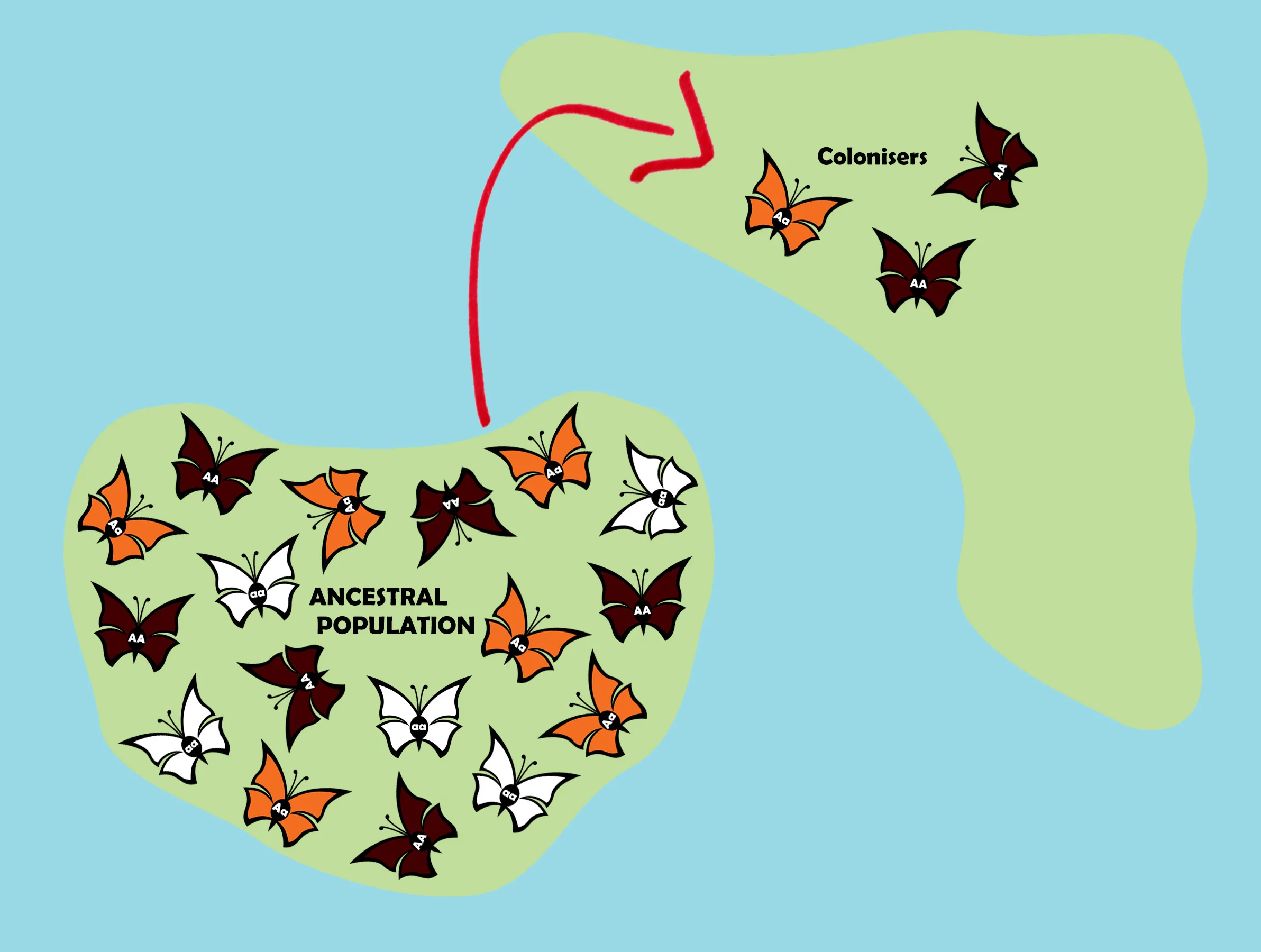
The type of genetic drift that follows the colonization of a new habitat by a small group of individuals is called
the Hardy-Weinberg principle.
the founder effect.
directional selection
stabilizing selection.
48
Multiple Choice
The genetic equilibrium of a population can be disturbed by each of the following EXCEPT
nonrandom mating.
movement into and out of the population.
a large population size.
mutations.
49
The genetic equilibrium of a population of species is achieved when the allelic or genome frequency does not change with time.
The genetic equilibrium can be disturbed by a number of factors but not by a large population size, which is one of the conditions for Hardy-Weinberg equilibrium.
50
Multiple Choice
The allele frequencies of a population are more likely to remain unchanged if
the population size is reduced.
frequent movement into and out of the population occurs.
all mating is random.
the mutation rate increases.
51
Random mating ensures that the distribution and propagation of alleles in a population are governed by the laws of probability.
52
Multiple Choice
What situation might develop in a population having some plants whose flowers open at midday and other plants whose flowers open late in the day?
behavioral isolation
geographic isolation
temporal isolation
genetic drift
53
Temporal isolation is the isolation in which two species never come into contact with each other because of having different breeding times, whether at a certain time of day or a certain time of year.
For example, the fowler's toad and the american toad, both are found in same geographical range-Canada to the Eastern US but their mating seasons do not overlap, so these two species never get the chance to mate because the american toad mates in the early summer while the fowler's toad has its mating season in late summer.
54
Multiple Choice
The Galápagos finch species are an excellent example of
speciation.
genetic equilibrium.
stabilizing selection.
selection on single-gene traits.
55
In 1859, Charles Darwin set a theory on Evolution by "Natural Selection" as an explanation of adaptation and speciation.
His concept was simple he states that individual best adapted to their environments are more likely to survive and reproduce.
Which of the following statements about species, as defined by the biological species concept, is (are) correct?
Biological species are defined by reproductive isolation.
Biological species are the model used for grouping extinct forms of life.
The biological species is the largest unit of population in which successful reproduction is possible.
Show answer
Auto Play
Slide 1 / 55
MULTIPLE CHOICE
Similar Resources on Wayground

49 questions
BIO111 Chp 16 Gene Expression
Presentation
•
University
48 questions
Ch 15 part 2
Presentation
•
University
50 questions
Gallbladder
Presentation
•
University
50 questions
Histology of the Respiratory System
Presentation
•
University
52 questions
BIO110 Chapter 2
Presentation
•
University
52 questions
Chapter 9 Notes - Muscles Intro
Presentation
•
University
52 questions
SPANISH EXPLORATION LESSON AND ASSIGNMENT
Presentation
•
KG - University
51 questions
L21 Inflation and the Federal Reserve
Presentation
•
University
Popular Resources on Wayground
20 questions
"What is the question asking??" Grades 3-5

Quiz
•
1st - 5th Grade
20 questions
“What is the question asking??” Grades 6-8
Quiz
•
6th - 8th Grade
10 questions
Fire Safety Quiz
Quiz
•
12th Grade
20 questions
Equivalent Fractions
Quiz
•
3rd Grade
34 questions
STAAR Review 6th - 8th grade Reading Part 1
Quiz
•
6th - 8th Grade
20 questions
“What is the question asking??” English I-II
Quiz
•
9th - 12th Grade
20 questions
Main Idea and Details
Quiz
•
5th Grade
47 questions
8th Grade Reading STAAR Ultimate Review!
Quiz
•
8th Grade