
Present and Perfect Participles

Presentation
•
English
•
University
•
Practice Problem
•
Easy

NINI CORREAL
Used 7+ times
FREE Resource
7 Slides • 6 Questions
1
AND
PERFECT PARTICIPLES
2
Definition
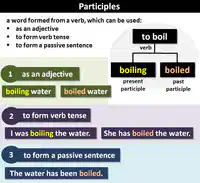
A present participle is a verb form that ends in -ing. It can be used as an adjective, a noun, or to form the continuous verb tenses.
3
As an adjective, the present participle can be used to describe a noun or pronoun. For example, "The walking man was tired."
As a noun, the present participle can be used to form a gerund. A gerund is a verb that functions as a noun. For example, "I enjoy swimming."
Usage
The present participle is formed by adding -ing to the base form of the verb. For example, the present participle of the verb "walk" is "walking."
Structure
4
Walking
Talking
Eating
Sleeping
Running
Swimming
Jumping
Falling
Crying
Laughing
5
Multiple Choice
Which participle verb correctly completes the sentence:
"The children were ____ in the park."
playing
played
having played
to play
6
Multiple Choice
Which participle verb correctly completes the sentence:
"The painting was ____ by the artist."
painted
to paint
7
Fill in the Blanks
Which participle verb correctly completes the sentence:
"I am
8
Definition
A perfect participle is a verb form that is used to indicate that an action was completed before another action began. It is formed by adding the present participle "having" to the past participle of the verb.
9
Perfect participles are most commonly used to modify nouns or pronouns. They can also be used to form the passive voice.
To modify a noun or pronoun, the perfect participle is placed after the noun or pronoun that it is modifying.
To form the passive voice, the perfect participle is placed after the verb "to be."
Usage
The perfect participle is formed by adding the following two parts together:
The present participle "having": This is the word "having" that is used to form the present perfect tense.
The past participle of the verb: This is the form of the verb that is used to form the past tense or the past participle.
Structure
10
Having finished his homework, he went to bed.
The woman having been robbed was very upset.
The car having been stolen, the police were called.
I am tired after having walked all day.
The food having been cooked, we sat down to eat.
11
Multiple Choice
Which perfect participle verb correctly completes the sentence:
"The woman ____ to the store was tired."
having walked
walked
12
Multiple Choice
Which perfect participle verb correctly completes the sentence:
"The car ____ by the thief was found abandoned."
stolen
having stolen
13
Fill in the Blanks
Which perfect participle verb correctly completes the sentence:
"The car
AND
PERFECT PARTICIPLES
Show answer
Auto Play
Slide 1 / 13
SLIDE
Similar Resources on Wayground

13 questions
Narrative Text
Presentation
•
University
9 questions
Glossary
Presentation
•
University
10 questions
Comparatives and superlatives INT3
Presentation
•
University
11 questions
main idea and supporting details
Presentation
•
University
10 questions
SENTENCE STRUCTURE LESSON 1
Presentation
•
University
9 questions
Guess the Celebrity!
Presentation
•
University
9 questions
first day
Presentation
•
University
9 questions
How important is communication in medical practice?
Presentation
•
University
Popular Resources on Wayground
10 questions
Safety Day 2026 – Student Review

Quiz
•
9th Grade
21 questions
Continents and Oceans
Quiz
•
6th Grade
20 questions
Parts of Speech
Quiz
•
5th Grade
16 questions
Subject & Predicate
Quiz
•
5th Grade
25 questions
Multiplication Facts
Quiz
•
5th Grade
12 questions
Map Skills
Quiz
•
3rd Grade
22 questions
Continents and Oceans
Quiz
•
5th Grade
15 questions
Rounding Decimals
Quiz
•
5th Grade
Discover more resources for English
20 questions
Disney Trivia
Quiz
•
University
10 questions
Spanish Greetings and Goodbyes!
Presentation
•
6th Grade - University
20 questions
Physical or Chemical Change/Phases
Quiz
•
8th Grade - University
39 questions
Unit 7 Key Terms
Quiz
•
11th Grade - University
25 questions
SER and Subject Pronouns
Quiz
•
8th Grade - University
38 questions
Unit 6 Key Terms
Quiz
•
11th Grade - University
19 questions
Key Concepts in Buddhism
Quiz
•
University
0 questions
Cell Domain Basic Review (Biology)
Quiz
•
University