

Connective Tissue

Presentation
•
Biology
•
12th Grade
•
Medium

Sharee Thomas
Used 11+ times
FREE Resource
36 Slides • 11 Questions
1

REVIEW OF EPITHLIIAL TISSUE
2

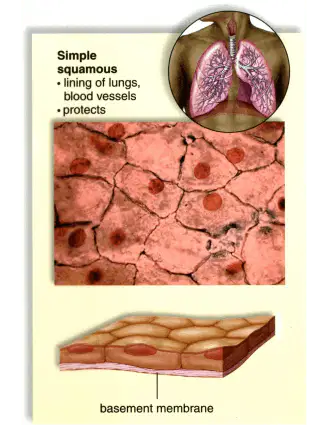
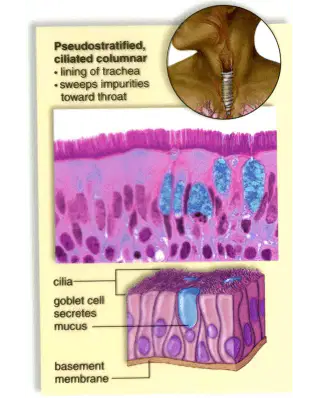
3

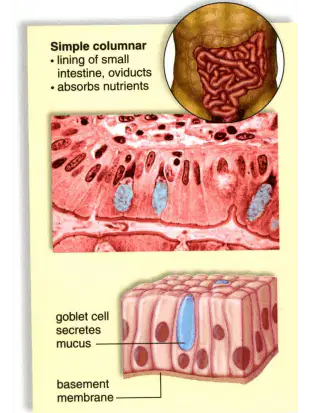
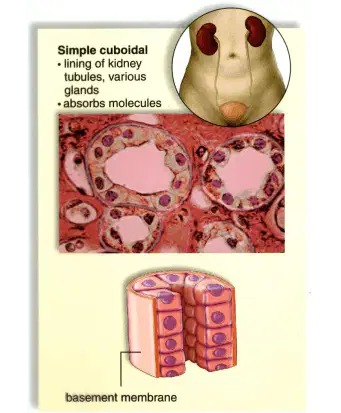
4

5
6

BELL Work 9/14
1) Take out your laptop
2) Take out your Packet
3) Note Cards will be due on Monday. ( posted on (Class Board)
4) Last call for Flipgrids
5) Log onto PPT.
Learning Objectives
By the end of this section, you will be able to:
1) Identify the four main tissue types Discuss the functions of
each tissue type
2)Relate the structure of each tissue type to their function
3)Discuss the embryonic origin of tissue
4) Identify the three major germ layers
5) Identify the main types of tissue membrane
7
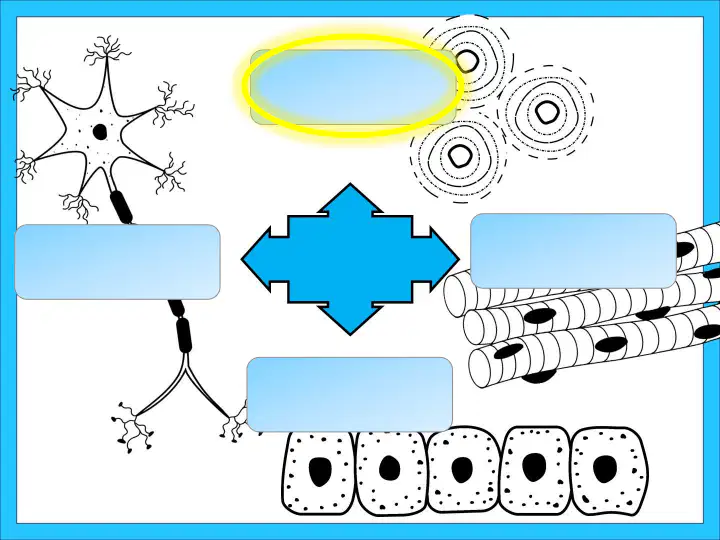
4 Types
of
Tissues
Connective
Tissue
Nervous
Tissue
Epithelial
Tissue
Muscle
Tissue
8
9
• Connective tissues provide support
and bind other tissues together.
• They can provide insulation and
protection for other tissues.
• Some are able to transport
substances.
• Most abundant tissue in your body.
10
• All connective tissues are formed
from one type of stem cell
(mesenchyme-embryonic origin).
• Connective tissues vary in their
degree of vascularity (presence of
blood vessels).
• All connective tissues are mostly
composed of extracellular matrix.
11

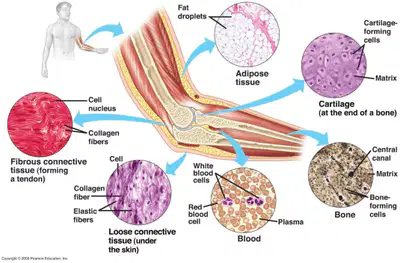
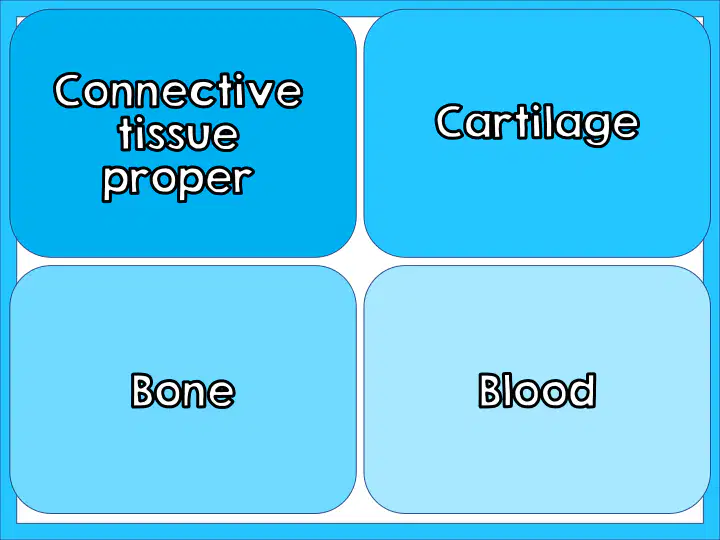
Categories of Connective Tissue
12
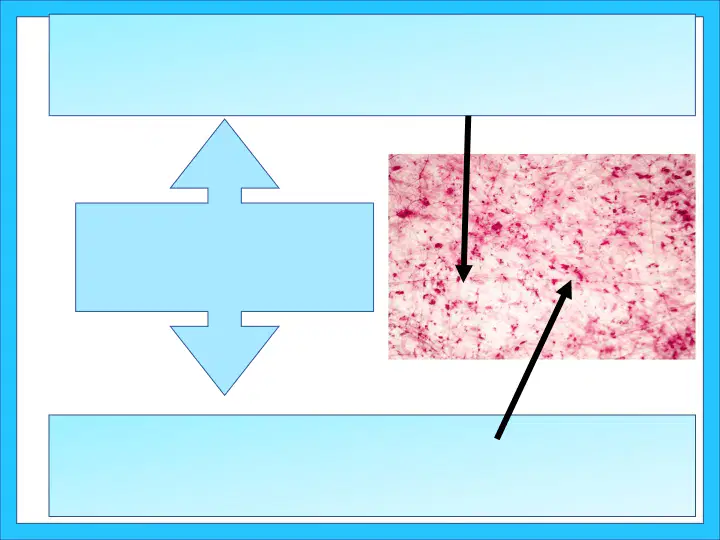
Extracellular
matrix
Ground
substance:
Watery or gel-like
substance secreted by
cells
Fibers or
Threads:
Collagen, elastic or
reticular
13

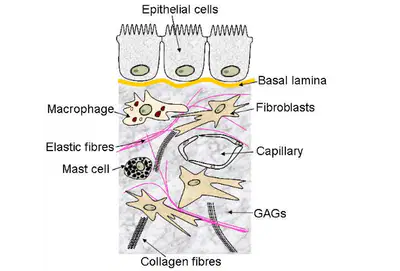
Ground substance
Basement Membrane
The MATRIX
Assignment: Color the
Matrix
14
Multiple Choice
Bone
Cartilage
Skin
Blood
15
Multiple Choice
Extracellular matrix
Fibers
Cells
Basement membrane
16
Multiple Choice
Connective tissues are composed of scattered cells within the _____.
intracellular space
matrix
epithelium
the open lumen
17

Loose
Connective
Tissue
• Areolar
• Adipose
• Reticular
Dense
Connective
Tissue
• Regular
• Irregular
• Elastic
18
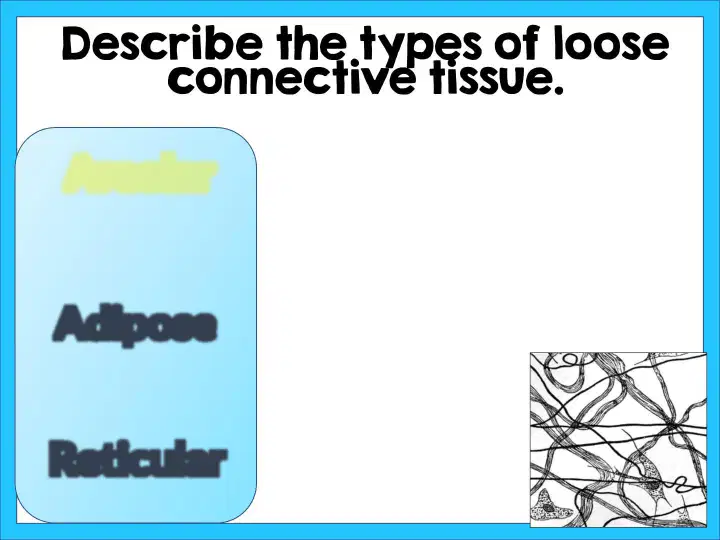
Areolar
Adipose
Reticular
• Mostly open space
• Holds water and salts
for surrounding tissues
• Found under
epithelium and around
organs
19

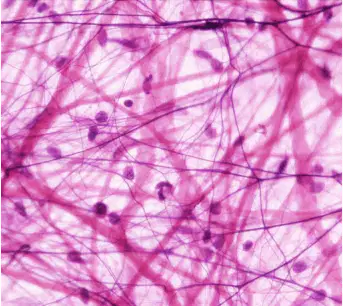
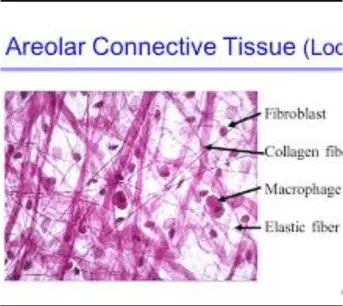
A. Loose Connective Tissue or
Areolar Tissue
20
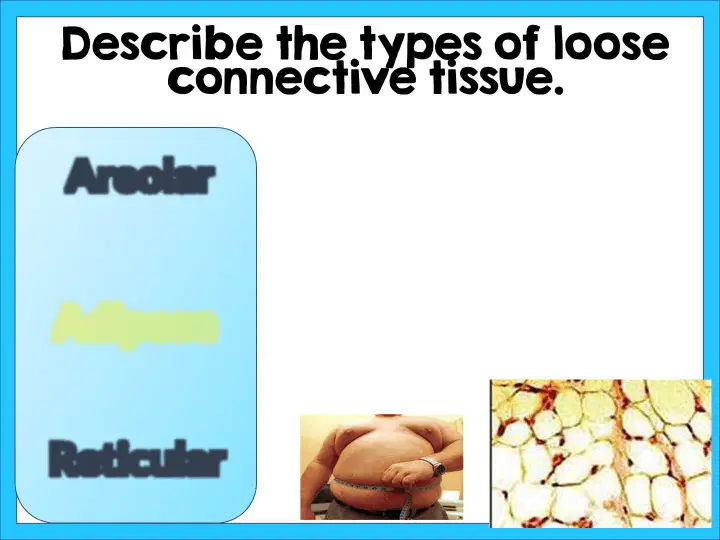
Adipose
Reticular
•
Comprised of fat cells
(adipocytes)
•
Have large vacuoles that
contain fat/oil
•
Insulates and warms the
body
•
Provides nutrients to
other cells
Areolar
21
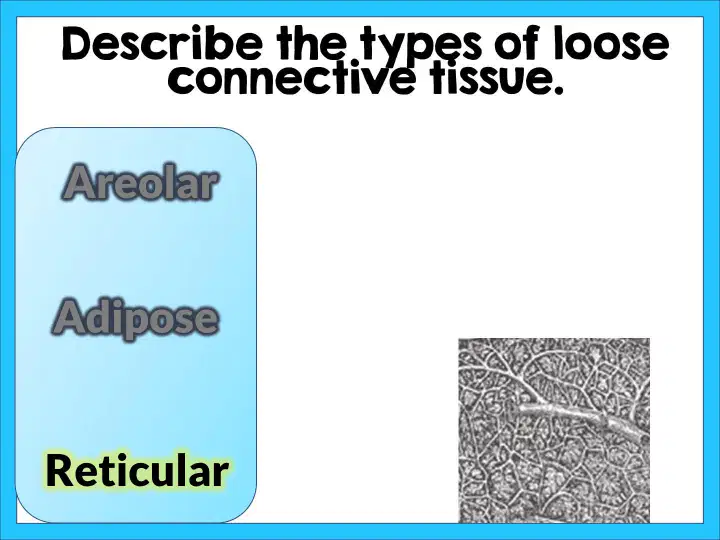
• Contains reticular
fibers, which create a
stiff framework that
support other cells
22
Regular
Irregular
Elastic
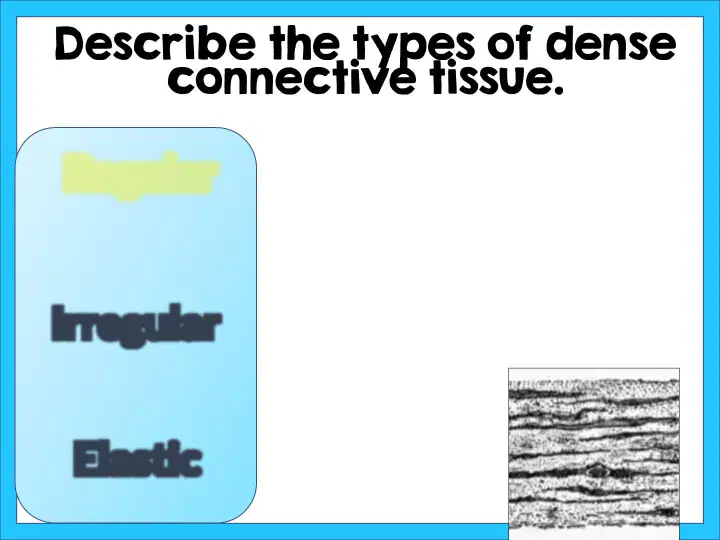
• Collagen fibers are
arranged in one
direction
• Provides “tensile
strength” like a rope
• Found in tendons &
ligaments
23
Irregular
Elastic
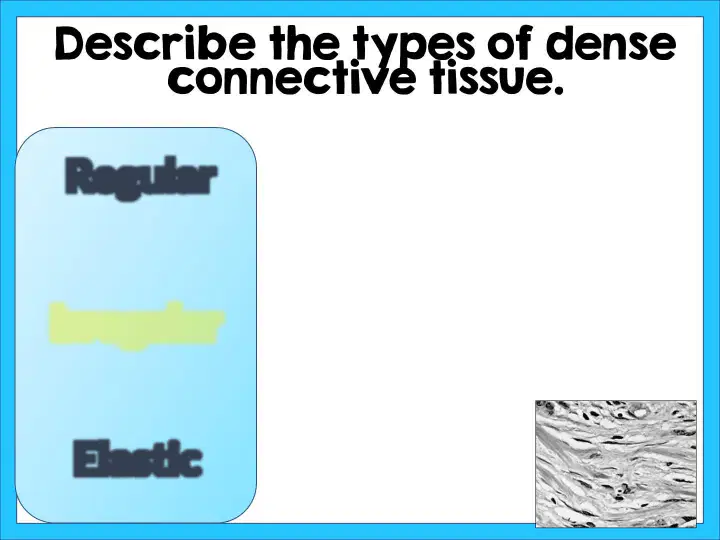
• Collagen fibers are
arranged in many
directions
• Provides strength in
multiple directions
• Found in capsules
around organs
Regular
24
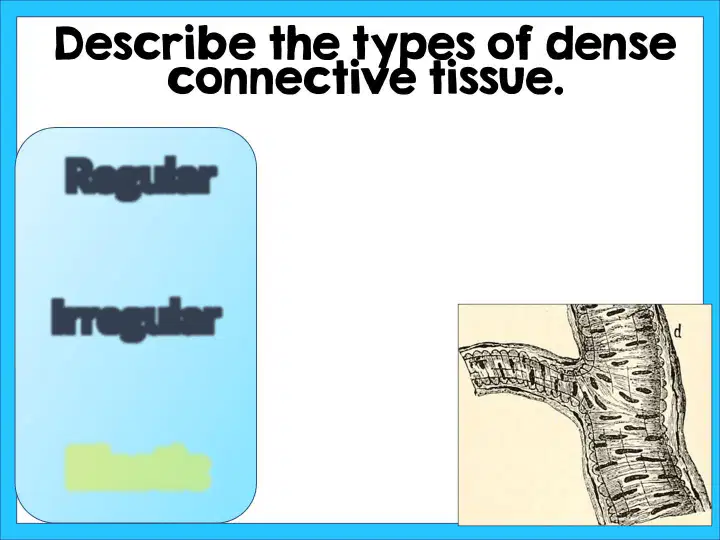
Elastic
• Provides flexible
cushioning
• Found between
vertebrae and in
arteries
Regular
Irregular
25
Multiple Choice
Bone
Cartilage
Blood
Adipose
26
Multiple Choice

Hyaline cartilage
Dense irregular tissue
Areolar tissue
Fibrocartilage
27
Multiple Choice
Which type of connective tissue makes up the dermis of the skin?
Stratified squamous
Loose connective
Adipose
Bone
28
Multiple Choice
Which tissue is loosely woven and absorbs fluids?
Reticular
Areolar
Adipose
Cartilage
29
Multiple Choice

Transitional epithelium
Cartilage
Dense Fibrous
Areolar
30
Multiple Choice
The tissue that protects, supports, and binds together other body tissue
Tissue that is the lining, covering, and glandular tissue of the body
Tissue that contracts and shortens to produce movement
31
Multiple Choice
Poor blood supply
Good blood supply
32
Multiple Choice
Loose connective
Dense connective
Cartilage
Bone
33

•Connective tissue is used to support
and bind other tissues. It is made of
cells surrounded by an extracellular
matrix. The matrix is made of fibers
that are loosely or densely
arranged.
34
35
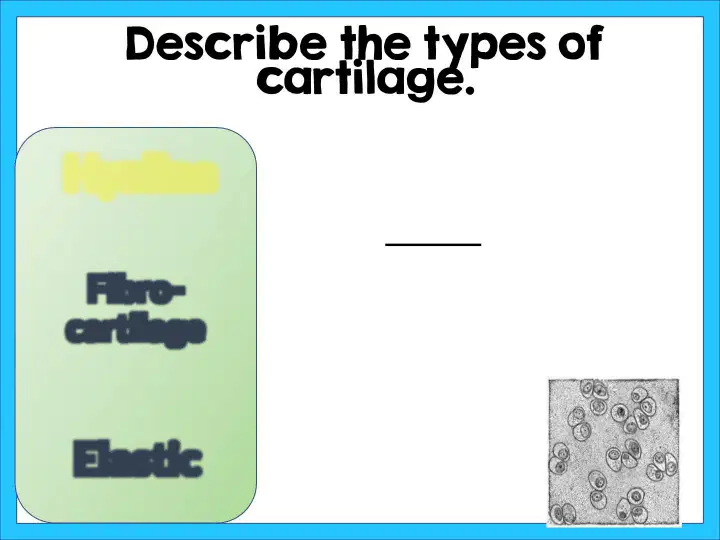
Hyaline
Fibro
-
cartilage
Elastic
•
Glassy looking
•
Firm ground substance
with lacuna (spaces for
cells)
•
Few collagen fibers
•
Found in larynx, bridge of
nose, and ribs
36

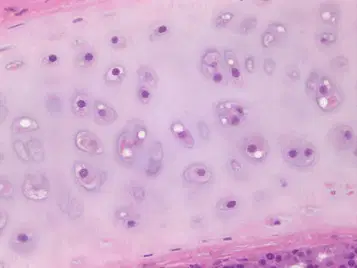
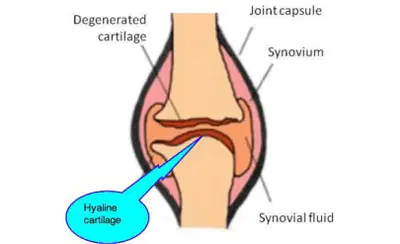
Hyaline Cartilage
Location: covers ends of joints, nose and respiratory
passages, serves as padding
37
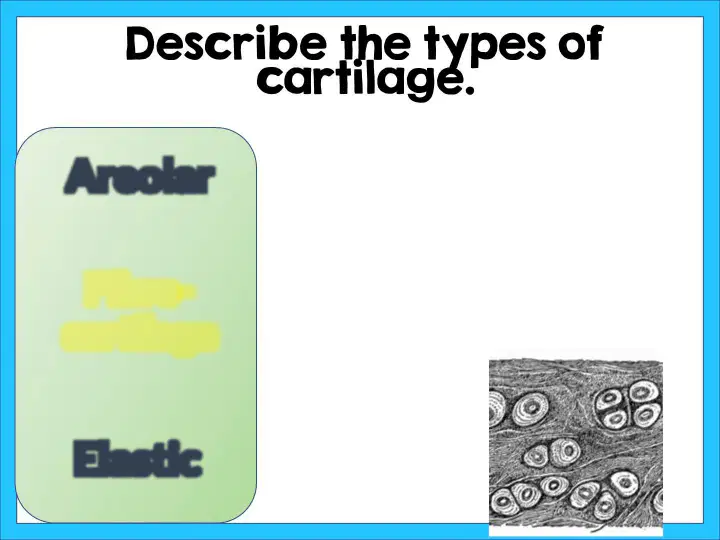
Fibro
-
cartilage
Elastic
• Contains lots of
collagen, mostly
running parallel.
• Found in intervertebral
spaces
Areolar
38
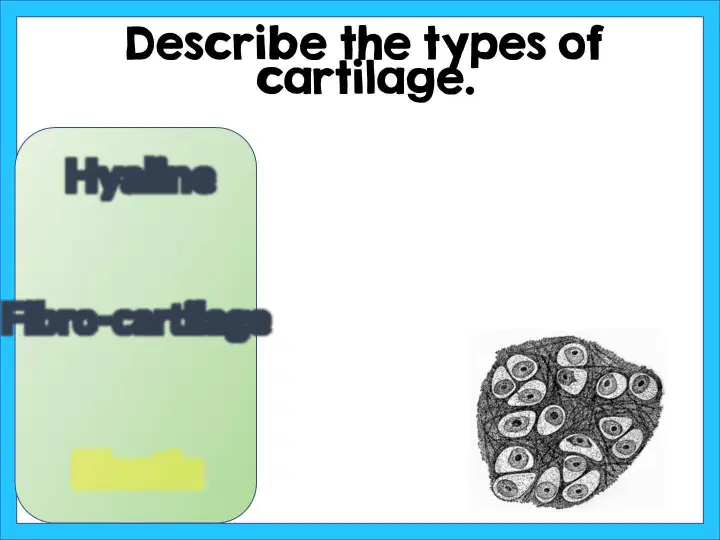
Elastic
• Highly flexible
• More elastic fibers
• Found in outer ear and
tip of nose
Hyaline
Fibro
-
cartilage
39
40
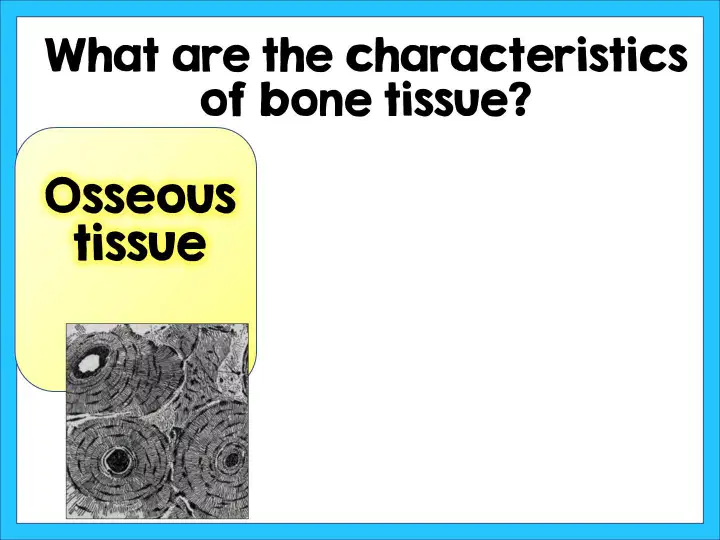
•
Osteocytes secrete ground
substances, fibers, collagen,
and fluids.
•
The ground substance
eventually becomes calcified
and hard.
•
2 types: spongy & compact
41
42

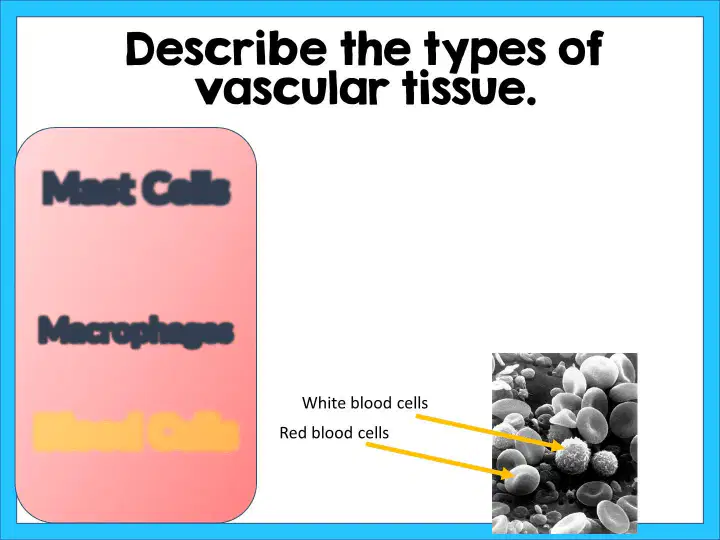
Although blood (vascular tissue)
doesn’t seem like a “connective”
tissue, it does have all the
requirements:
• Ground substance = plasma (fluid)
• “Fibers” = platelets which clot the
blood
43
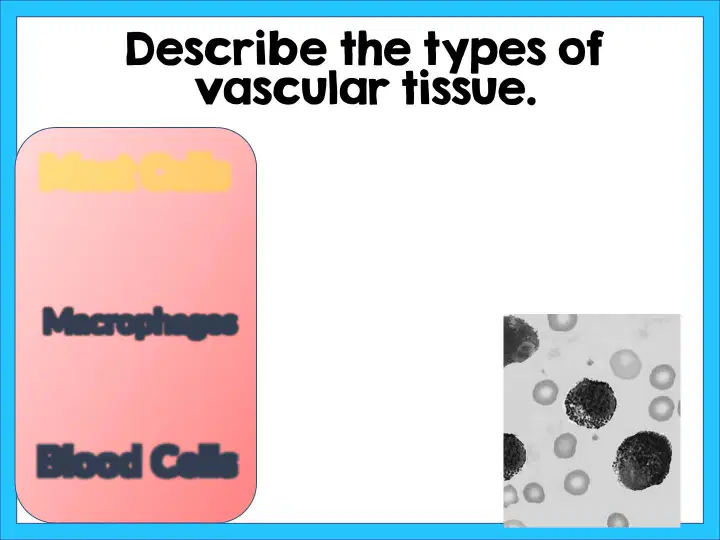
Mast Cells
Blood Cells
• Detect foreign
substances
• Contain granules that
secrete inflammatory
chemicals
Macrophages
44
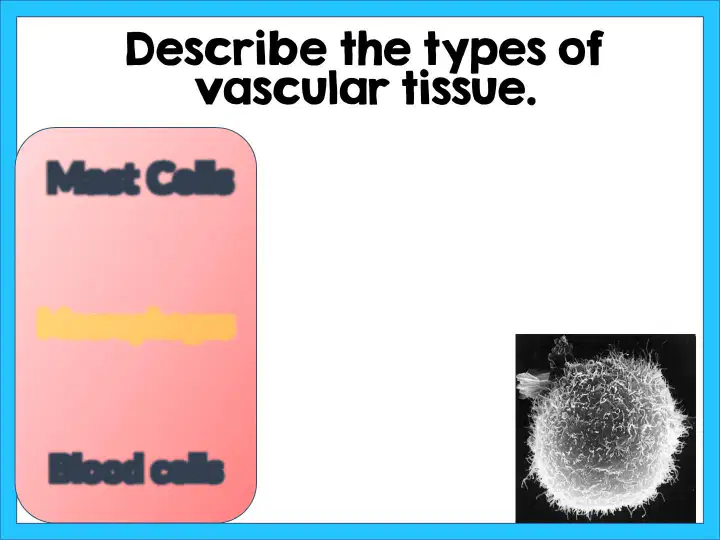
• Blob-like cells that
engulf invading
substances or
organisms
Mast Cells
Macrophages
Blood cells
45
Blood Cells
Macrophages
Mast Cells
•
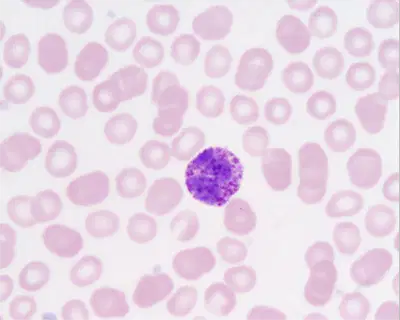
Red Blood Cells-
erythrocytes (carry oxygen)
•
White Blood Cells-
leukocytes (provide
immune response)
46

F. Blood Tissue
More on this in the
circulatory system unit.
Warning: Students
often forget that
blood is a type of
connective tissue!
47

•Connective tissues can have
different types of ground substances
in the extracellular matrix. Cartilage
has a flexible ground substance,
bone has a calcified ground
substance, and blood has a fluid
ground substance.
REVIEW OF EPITHLIIAL TISSUE
Show answer
Auto Play
Slide 1 / 47
SLIDE
Similar Resources on Wayground

43 questions
Virus and Bacteria
Presentation
•
11th Grade
42 questions
Energy System Adaptations
Presentation
•
12th Grade
42 questions
Year 12 - AIT - Application Skills
Presentation
•
12th Grade
40 questions
Mechanism of Opening and Closing of Stomata
Presentation
•
11th Grade
40 questions
Skeletal System
Presentation
•
12th Grade
43 questions
Viruses
Presentation
•
11th Grade
40 questions
Cardiovascular System Recap
Presentation
•
12th Grade
42 questions
Labeling Muscles
Presentation
•
University
Popular Resources on Wayground
6 questions
Secondary Safety Quiz
Presentation
•
9th - 12th Grade
10 questions
MyPath Diagnostic Overview
Presentation
•
6th - 8th Grade
20 questions
Lab Safety Quiz

Quiz
•
6th Grade
21 questions
Continents and Oceans
Quiz
•
6th Grade
20 questions
Adding and Subtracting Decimals
Quiz
•
5th Grade
20 questions
Parts of Speech
Quiz
•
5th Grade
16 questions
Subject & Predicate
Quiz
•
5th Grade
21 questions
Lab Safety
Quiz
•
10th Grade
Discover more resources for Biology
20 questions
Scientific Method & Variables
Quiz
•
9th - 12th Grade
10 questions
Exploring the 4 Major Macromolecules and Their Functions

Interactive video
•
9th - 12th Grade
16 questions
AP Biology: Unit 1 Review (CED)
Quiz
•
9th - 12th Grade
14 questions
AP Bio Insta-Review Topic 1.1*: Structure of Water & H Bonding
Quiz
•
9th - 12th Grade
24 questions
Cell vocabulary practice 1
Quiz
•
9th - 12th Grade
20 questions
Properties of Water
Quiz
•
9th - 12th Grade
20 questions
Anatomy Directions and planes
Quiz
•
12th Grade
9 questions
Body Cavities
Quiz
•
12th Grade