Search Header Logo
  1. Resource Library
  2. Math
  3. Probability And Statistics
  4. Experimental Probability
  5. Basics Of Probability
Basics of Probability

Basics of Probability

Assessment

Presentation

Mathematics

9th - 12th Grade

Practice Problem

Hard

CCSS
7.SP.C.6, 8.SP.A.4, 7.SP.C.7B

+3

Standards-aligned

Created by

Juan Tolentino

Used 1+ times

FREE Resource

6 Slides • 19 Questions

1

Relative Frequency

• This is the kind of probability that we determine from a survey or an experiment.


•Also known as experimental probability.

2

Relative Frequency


3

1. In a survey of 50 people, 23 individuals answered that their favorite ice cream flavor was vanilla. What was the relative frequency of individuals who chose vanilla? Express your answer as a ratio and a percent.

4

Multiple Choice

Question image
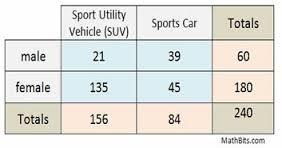
What percentage of males drive sports cars?
1

35%

2

16.25%

3

65%

4

25%

5

Multiple Choice

Question image
What percent of the total population surveyed were electrical engineers that like math?
1

33.9%

2

48.6%

3

16.5%

4

21.7%

6

Multiple Choice

Question image

According to the table, what is the relative frequency of students ages 14 - 17 who skip breakfast?

1

About 67%

2

About 35%

3

About 15%

4

About 60%

7

Multiple Choice

Question image
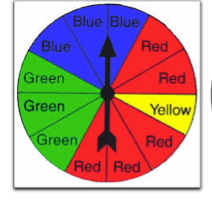
What is the probability of spinning red?
1

0

2

1/2

3

3/4

4

1

8

Multiple Choice

Question image
What is the probability of spinning green?
1

0

2

1/4

3

1/2

4

3/4

9

Multiple Choice

The letters that form the word ALGEBRA are placed in a bowl. What is the probability of choosing a letter other than “A”? 
1

2/7

2

5/49

3

5/7

4

10/49

10

Multiple Choice

The letters that form the word MATHEMATICS are placed in a bowl. What is the probability of choosing a letter that is a vowel?
1

8/121

2

4/11

3

2/11

4

4/121

11

Multiple Choice

Question image
What is the relative frequency (to the nearest percent) of boys among those who cannot bike to school? 
1

4%

2

14%

3

13%

4

29%

12

How to read the probability scale:

  • Impossible (0%): something cannot occur

  • Unlikely: there is a small percentage of occurring

  • Even Chance (50%): there is a 50% chance it can occur and 50% it cannot

  • Likely: there more of a chance something occurring than not

  • Certain (100%): it will happen

media

13

Theoretical vs Experimental Probability

14

Multiple Choice

Experimental Probability is:

1

What will happen

2

What should happen

3

What I think happens

4

What does happen

15

Multiple Choice

Theoretical Probability is:

1

What will happen

2

What should happen

3

What I want to happen

4

What does happen

16

Experimental Probability

media

17

Multiple Choice

Question image

Based on the chart, what is the experimental probability of pulling a green marble?

1

12.5 %

2

8%

3

80%

4

32%

18

Multiple Choice

Question image

The table shows the results of 50 rolls of a number cube. According to the data in the table, what was the experimental probability of rolling a 1? (Simplify if needed)

1
2
3
4

19

Multiple Choice

Question image

Sarah hit the ball 3 times out of the 8 times.

What is the experimental probability (as a percent) that she will hit the ball next?

1

22.5%

2

37.5%

3

45%

4

3%

20

Multiple Choice

The probability of picking a quarter from a jar of coins is 0.125. If Daniel has 250 coins in the jar, about how many quarters are in the jar?

1

25

2

30

3

35

4

40

21

Multiple Choice

Question image

Leonta will spin the spinner 575 times. About how many times should Leonta expect to land on an odd number?

1

200

2

250

3

350

4

400

22

Multiple Choice

Every 3 out of 12 vehicles on a highway is a truck. How many trucks are expected to be on a highway with 3,600 vehicles?

1

300

2

600

3

900

4

1,200

23

Multiple Choice

Jeremy did an experiment where he flipped a coin 40 times. He landed on heads 12 of those 40 times.


If he flipped the coin 100 more times, based on his experiment how many times could he expect to land on heads?

1

12/100

2

40

3

1200

4

30

24

Fill in the Blank

25

Fill in the Blank

Relative Frequency

• This is the kind of probability that we determine from a survey or an experiment.


•Also known as experimental probability.

Show answer

Auto Play

Slide 1 / 25

SLIDE