
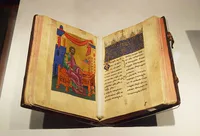
The gosples 1a & 1b

Presentation
•
Religious Studies
•
7th Grade
•
Practice Problem
•
Hard

adaya ferguson
Used 3+ times
FREE Resource
8 Slides • 0 Questions
1

Unique Facts In Each Gospel
INTRODUCTION:
How much do you know about the Gospels? While the Old
Testament talks of the coming Redeemer, the New
Testament and particularly the Gospels, talk about the
fulfillment of these promises, painting a full picture of
Jesus. Matthew, Mark, Luke and John are written from
different perspectives and together give a complete picture
of the Lord Jesus Christ and how He was the fulfillment of
Old Testament promises.
The four Gospels we have in our Bible today are called Canonical Gospels. This means they are included in the canon of
Scripture. Three of the Gospels are called the Synoptic Gospels: Matthew, Mark and Luke. The reason they are given
this title is because these three books are similar in content. The majority of the stories and the chronology of them is
similar. The reason John is not one of the synoptic Gospels is because it varies greatly on the stories told and somewhat
on the chronology of events. Interested in learning more about the Gospels in the New Testament? Here are five
important facts about the Gospels.
2

Unique Facts In Each Gospel
Canonical Gospels (Canon):
What Does it Mean?
Canon refers to a collection of rules or texts that
are considered to be authoritative. Our Bible
include only writings that met the “standards” that
determined that they could be trusted as
autoreactive.
3
What Are The Gospels?
The Gospels are the first four books of the New Testament, Matthew,
Mark, Luke and John. They contain the accounts of the Life of Christ’s
life including, his teachings, ministry, miracles, birth, sacrificial death,
and resurrection.
SYNOPTIC GOSPELS:
Three of the gospels, Matthew, Mark and Luke, are very similar in
their accounts of the life of Christ as they include many of the same
accounts, often told in the same sequence, and in some cases in the
same wording. For this reason they are refereed to as the Synoptics
meaning “same”
These gospels stand in great contrast to the Gospel of John which
focuses more on Jesus’ discourses on theological matters and is not a
repetition of the stories as recorded in the Synoptics. John Gospel is
the only gospel that has no parables.

4

Unique Facts In Each Gospel
Each Gospel is Unique
Each Gospel is unique to its author, even though some fit
more closely in style and content, e.g., The Synoptics
(Matthew, Mark and Luke) than John’s Gospel.
While each writer gives accounts of the life of Jesus, the
various perspectives of the writers, their personal history,
family background, and their intended audience help make
each one of the books unique. They give a beautiful and
complete picture of the Lord through their various writings.
Mark is recognized as the Gospel of the suffering Son of
God. Matthew is recognized as the Gospel of the Messiah.
Luke is the Gospel of the Savior of all the people and John is
the Gospel of the Son who reveals the Father. These writings
may be from different authors, but ultimately share an
important picture of who Jesus was.
5

Who Are The Authors of The Gospels?
Matthew: One of the 12 disciple of Jesus. He was a tax collector.
Prior to repenting of his sins, he stole money through his job as a
tax collector. After his repentance, he repaid all of the persons he
stole from with interest. His gospel was written mainly to connect
Jesus as the Messiah as promised in the Old Testament prophecies.
Matthew's gospel is clearly written for a Jewish Christian audience
living within the immediate proximity of the homeland itself.
Matthew's is the most Jewish of all the gospels.
There are more than 60 Old Testament references in the Book of
Matthew. Even though Jesus is presented as King in this book,
Matthew also shows how Jesus was rejected by the Jews. They
were looking for an earthly king to deliver them from the Romans,
not a heavenly king. The phrase “kingdom of heaven” is used 32
times and only found in Matthew. Christ proclaimed in Matthew
that the purpose of His coming was to fulfill the prophecies of the
Old Testament.
6

Who Are The Authors of The Gospels?
Matthew: The Gospel of the Messiah
5. Matthew’s Gospel is the most Jewish of the four Gospels,
presenting Jesus as the Jewish Messiah who brings
God’s people salvation from their sins.
6. In his Great Commission (Matt. 28:18 – 20) Jesus tells his
followers to make disciples of all nations, baptizing them
in the name of the Father, the Son, and the Holy Spirit.
7. The religious leaders play a more negative role
in Matthew than in Mark. They are wicked and hypocritical
opponents of God’s plan.
8. Matthew’s central theological theme is that salvation
history finds its climax in the coming of Jesus the
Messiah, inaugurator of the kingdom of heaven.
7

Who Are The Authors of The Gospels?
Mark: The secretary of the Apostle Peter. Mark’s gospel is believed
to be a reflection of Peter’s directing. He may have been a convert
of Peter’s since Peter is mentioned so many times by name in the
book. Mark was also an associate of the Apostle Paul. (John Mark
is named in the Acts of the Apostles as an assistant accompanying
Paul and Barnabas on their missionary journeys.)
The Book of Mark is written with a Roman audience in mind. Many
Jewish words and traditions are explained with the assumption
that the readers were not Jews. It contains very few Old Testament
references. The book presents Christ as the suffering servant yet,
as a powerful Savior. This would appeal to a Roman reader.
Mark’s is the shortest of the four gospels and many scholars
believe his was the first to be written and served as a source for
the other synoptic gospels.
8

Who Are The Authors of The Gospels?
Mark: The Gospel of the Suffering Son of God
1. Jesus’ arrest and crucifixion in Mark are scenes of
betrayal, desertion, and rejection. The disciples flee at his
arrest; his opponents mock and scorn him. He dies in
agony on the cross, forsaken by all, even his Father in
heaven.
2. Yet the informed reader knows that Jesus’ death is not in
vain but is a messianic act of atonement, the ransom
sacrifice for the sins of the world.
3. Interestingly, the role of the disciples is primarily negative
in Mark’s Gospel. They demonstrate ignorance, pride, and
wavering faith. Jesus instead provides the true model for
discipleship.
Unique Facts In Each Gospel
INTRODUCTION:
How much do you know about the Gospels? While the Old
Testament talks of the coming Redeemer, the New
Testament and particularly the Gospels, talk about the
fulfillment of these promises, painting a full picture of
Jesus. Matthew, Mark, Luke and John are written from
different perspectives and together give a complete picture
of the Lord Jesus Christ and how He was the fulfillment of
Old Testament promises.
The four Gospels we have in our Bible today are called Canonical Gospels. This means they are included in the canon of
Scripture. Three of the Gospels are called the Synoptic Gospels: Matthew, Mark and Luke. The reason they are given
this title is because these three books are similar in content. The majority of the stories and the chronology of them is
similar. The reason John is not one of the synoptic Gospels is because it varies greatly on the stories told and somewhat
on the chronology of events. Interested in learning more about the Gospels in the New Testament? Here are five
important facts about the Gospels.
Show answer
Auto Play
Slide 1 / 8
SLIDE
Similar Resources on Wayground

8 questions
2.4C Transfiguration
Presentation
•
7th Grade
8 questions
Hakdama Rambam 5
Presentation
•
7th Grade
9 questions
Longitude & Latitude Practice
Presentation
•
7th Grade
7 questions
Equivalent Negative Fractions
Presentation
•
7th Grade
8 questions
Aqidah akhlak
Presentation
•
7th Grade
8 questions
Natural Selection and Selective Breeding
Presentation
•
7th Grade
6 questions
Author POV
Presentation
•
6th - 7th Grade
9 questions
Hijrah Nabi ke Madinah
Presentation
•
7th Grade
Popular Resources on Wayground
10 questions
Safety Day 2026 – Student Review

Quiz
•
9th Grade
21 questions
Continents and Oceans
Quiz
•
6th Grade
20 questions
Parts of Speech
Quiz
•
5th Grade
16 questions
Subject & Predicate
Quiz
•
5th Grade
25 questions
Multiplication Facts
Quiz
•
5th Grade
12 questions
Map Skills
Quiz
•
3rd Grade
22 questions
Continents and Oceans
Quiz
•
5th Grade
15 questions
Rounding Decimals
Quiz
•
5th Grade
Discover more resources for Religious Studies
10 questions
Columbus Day and Indigenous People's Day

Interactive video
•
5th - 8th Grade
16 questions
Proportional and Non Proportional Relationships in Tables, Graphs, and Equations
Quiz
•
7th Grade
20 questions
Constant of Proportionality
Quiz
•
7th Grade
20 questions
Halloween Trivia
Quiz
•
7th Grade
15 questions
One-Step Equations
Quiz
•
7th Grade
20 questions
Add and Subtract Integers
Quiz
•
6th - 8th Grade
28 questions
SMS Staff by the Numbers
Quiz
•
6th - 8th Grade
16 questions
Adding and Subtracting Integers
Quiz
•
7th Grade