
![Human Body [Muscular System]](https://cf.quizizz.com/img/wayground/activity/activity-square.jpg?w=200&h=200)
Human Body [Muscular System]

Presentation
•
Science
•
5th Grade
•
Practice Problem
•
Easy
+10
Standards-aligned

R Menard
Used 3+ times
FREE Resource
14 Slides • 8 Questions
1
Key Concepts
- What types of muscles are found in the body?
- Why do skeletal muscles work in pairs?
Vocabulary Words
- involuntary muscle
- voluntary muscle
- skeletal muscle
- tendon
- striated muscle
- smooth muscle
- cardiac muscle
2
How Do Muscles Work?
Grip a spring-type object with the thumb and index finger of your writing hand. Squeeze the object open and shut as quickly as possible for two minutes. Count how many times you can squeeze the object before your muscles tire.
Rest for one minute. Then, repeat Step 1.
3
Open Ended
What do you think would happen if you repeated Steps 1 and 2 with your other hand? Give a reason for your prediction. Then, test your prediction.
4
Video About the Muscular System
When you are finished, close the video and continue to the next slide.
5
Muscles that are under your conscious control. Smiling, turning a page in a book, or getting out of your chair are all controlled by voluntary muscles.
Voluntary Muscles
Muscles that are not under your conscious control. They are responsible for essential activities such as breathing and digesting food.
Involuntary Muscles
6
Multiple Choice
What are involuntary muscles?
Muscles that are not under your conscious control
Muscles that are under your conscious control
7
Multiple Choice
Smiling, turning a page in a book, and getting out of your chair are examples of using what kind of muscles?
Involuntary Muscles
Voluntary Muscles
8
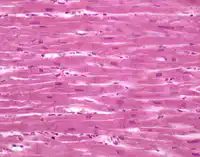
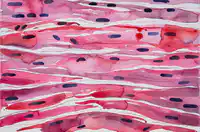
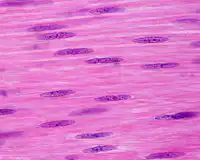
Cardiac muscle is found only in the heart. This muscle is involuntary and does not get tired.
Cardiac Muscle
Skeletal muscles are attached to the bones of your skeleton and provide the force that moves your bones. This muscle is voluntary, but they get tired easily.
Skeletal Muscle
Smooth muscles are located on the inside of many internal organs such as the stomach blood vessels. This muscle is involuntary and automatically controls movement.
Smooth Muscle
9
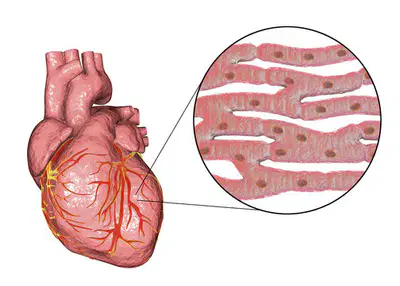
The tissue called cardiac muscle is found only in your heart. Cardiac muscle has some characteristics in common with both smooth muscle and skeletal muscle. Like smooth muscle, cardiac muscle is involuntary. Like skeletal muscle, cardiac muscle cells are striated. However, unlike skeletal muscle, cardiac muscle does not get tired. It can contract repeatedly. The repeated contractions are called heartbeats.
Cardiac Muscle
striated muscle - muscle tissue that appears striped or banded.
10
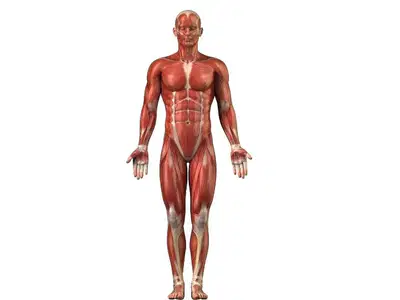
Every time you walk across the room, you are using skeletal muscles. Skeletal muscles are attached to the bones of your skeleton and provide the force that moves your bones. At each end of the skeletal muscle is a tendon. A tendon is a strong connective tissue that attaches muscle to bone.
Because you have conscious control of skeletal muscles, they are voluntary muscles. Skeletal muscles react very quickly. However, they also get tired quickly.
Skeletal Muscle
11
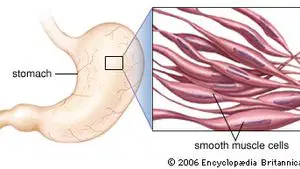
The inside of many internal organs, such as the stomach and blood vessels, contain smooth muscles. Smooth muscles are involuntary muscles. They work automatically to control certain movements inside your body, such as those involved in digestion. For example, as the smooth muscle of your stomach contract, they produce a churning action. The churning mixes the food with chemicals, and helps to digest the food.
Unlike skeletal muscles, smooth muscles are not striated. Smooth muscles react slowly and do not tire as quickly.
Smooth Muscle
12
Multiple Choice
What muscle is found only in the heart?
Smooth Muscle
Skeletal Muscle
Cardiac Muscle
13
Multiple Choice
What muscle is attached to the bones of your skeleton?
Skeletal Muscle
Cardiac Muscle
Smooth Muscle
14
Multiple Choice
What muscle is found inside many of your internal organs, such as the stomach?
Cardiac Muscle
Skeletal Muscle
Smooth Muscle
15
Video About Tendons
When you are finished, close the video and continue to the next slide.
16
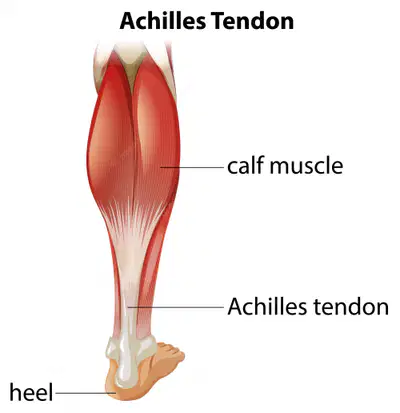
Tendons are strong connective tissues that attach muscle to bone.
Tendons
Ligaments are strong connective tissues that attach bone to bone
Ligaments
17
Multiple Choice
Which strong connective tissue connects muscle to bone?
Ligament
Tendon
18
Multiple Choice
Which strong connective tissue connects bone to bone?
Ligament
Tendon
19
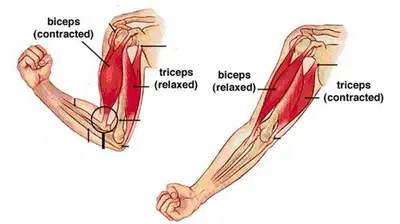
Has anyone ever asked you to "make a muscle"? If so, you probably tightened your fist, bent your arm at the elbow, and made the muscles in your upper arm bulge. Like other skeletal muscles, the muscles in your arm do their work by contracting, becoming shorter and thicker. Muscle cells contract when they receive messages from the nervous system.
Muscles at Work
Because muscle cells can only contract, not extend, skeletal muscles must work in pairs. While one muscle contracts, the other muscle in the pair relaxes to its original length.
20
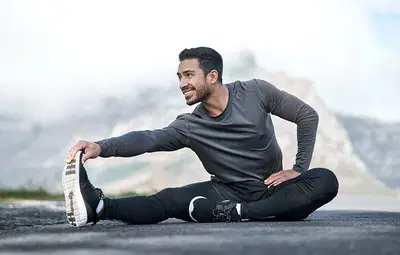
Regular exercise is important for maintaining both muscular strength and flexibility. Exercise makes individual muscle cells grow in size. As a result, the whole muscle becomes thicker. The thicker a muscle is, the stronger the muscle is. When you warm up thoroughly before exercising, the blood flow to your muscles increases and they become more flexible. Stretching after you warm up helps prepare your muscles for more vigorous exercise or play ahead.
Muscular Strength and Flexibility
When you warm up before exercising, you increase the flexibility of your muscles.
21
Refer to the worksheet and complete the questions attached. Once finished, move on to the next slide.
22
GREAT JOB!!!
Key Concepts
- What types of muscles are found in the body?
- Why do skeletal muscles work in pairs?
Vocabulary Words
- involuntary muscle
- voluntary muscle
- skeletal muscle
- tendon
- striated muscle
- smooth muscle
- cardiac muscle
Show answer
Auto Play
Slide 1 / 22
SLIDE
Similar Resources on Wayground

18 questions
Sound - Vibrations, Frequency, and Pitch
Presentation
•
5th Grade
18 questions
Dissolving Process (Solvent, Solute and Solution)
Presentation
•
5th Grade
20 questions
Circulatory System
Presentation
•
5th Grade
20 questions
5th Grade Science EOG Review
Presentation
•
5th Grade
20 questions
States of Matter Review
Presentation
•
3rd Grade
19 questions
Nervous System!
Presentation
•
5th - 6th Grade
17 questions
Unit 6 Science Review-HMH
Presentation
•
4th Grade
18 questions
Energy Transfer
Presentation
•
6th Grade
Popular Resources on Wayground
10 questions
How much do you know about our Portrait of an Eagle?

Quiz
•
10th Grade
10 questions
Fast Food Slogans
Quiz
•
6th - 8th Grade
21 questions
Continents and Oceans
Quiz
•
6th Grade
20 questions
Parts of Speech
Quiz
•
5th Grade
16 questions
Subject & Predicate
Quiz
•
5th Grade
25 questions
Multiplication Facts
Quiz
•
5th Grade
12 questions
Map Skills
Quiz
•
3rd Grade
22 questions
Continents and Oceans
Quiz
•
5th Grade
Discover more resources for Science
9 questions
Properties of matter and Mixtures
Quiz
•
5th Grade
20 questions
Mixtures and Solutions Practice
Quiz
•
5th Grade
20 questions
Food Chains and Food Webs Review
Quiz
•
5th Grade
11 questions
Understanding Light Review 4
Quiz
•
5th Grade
15 questions
Force and Motion
Presentation
•
5th Grade
20 questions
Food Chains & Food Webs
Quiz
•
5th - 7th Grade
20 questions
Weathering, Erosion, & Deposition
Quiz
•
5th Grade
16 questions
Mixture or Solution?
Quiz
•
5th Grade