
Governance

Presentation
•
History
•
8th Grade
•
Practice Problem
•
Medium

Mrs Phillips
Used 21+ times
FREE Resource
21 Slides • 16 Questions
1

THE FIRST PARLIAMENT
Governance
Monday, 09 October 2023
2

Wednesday, 11
October 2023
Learning Outcomes
• Understand the flaws of the feudal system.
• Suggest ways in which a King's power could be
controlled.
• Evaluate who gained from Magna Carta.
• Come to a judgement on how democratic Magna Carta
was.
3


Who was the real King John?
6
4

5
Draw
Draw your own version of John, from the descriptions
6

10
What could the
barons do?
On your mini whiteboard,
note down what you think
the barons could do if the
king was not doing his job
properly.
7

Magna Carta – Great Charter
11
40 English barons formed an army and gave King John a choice –
agree to their demands, or be forced to fight them.
King John eventually agreed to sign the Magna Carta, a list of 63
rights and freedoms that the barons wanted to be law.
This was the first time in British history that a monarch had been
forced to obey the wishes of their subjects.
8

I, King John, accept that I must run the
country according to the law. I agree:
Not to interfere with the church
Not to imprison freemen or nobles without a
trial
That trials will be held quickly and fairly
To stop unfair taxes
Not to ask for extra taxes without consulting
the Great Council
To let merchants travel around the country to
buy and sell without having to pay large taxes
That 25 barons will be elected by the other
barons to make sure I follow this agreement.
12
9
Multiple Select
Which of the following were on the Magna Carta?
The king could not interfere with the church
The king could not raise unfair taxes
The king could ignore the barons
Freemen could not be imprisoned without trial
Trials would take a long time
10
Categorize
It helped, as the king could not interfere with the church.
It helped because the king could not raise unfair taxes.
It helped because they could not be imprisoned without a trial.
It helped because they could buy and sell without paying large taxes.
It didn't help, as they could still be imprisoned without trial.
11


Plenary
King John signed the Magna Carta at
Runnymede, near Windsor.
Do you agree with this sign?
Is there any similarity between the
Magna Carta and Athenian democracy?
Make notes on your mini whiteboard.
12
Poll
Is the Magna Carta similar to democracy in Ancient Greece?
No, because people are still not allowed to vote.
Slightly, as the king has rules he must obey.
Partly, as the king's power is no longer absolute.
Mostly, because the king was forced to follow the rules by the barons.
13

Monday, 09
October 2023
Learning Outcomes
•Understand the meaning of the House of Commons and the
House of Lords.
•Compare Parliament with Ancient Greece.
•Come to a judgement on the most effective form of
governing.
14

Like father, like son!
6
King Henry III signed the Magna Carta when he became king,
and listened to his barons' advice. However, when he was
older, he began to be angry with the terms of the Magna
Carta.
In 1258 the barons had had enough of King Henry, and
forced him to attend a Great Council where he was
presented with The Provisions of Oxford.
15


•The
king
cannot
make
decisions without the Great
Council’s agreement.
•The
Great
Council
should
choose
the
king’s
main
advisers.
•A
Parliament
made
up
of
fifteen members of the Great
Council,
plus
twelve
other
barons, has
to meet three
times a year.
What did Henry
have to agree to?
7
16
Match
Match the following
The king cannot make decisions without
The Great Council should choose
A parliament, made up of 15 members of the Great Council, plus 12
the Great Council's agreement.
the king's main advisors.
barons, had to meet 3 times a year.
the Great Council's agreement.
the king's main advisors.
barons, had to meet 3 times a year.
17


Parliament
11
18
Drag and Drop
19
Fill in the Blanks
The House of _____ advised the ____. The right to attend passed from ______ to ___.
20
Multiple Select
The people in the House of Commons were usually... (select all correct answers).
barons
rich people
knights
peasants
21

Which system do you think is
better for governing a country
- Athenian democracy or the
Parliamentary system?
Answer the question on page
15.
13
Plenary
22
Poll
Was democracy in Ancient Greece more effective than the first parliament?
Ancient Greece was more effective as members of the government were chosen by lottery.
Ancient Greece was more effective as all freemen could vote, not just two men from each county and town.
Parliament was more effective as the House of Lords were able to advise the king on laws.
Parliament was more effective as you had barons, knights and townspeople advising on the running of the country.
23

THE REFORMATION
Governance
Monday, 09 October 2023
24

Monday, 09
October 2023
Learning Outcomes
•
Suggest who may have more power than Henry
VIII.
•
Understand that Henry had many problems.
•
Investigate how Henry solved his problems.
25
Draw
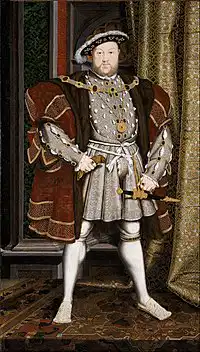
Draw Henry VIII 😊
26


King Henry VIII’s Great Matter
5
Henry had been married to his
wife Catherine of Aragon for 24
years, but their only surviving
child was a girl, Princess Mary.
Henry believed that he needed
a boy to inherit the throne after
he died or the country could
suffer a civil war.
27


King Henry VIII’s Great Matter
6
Henry believed that
divorcing Catherine and
marrying again was the only
way he would get a son who
could inherit the throne.
He was already in love with
one of Catherine’s ladies in
waiting, Anne Boleyn.

28


Task - What were Henry’s problems in
1533?
7
By 1533 Henry VIII had been on the throne for 24 years
but he was having a lot of problems. You can separate
them into four types. Look at page 18 to help you, then fill
in the grid.
Religion
Power
Money
Love
29
Categorize
People in England are becoming more annoyed with the ways of the Catholic Church.
The taxes given in church by my people go straight to Rome.
I need to finance wars against France.
A new lady at court, Anne Boleyn, has stolen my heart.
Anne refuses to let me be with her unless we are married.
I have promised Anne I will marry her.
I am very expensive and my new house, Hampton Court, needs to be refurnished.
My wife, Catherine of Aragon, is too old to have more children and I only have a daughter.
I need a son to carry on the Tudor name.
Protestant ideas are spreading quickly. They want to reform the church.
Pope Leo X refuses to grant me an annulment (divorce) from Catherine.
I married my brother's widow; the Bible said you shouldn't.
30


How did Henry solve his problems?
8
Thomas Cromwell, Henry’s
most trusted advisor, dealt
with the problem of Pope
Leo X not allowing Henry
an annulment. Cromwell
persuaded Parliament to
pass the Act of
Supremacy in 1534. This
made Henry the Supreme
Head of the Church of
England. This ended the
Pope’s authority over the
church in England.
Those people who
opposed Henry taking
over the church in
England were killed.
These included
important people like
Sir Thomas More, who
had been a close
friend of Henry’s.
Bishop Fisher, a
supporter of Catherine
of Aragon, was also
killed, along with many
monks and priests.
31
Multiple Select
The Act of Supremacy made Henry the Supreme Head of the Church. Which problems did this solve? (Choose all correct answers).
He could get his divorce from Catherine.
The taxes would no longer go to Rome, but to Henry.
Henry could build lots of palaces.
Henry could have lots of sons.
32
Multiple Select
The people who opposed Henry taking over the church were killed. Which of Henry's problems would this solve?
Henry could fight his war with France.
Protestant ideas could now be used in England and Wales.
The church in England and Wales could be reformed.
Henry could refurbish Hampton Court.
33


How did Henry solve his problems?
9
As Henry was head of the
Church
of
England,
he
gave himself an annulment
from Catherine of Aragon
and married Anne Boleyn.
He married her in January
1533 and she was crowned
queen five months later,
one
month
after
his
marriage to Catherine was
officially ended.
Between
1536
and
1539, Henry had all
the monasteries shut
down. This was known
as the Dissolution of
the Monasteries. He
took their gold and
silver and sold off their
lands.
34
Drag and Drop
35
Multiple Select
Henry closed all the monasteries (the Dissolution of the monasteries) and took all their riches. What problems did this solve?
It made Henry rich.
Henry could now have a divorce.
Henry could pay for his wars.
Henry could pay for his palaces to be refurbished.
36

Plenary
On a scale of 1-10, how
powerful do you think King
Henry VIII was by 1539?
Give reasons for your answer
by thinking about how he
solved his problems.
10
37
Poll
How powerful do you think Henry was by 1539?
Not very powerful.
(1 - 2)
He had some power.
(3 - 5)
He was fairly powerful.
(6-8)
He was very powerful.
(9-10)
THE FIRST PARLIAMENT
Governance
Monday, 09 October 2023
Show answer
Auto Play
Slide 1 / 37
SLIDE
Similar Resources on Wayground

30 questions
Maya Civilization
Presentation
•
8th Grade
34 questions
Civil War Begins part 2 a
Presentation
•
8th Grade
30 questions
Bill of Rights
Presentation
•
8th Grade
29 questions
TCI 12.4 President Jefferson's Dilemma: Dealing with Pirates
Presentation
•
8th Grade
27 questions
Lesson - Separation of Powers & Checks and Balances
Presentation
•
8th Grade
35 questions
NC Indian Tribes
Presentation
•
8th Grade
33 questions
Module 4, Lesson 4 - Struggle for Liberty
Presentation
•
8th Grade
33 questions
Mesopotamia
Presentation
•
8th Grade
Popular Resources on Wayground
10 questions
Safety Day 2026 – Student Review

Quiz
•
9th Grade
21 questions
Continents and Oceans
Quiz
•
6th Grade
20 questions
Parts of Speech
Quiz
•
5th Grade
16 questions
Subject & Predicate
Quiz
•
5th Grade
25 questions
Multiplication Facts
Quiz
•
5th Grade
12 questions
Map Skills
Quiz
•
3rd Grade
22 questions
Continents and Oceans
Quiz
•
5th Grade
15 questions
Rounding Decimals
Quiz
•
5th Grade
Discover more resources for History
15 questions
Unit 3 - Part 1 Road to Revolution
Quiz
•
8th Grade
25 questions
WWII Assessment
Quiz
•
8th Grade
25 questions
The American Revolution
Quiz
•
7th - 10th Grade
15 questions
The Bill of Rights
Quiz
•
8th - 12th Grade
18 questions
American Revolution Review
Quiz
•
8th Grade
14 questions
Weekly Wrap Up #3: CE.1a/e -Fundamental Principles
Quiz
•
8th Grade
15 questions
Ancient Rome
Quiz
•
7th - 10th Grade
16 questions
Students of Civics Unit 2: The Constitution
Quiz
•
7th - 11th Grade