Search Header Logo
23/24 Fall Q1 Benchmark Review: Bio

23/24 Fall Q1 Benchmark Review: Bio

Assessment

Presentation

•

Biology

•

12th Grade

•

Medium

Created by

Kayla White

Used 5+ times

FREE Resource

10 Slides • 59 Questions

1

Fall 2023-2024 Q1 Benchmark Review

2

Content Covered on Benchmark

​Standard

​Content

​Bio 4.1.1

​Macromolecules

​Bio 4.1.3

​Enzymes

​Bio 1.1.1

​Eukaryotic Cells

​Bio 1.1.2

​Prokaryotic vs Eukaryotic Cells

​Bio 1.1.3

​Cell Specialization

​Bio 1.2.1, 4.2.2

​Cell Transport

​Bio 1.2.2

​Cell Cycle

​Bio 1.2.3

​Unicellular Organisms

​Bio 4.2.1

​Photosynthesis and Cell Respiration

3

Bio 4.1.1 - Macromolecules

​LIPIDS
Monomer: glycerol and fatty acids
Function: long-term energy storage
Examples: fat, oils, waxes, phospholipids

CARBOHYDRATES​
Monomer: simple sugars
Function: short-term energy and structure
Examples: glucose, starch, cellulose

​PROTEINS
Monomer: amino acids
Function: structure, transport, catalyst
Examples: enzymes, hemoglobin, insulin

​NUCLEIC ACIDS
Monomer: nucleotides
Function: store genetic information and code proteins
Examples: DNA and RNA

media
media
media
media

4

Multiple Choice

Proteins are made of monomers called ___________
1
Nucleotides
2
Monosaccharides
3
Amino Acids
4
Glycerol and fatty acids

5

Multiple Choice

DNA and RNA are examples of 
1
Carbohydrates
2
Lipids
3
Proteins
4
Nucleic Acids

6

Multiple Choice

Nucleotides are monomers of
1
Carbohydrates
2
Lipids
3
Proteins
4
Nucleic Acids

7

Multiple Choice

Waxes, oils and fats are examples of
1
Carbohydrates
2
Lipids
3
Proteins
4
Nucleic Acids

8

Multiple Choice

What is the function of nucleic acids?
1
store genetic information
2
store energy (long-term)
3
store energy (short-term)
4
build skin, hair, nails, muscles

9

Multiple Choice

Which macromolecule stores energy, insulates us, and makes up the cell membrane?
1
lipids
2
proteins
3
carbohydrates
4
nucleic acids

10

Multiple Choice

Which of the following organic compounds is the main source of energy for living things?
1
carbohydrates
2
lipids
3
nucleic acids
4
proteins

11

Multiple Choice

Question image

Which macromolecule is shown?

1

lipid

2

protein

3

nucleic acid

4

carbohydrate

12

Multiple Choice

Question image
Is found in the cell membrane as a bilayer. 
1
lipids
2
protein
3
nucleic acid
4
carbohydrate

13

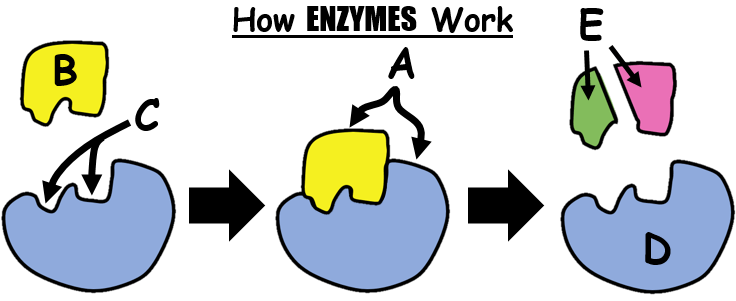
4.1.3 - Enzymes

Optimal Point: when enzymes work at their best (100% activity)

Denature: when enzyme loses structure so it loses function
- pH, temperature

Enzyme: protein that catalyzes a chemical reaction

Activation energy: amount of energy needed for a chemical reaction to occur

media
media

14

Multiple Choice

Question image

Enzymes are

1

Lipids

2

Protein

3

Carbohydrates

4

Nucleic Acids

15

Multiple Choice

Enzymes are responsible for-

1

Speeding up reactions

2

Giving the body energy

3

Slowing down reactions

16

Multiple Choice

Which of these is most likely an enzyme?  

1

Sucrose

2

Galactose

3

Fructose

4

Amylase

17

Multiple Choice

Question image

Letter D...

1

active site

2

enzyme

3

substrate

4

products

18

Multiple Choice

Question image

Letter B...

1

active site

2

enzyme

3

substrate

4

products

19

Multiple Choice

Question image

Letter c...

1

active site

2

enzyme

3

substrate

4

products

20

Multiple Choice

An enzyme speeds up a chemical reaction in the cell but can only be used once.  True or False? 

1

true

2

false

21

Multiple Choice

What happens when enzymes are heated to a high temperature?

1

The enzymes die.

2

The shapes of the enzyme are altered denature

3

The enzymes' amino acid sequence changes.

4

The enzymes remain the same

22

1.1.1 - Eukaryotic Cells

  • Complex

  • Membrane-bound organelles

    • Nucleus!!

  • Animal and plant cells

media
media

23

1.1.2 - Prokaryotic vs Eukaryotic Cells

media

24

1.2.3 - Unicellular Organisms

media

25

Multiple Choice

Only ____________ cells have a cell wall instead of a cell membrane.

1

plant

2

animal

3

white blood

4

living

26

Multiple Choice

Prokaryote are ______.

1

bacteria

2

fungi

3

large in size

4

complex cells

27

Multiple Choice

Eukaryote are ______

1

bacteria

2

large in size

3

simple cells

4

small in size

28

Multiple Choice

What is something that Prokaryotes and Eukaryote both have in common?

1

small in size

2

bacteria

3

have DNA

4

complex cells

29

Multiple Choice

Mitochondria is ______.

1

Responsible for making energy (ATP) needed for the cell

2

the site of cell respiration

3

Found in animal and plant cells

4

All of the above

30

Multiple Choice

Cytoplasm is Inflexible barrier for support and structure and is found in _____ and _______.

1

fruits and vegetables

2

dogs and cats

3

Prokaryotes and Eukaryotes

4

inner and outer membrains

31

Multiple Choice

Plasma (Cell) Membrane is found in Prokaryotes and Eukaryotes and ______.

1

makes food for the cell

2

gives sturcture to the cell

3

controls what enters and exits the cell

4

helps store material

32

Multiple Choice

Cilia are found in Prokaryotes and animal cells and have __________ used for locamotion.

1

spear shaped tails

2

trianlge shaped tails

3

numerous hair-like projections that move back and forth

4

gills

33

Multiple Choice

Flagella are found in Prokaryotes and animal cells and have a ________ shaped tail used for locamotion.

1

whip like

2

star

3

heart

4

triangle

34

Multiple Choice

Which of the following is NOT a cell structure used for locomotion by unicellular organisms?
1
cell wall
2
pseudopod
3
flagellum
4
cilium

35

Multiple Choice

Which best explains how a single-celled organism can survive without other cells?
1
They do not need to perform more than one function to survive.
2
They are able to perform all necessary functions within one cell.
3
They do not need any substance from outside of the cell.

36

Multiple Choice

Logan is comparing the characteristics of different types of organisms. Which best describes a difference between insects and bacteria?
1
Insects are made of one cell, while bacteria are made of many cells.
2
Insects require energy to perform life functions while bacteria do not.
3
Bacteria are made of one cell, while insects are made of many cells.
4
Bacteria require energy to perform life functions while insects do not.

37

Multiple Choice

What do you call the part of amoeba that helps it move?

1

Flagella

2

Cilia

3

Buds

4

Pseudopods

38

Multiple Choice

Which among the uni- cellular organisms can perform photosynthesis

1

Bacteria

2

Fungi

3

Euglena

4

Amoeba

39

Multiple Choice

Which part of Euglena helps it to detect sunlight for photosynthesis?

1

flagellum

2

eyespot

3

stigma

4

nucleolus

40

Multiple Choice

Euglena make their food in the...

1

Flagellum

2

Chloroplast

3

Cell Membrane

4

Eye spot

41

1.2.1, 4.2.2 - Cell Transport

media

42

1.2.2 - Cell Cycle

media
media

43

Multiple Choice

What is replicated in S phase of Interphase?

1

Cytoplasm

2

Cell

3

DNA

4

Nucleus

44

Multiple Choice

Interphase is preparing the cell for...

1

Cell division

2

cell fragmentation

3

cell deterioration

4

cell proliferation

45

Multiple Choice

Question image

Which phase is demonstrated in the image?

1

Prophase

2

Metaphase

3

Anaphase

4

Telophase

46

Multiple Choice

Question image

Which phase is demonstrated in the image?

1

Prophase

2

Metaphase

3

Anaphase

4

Telophase

47

Multiple Choice

Question image

Which phase is demonstrated in the image?

1

Prophase

2

Metaphase

3

Anaphase

4

Telophase

48

Multiple Choice

Question image

Which phase is demonstrated in the image?

1

Prophase

2

Metaphase

3

Anaphase

4

Telophase

49

Multiple Choice

Question image
What is the name of the structure labeled X?
1
Centriole
2
Centrosome
3
Chromatid
4
Chromosome 

50

Multiple Choice

Before cells can divide, what must be copied?
1
mitochondria
2
cytoplasm
3
DNA
4
Cell Wall

51

Multiple Choice

Which of the following is NOT occuring during interphase?
1
Cell growth
2
DNA being copied
3
DNA condensing
4
Two new cells are made

52

Multiple Choice

In which phase does the cell spend most of it's life?
1
Interphase
2
Nuclear Division
3
Telophase
4
Mitosis

53

Multiple Choice

Question image

Check the two correct boxes:

1

Plant Cell - cell plate; Animal Cell - cleavage furrow

2

Plant Cell - cleavage furrow; Animal Cell - cell plate

54

Multiple Choice

Question image
Fruit fly body cells have 8 chromosomes. After mitosis, you would expect a resulting fruit fly daughter cell to have ...
1
16 chromosomes.
2
46 chromosomes.
3
8 chromosomes.
4
4 chromosomes.

55

Multiple Choice

Question image
The organelle that helps in cell division and produces spindle fibers.
1
Chromosome
2
Centriole
3
Cytoplasm
4
Chloroplast

56

4.2.1 - Photosynthesis and Cell Respiration

media

​Aerobic = oxygen
Anaerobic = no oxygen

57

Multiple Choice

What is the purpose of photosynthesis?
1
make glucose
2
make ATP
3
make light
4
release carbon dioxide

58

Multiple Choice

Question image
In which organelle (part of the cell) does photosynthesis take place?
1
mitochondria
2
chloroplast
3
nucleus
4
cell membrane

59

Multiple Choice

Which of the following is the correct equation for PHOTOSYNTHESIS?
1
CO+ light + H2O --> O+ Sugar
2
CO+ sugar + H2O --> O+ light
3
O2 + light + H2O --> CO+ Sugar
4
CO+ O2 + H2O --> Light+ Sugar

60

Multiple Choice

What is the pigment in chloroplasts that performs photosynthesis?
1
Chlorosynthesis
2
Chlorophyll
3
ADP
4
Electron Transport

61

Multiple Choice

What are the products of photosynthesis?
1
Carbon dioxide and water
2
Carbon dioxide and oxygen
3
Glucose and oxygen
4
Glucose and water

62

Multiple Choice

Cellular Respiration's goal is to
1
make water
2
make ATP
3
make glucose
4
make  oxygen

63

Multiple Choice

Cellular respiration occurs in both plants and animals.
1
true
2
false

64

Multiple Choice

Which process absorbs energy? 
1
Photosynthesis
2
Cellular Respiration

65

Multiple Choice

Which process releases energy? 
1
cellular respiration 
2
photosynthesis

66

Multiple Choice

Oxygen (O2) is a reactant material of which process?

1

Photosynthesis

2

Cellular Respiration

67

Multiple Choice

Carbon dioxide (CO2) is a raw material in which process?  
1
Photosynthesis
2
Cellular Respiration

68

Multiple Choice

Which organelle is responsible for releasing energy in eukaryotic cells? 
1
Lysosomes
2
Mitochondria
3
Golgi Bodies
4
Vacuoles 

69

Multiple Choice

Which organelle allows plants to convert solar energy into chemical energy?
1
Chloroplast
2
Mitochondria
3
Vesicle
4
ER

Fall 2023-2024 Q1 Benchmark Review

Show answer

Auto Play

Slide 1 / 69

SLIDE