

Unit 3 Test Corrections

Presentation
•
Biology
•
10th Grade
•
Practice Problem
•
Hard

Alissa Estes
FREE Resource
10 Slides • 12 Questions
1
Unit 3 Test Corrections
These are the most missed questions from your class. Please read the informational slides and complete the questions that follow. I will add points back to your test grade based on your completion and effort on this assignment.
2

9. Which type of passive transport involves
proteins to move materials across the cell
membrane?
There are three types of passive transport.
None of them require energy and they are all
driven by balance.
Look at the next slide to see the differences
between the three types, then try question 9
again.
Test question number 9
3

4
Multiple Choice
Which type of passive transport involves proteins to move materials across the cell membrane?
Osmosis
Facilitated Diffusion
Simple Diffusion
Endocytosis
5

This question asked you to distinguish between
oxygen, glucose, and sodium, then to decide
how they cross the membrane using pictures.
Look at the next several slides to remind yourself
how these molecules move across the
membrane, then try question 5 again.
Make sure you look at the key and at the
direction of the arrows when you try the
question again.
Test question number 5
6

7

8

9
Labelling
Label the cell membrane with the correct transport mechanism according to the type of molecule moving across the membrane.
ATP Pump
Phospholipids
Channel
10


21. Miguel is looking at cells through a microscope. His
teacher, Ms. Sheng, has told him that he is viewing
either a tomato leaf cell or sheep cell. Ms. Sheng asks
Miguel to figure out what type of cell he is viewing.
What cell structure should Miguel be looking for to
determine whether this cell came from a tomato plant?
Test question number 21
Tomato Cell:
Sheep Cell:
11
Multiple Choice
Miguel is looking at cells through a microscope. His teacher, Ms. Sheng, has told him that he is viewing either a tomato leaf cell or sheep cell. Ms. Sheng asks Miguel to figure out what type of cell he is viewing. What cell structure should Miguel be looking for to determine whether this cell came from a tomato plant?
Chloroplast
Mitochondria
Nucleus
DNA
12


20. The image below shows the movement of
molecules across a cell membrane. Which
conclusion can be drawn from the image?
Test question number 20
Look at the key and
count the
molecules!!!!
13
Multiple Choice
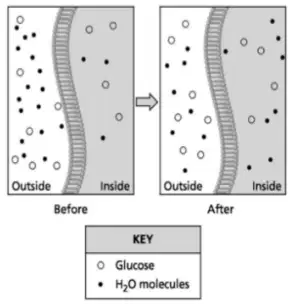
The image below shows the movement of molecules across a cell membrane. Which conclusion can be drawn from the image?
Water molecules moved from an area of greater concentration to an area of lower concentration.
Glucose molecules moved from an area of greater concentration to an area of lower concentration.
Water molecules moved from an area of lower concentration to an area of greater concentration.
No movement of molecules occurred.
14


3. Molecules move in and out of a cell by diffusion. The picture
shows a cell and molecules both inside and outside the cell. How will
the molecules in this illustration move as a result of diffusion?
This question asked you to determine how the molecules will move
due to diffusion.
Remember, diffusion is under the category of passive transport.
Passive transport does not require energy because molecules move
across the cell membrane in order to create balance. Ask yourself
how the molecules will move to balance the sides of the cell.
Test question number 3
15
Multiple Choice
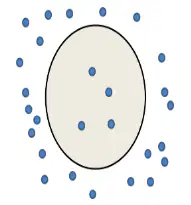
Molecules move in and out of a cell by diffusion. The picture shows a cell and molecules both inside and outside the cell. How will the molecules in this illustration move as a result of diffusion?
Out of the cell
Into another cell
Into the external environment
Into the cell
16
Multiple Choice
15. Eukaryotic and Prokaryotic cells have some parts in common. Which of the following pairs or parts would you find in both types of cells?
cytoplasm and nucleus
cell membrane and cytoplasm
DNA and membrane-bound organelles
cell membrane and membrane-bound organelles
17
Multiple Choice
4. During diffusion, when the concentration of molecules on both sides of a membrane is the same, the molecules will
move across the membrane to the outside of the cell.
stop moving across the membrane.
continue to move across the membrane in both directions.
move across the membrane to the inside of the cell.
18
Poll
Self-Reflect: How do you feel about the score you earned on your test?
I know I did the best I could
I did ok, but I could have studied more
I thought I would do better than I did
Not great...I need to pay more attention!
Other
19
Open Ended
Self Reflect: What is something you did well during this unit?
20
Open Ended
Self Reflect: What is something you wish you would have done differently and would like to improve moving forward?
21
Poll
Rate your attention and phone usage in class during Quarter 1
I always put my phone away and keep it away during class
I'm on my phone sometimes but I don't feel that it's a distraction
I need to be told to put my phone away or turn my music off, but I do
I'm listening to music or on my phone most of the class, even if asked to put it away
22
Open Ended
What feedback do you have for me? Were there activities that we did during this unit that helped you to learn or didn't help you to learn? What do you feel was helpful and/or unhelpful?
Unit 3 Test Corrections
These are the most missed questions from your class. Please read the informational slides and complete the questions that follow. I will add points back to your test grade based on your completion and effort on this assignment.
Show answer
Auto Play
Slide 1 / 22
SLIDE
Similar Resources on Wayground

16 questions
The Theory of Evolution
Presentation
•
8th Grade
20 questions
Human nutrition
Presentation
•
10th Grade
17 questions
Mechanisms of Evolution
Presentation
•
9th Grade
19 questions
Unit 2 Cell Review
Presentation
•
9th - 10th Grade
15 questions
Cell Transport - Active Transport
Presentation
•
9th Grade
19 questions
Muscles Intro
Presentation
•
11th Grade
17 questions
The Man of The House - Interactive Lesson
Presentation
•
10th Grade
16 questions
Pearl Harbor
Presentation
•
10th Grade
Popular Resources on Wayground
10 questions
HCS SCI 03 Summer School Review 4

Quiz
•
3rd Grade
11 questions
HSMS - Standard Response Protocol
Quiz
•
6th - 8th Grade
16 questions
1.1-1.2 Quiz Review
Quiz
•
9th - 12th Grade
12 questions
Exponent Expressions
Quiz
•
6th Grade
20 questions
Adding and Subtracting Integers
Quiz
•
6th - 7th Grade
11 questions
Northeast States
Quiz
•
3rd - 4th Grade
10 questions
Characterization
Quiz
•
3rd - 7th Grade
10 questions
Common Denominators
Quiz
•
5th Grade