Search Header Logo
LIGHT

LIGHT

Assessment

Presentation

Physics

KG

Medium

Created by

devita simon

Used 1+ times

FREE Resource

43 Slides • 18 Questions

1

media

2

media

3

media

4

media

5

media

6

media

7

media

8

media

9

media

10

media

11

media

12

media

13

media

14

media

15

media

16

media

17

media

18

media

19

media

20

media

21

media

22

LIght Waves

By Azizah Mutiarani

23

media

24

media

25

media

26

media

27

media

28

media

29

Multiple Choice

If light strikes the surface at a greater angle than the critical angle :

1

The ray splits, but the refracted ray only just travels along the surface.

2

The ray spits into a refracted ray and a weaker reflection.

3

There is no refracted ray, but a total internal reflection takes place.

30

Multiple Choice

The refractive index of a glass prism is 1.9. Determine its critical angle.

1

23o

2

30o

3

32º

4

35o

31

Multiple Choice

When the angle of refraction is 90 °\degree  the angle of incidence is called the... 

1

Angle of incidence

2

Critical angle

3

Angle of total internal reflection

4

Angle of refraction

32

Multiple Choice

When angle of incident (i) equals to critical angle (c) if light is traveled from a denser medium to a less dense medium,

1

total internal reflection occurs.

2

angle of refraction is equal to 90 degree.

3

light is refracted out

4

light travel in straight line

33

Multiple Choice

Question image

What happens to light during total internal reflection?

1

The angle of incidence is greater than the critical angle.

2

The angle of reflection is the same as the critical angle.

3

The angle of refraction is less than the critical angle.

4

The angle of incidence is zero.

34

media

35

media

36

Multiple Choice

Fiber optic cables work because of the principle of _____.

1

total internal refraction

2

incomplete internal refraction

3

total internal reflection

4

partial internal reflection

37

Multiple Choice

Question image

_____ cables transmit beams of light without allowing any of the light to escape until it gets to the end of the cable.

1

Ethernet

2

Fiber optic

3

Armored

4

Coaxial

38

media

39

media

40

media

41

Multiple Choice

Question image

Is a convex lens thicker or thinner in the middle?

1

Thicker

2

Thinner

42

Multiple Choice

A diverging lens is also known as a ____lens.

1

refracted

2

diffracted

3

convex

4

concave

43

Multiple Choice

What does the word "diverging" mean?

1

to spread apart

2

to come together

3

parallel

4

perpendicular

44

Multiple Choice

A converging lens is also known as a ____ lens.

1

convex

2

concave

3

double

4

refracted

45

Multiple Choice

What does the word "converging" mean?

1

to separate

2

to come together

3

parallel

4

perpendicular

46

media

47

media

48

Multiple Choice

Question image

This image is.....

1

inverted and smaller

2

inverted and larger

3

not inverted and smaller

4

not inverted and larger

49

Multiple Choice

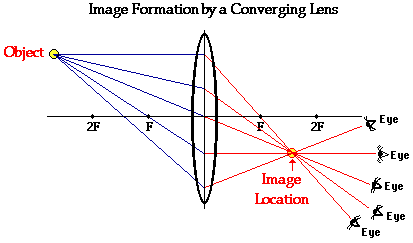
When an object is placed between the focal point and the convex lens, the image produced is ___.

1

real, reduced, and inverted

2

real, enlarged, and inverted

3

virtual, enlarged, and upright

4

virtual, reduced, and upright

50

Concave lenses

  • Curve INWARD

  • Divereges orspreads out light

  • Used in....binoculars, spy hole in doors, flashlights, and glasses

media

51

Convex lenses

  • Curves OUTWARD

  • Focuses light together or converges

  • Used in....YOUR EYE, magnifying glasses, telescopes, Microscopes, glasses

media

52

Multiple Choice

Question image

Which type of lens is this?

1

Concave

2

Convex

53

Multiple Choice

Question image

Which type of lens is this?

1

Concave

2

Convex

54

Multiple Choice

Question image

Which type of lens is this?

1

Concave

2

Convex

55

Multiple Choice

Question image

Which type of lens is this? (Curved outward)

1

Concave

2

Convex

56

57

Dispersion: The Rainbow and Prisms

media

58

LEARNING OBJECTIVE

By the end of this section, you will be able to:


Explain the phenomenon of dispersion and discuss its advantages and disadvantages.


Everyone enjoys the spectacle of a rainbow glimmering against a dark stormy sky. How does sunlight falling on clear drops of rain get broken into the rainbow of colors we see? The same process causes white light to be broken into colors by a clear glass prism or a diamond. (See Figure 1.)

media

59

We see about six colors in a rainbow—red, orange, yellow, green, blue, and violet; sometimes indigo is listed, too. Those colors are associated with different wavelengths of light, as shown in Figure 2. When our eye receives pure-wavelength light, we tend to see only one of the six colors, depending on wavelength. The thousands of other hues we can sense in other situations are our eye’s response to various mixtures of wavelengths. White light, in particular, is a fairly uniform mixture of all visible wavelengths. Sunlight, considered to be white, actually appears to be a bit yellow because of its mixture of wavelengths, but it does contain all visible wavelengths.

media

60

The effect is most spectacular when the background is dark, as in stormy weather, but can also be observed in waterfalls and lawn sprinklers. The arc of a rainbow comes from the need to be looking at a specific angle relative to the direction of the sun, as illustrated in Figure 5b. (If there are two reflections of light within the water drop, another “secondary” rainbow is produced. This rare event produces an arc that lies above the primary rainbow arc—see Figure 5c.)

media

61

Section Summary

The spreading of white light into its full spectrum of wavelengths is called dispersion.


Rainbows are produced by a combination of refraction and reflection and involve the dispersion of sunlight into a continuous distribution of colors.


Dispersion produces beautiful rainbows but also causes problems in certain optical systems.

media
media

Show answer

Auto Play

Slide 1 / 61

SLIDE