
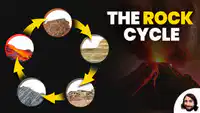
The Rock Cycle: A Journey Through Earth's Transformations

Presentation
•
Science
•
6th - 8th Grade
•
Practice Problem
•
Medium
+8
Standards-aligned

EVAN LECKER
Used 18+ times
FREE Resource
11 Slides • 5 Questions
1
A Journey Through Earth's Transformations
2
The Rock Cycle
The rock cycle is a continuous process that describes how rocks are formed, transformed, and recycled over time. It involves three main types of rocks: igneous, sedimentary, and metamorphic. Through processes like weathering, erosion, heat, and pressure, rocks can change from one type to another. This cycle plays a crucial role in shaping the Earth's surface and geologic history. Understanding the rock cycle is essential for studying Earth's transformations and the formation of different rock types.
3
Multiple Choice
What are the three main types of rocks involved in the rock cycle?
Igneous, sedimentary, and metamorphic
Sedimentary, metamorphic, and volcanic
Igneous, sedimentary, and volcanic
Sedimentary, metamorphic, and igneous
4
Rock Cycle:
Igneous, sedimentary, and metamorphic are the three main types of rocks involved in the rock cycle. Igneous rocks form from cooled magma, sedimentary rocks are formed from the accumulation of sediments, and metamorphic rocks are formed from the transformation of existing rocks under high pressure and temperature. The rock cycle is a continuous process of rock formation, erosion, and transformation.


5
The Rock Cycle
The formation of igneous rocks is a key part of the rock cycle. Igneous rocks are formed when molten rock, or magma, cools and solidifies. This can happen either below the Earth's surface, resulting in intrusive igneous rocks, or on the surface, resulting in extrusive igneous rocks. The cooling rate and mineral composition determine the texture and appearance of the igneous rock. Examples of igneous rocks include granite, basalt, and obsidian.
6
Multiple Choice
What are the two types of igneous rocks based on their formation?
Intrusive and extrusive
Granite and basalt
Magma and obsidian
Cooling rate and mineral composition
7
Intrusive and Extrusive
Igneous rocks can be classified into two types based on their formation:
8
Formation of Sedimentary Rocks
9
Multiple Choice
What are the processes involved in the formation of sedimentary rocks?
Weathering, erosion, deposition, compaction, and cementation
Melting, crystallization, and solidification
Volcanic activity, magma cooling, and crystallization
Pressure and heat transformation
10
Sedimentary Rocks
Trivia: Sedimentary rocks are formed through a series of processes including weathering, erosion, deposition, compaction, and cementation. These rocks hold valuable information about Earth's history and often contain fossils. They cover about 75% of the Earth's surface and are an important resource for energy and construction materials.
11
Formation of Metamorphic Rocks
12
Multiple Choice
What is the process through which metamorphic rocks are formed?
Erosion
Weathering
Metamorphism
Volcanism
13
Metamorphic Rocks
Trivia: Metamorphic rocks are formed through the process of metamorphism. This process involves the transformation of existing rocks due to high pressure, heat, or chemical reactions. Unlike other processes like erosion, weathering, or volcanism, metamorphism changes the mineral composition and texture of rocks, resulting in unique and beautiful formations.
14
The Rock Cycle
A journey through Earth's transformations: Weathering and Erosion. Weathering breaks down rocks into smaller pieces, while erosion transports these pieces to new locations. Both processes play a crucial role in shaping the Earth's surface. Weathering can occur through physical (mechanical) or chemical processes, while erosion is mainly caused by water, wind, or ice. Understanding these processes helps us comprehend the dynamic nature of our planet.
15
Multiple Choice
What are the two processes that play a crucial role in shaping the Earth's surface?
Weathering and Erosion
Volcanic eruptions and earthquakes
Plate tectonics and continental drift
Photosynthesis and respiration
16
Weathering and Erosion
Did you know? Weathering is the process of breaking down rocks into smaller pieces, while erosion is the movement of these pieces to new locations. Together, they shape the Earth's surface by creating mountains, valleys, and even beaches. Weathering can be caused by wind, water, or ice, while erosion is mainly driven by water and gravity.
A Journey Through Earth's Transformations
Show answer
Auto Play
Slide 1 / 16
SLIDE
Similar Resources on Wayground

15 questions
Quarter 2 Mini-Lesson: Earth's Spheres
Presentation
•
6th - 8th Grade
12 questions
Bill Nye the Science Guy: Rock and Soil
Presentation
•
6th - 8th Grade
13 questions
Plate Tectonics (6.E.2.2) Test Review
Presentation
•
6th - 8th Grade
9 questions
Geologic Time Scale
Presentation
•
6th - 8th Grade
12 questions
Earth's Sphere Review
Presentation
•
6th - 8th Grade
12 questions
Fossil Evidence and Rock Strata
Presentation
•
6th - 8th Grade
12 questions
Matter and Energy in the Earth's System Vocab
Presentation
•
6th - 8th Grade
15 questions
Photosynthesis
Presentation
•
7th Grade
Popular Resources on Wayground
21 questions
Continents and Oceans

Quiz
•
6th Grade
20 questions
Parts of Speech
Quiz
•
5th Grade
16 questions
Subject & Predicate
Quiz
•
5th Grade
25 questions
Multiplication Facts
Quiz
•
5th Grade
12 questions
Map Skills
Quiz
•
3rd Grade
22 questions
Continents and Oceans
Quiz
•
5th Grade
15 questions
Rounding Decimals
Quiz
•
5th Grade
20 questions
Brand Labels
Quiz
•
5th - 12th Grade
Discover more resources for Science
20 questions
Newton's Laws of Motion
Quiz
•
8th Grade
20 questions
Elements, compounds, and mixtures
Quiz
•
6th Grade
17 questions
7.6D Aqueous Solutions
Quiz
•
7th Grade
20 questions
Scientific Method and Variables
Quiz
•
8th Grade
20 questions
Scientific method and variables
Quiz
•
8th Grade
10 questions
6.6D - Relative Density Review
Quiz
•
6th Grade
20 questions
Claim, Evidence and Reasoning (CER)
Quiz
•
6th - 8th Grade
21 questions
Newton's Laws of Motion
Quiz
•
8th Grade