

Amplify Lesson 8 part 1 unit 4

Presentation
•
English
•
5th Grade
•
Practice Problem
•
Medium
+19
Standards-aligned

Stefany Ramirez
Used 2+ times
FREE Resource
43 Slides • 11 Questions
1


Lesson Focus
LO: I am learning about the author’s
word choice and writing style in the
text.
SC:
I can identify the author’s word choice
in the text.
I can identify the author’s writing style
in the text.
I can examine the author’s word
choice and writing style during a
close reading of the text.
2

Lesson 8
Vocabulary
3


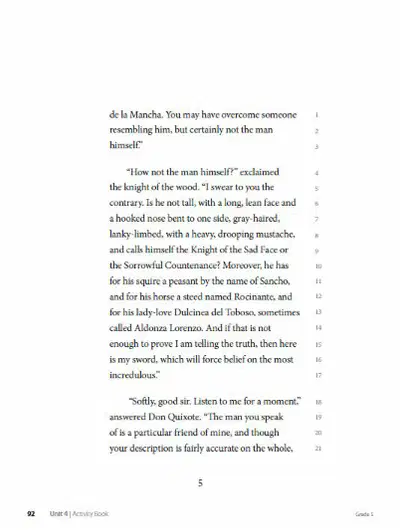
reason
They had not
expected a
man who would
reason so well.
verb
to think in a sensible and logical
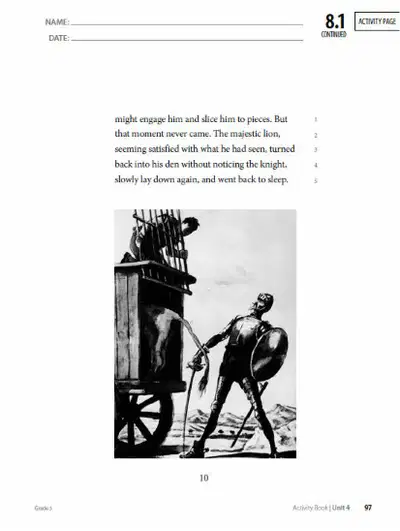
way
4


partridge
“In that case,”
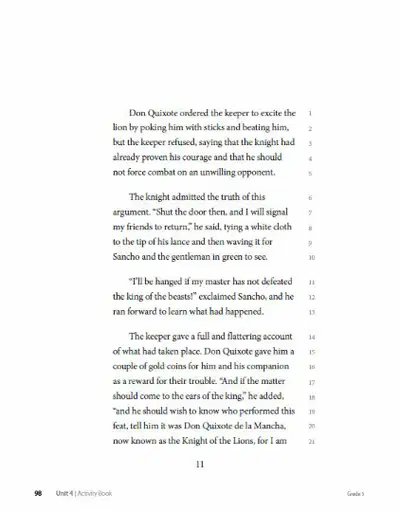
Sancho said,
“those partridges
will be fine for
me.”
noun
a bird that is hunted and
eaten for food
5


commotion
On the night of
Sancho’s seventh
day as governor
when he began to
fall asleep, there
was a great
commotion
outside.
noun
noise
6


ingenuity
We need your
strength, your
ingenuity, your
courage to guide us!
noun
skill or cleverness that allows
someone to create
something or solve a problem
7


reluctantly
“All right, all
right, I’ll take
up arms,”
Sancho
reluctantly
agreed.
adjective
done with hesitation or
unwillingness
8


agony
All I want is to be free
from this agony.
noun
extreme pain
9


booty
Let’s go divide the
booty.
noun
valuable goods or money
taken as a prize after victory
10


administration
We would let you go,
even though we’re
sorry to lose you, but
every governor must
account for his
administration.
noun
government
11


resign
He found out he
could not handle
the job, and he had
the courage to
resign.
verb
to give up a job in an official
way
12


dignity
At the end, though, his
honesty and dignity
made them admire
Sancho Panza as a
human being.
adjective
calm behavior and self-control
13


woe
I take it your
woes are due to
love–an
unrequited
passion for a
fair lady?”
noun
sadness
14


unrequited
I take it your woes
are due to
love–an
unrequited
passion for a fair
lady?”
adjective
unreturned; one-sided
15


scorn
“That is my fate,”
he replied,
“though I cannot
exactly say my
lady scorns me.”
verb
to hate
16


bestow
It is a poor
knight-errant who
cannot bestow an
earldom, or a
government, on
his squire.
verb
to give
17


scoundrel
Likely enough, if we were
wise men we would stay
at home with our families
instead of tramping
around the country with a
master like mine, who
is as crazy as he is brave,
and even more than that,
is a scoundrel.
noun
a person with a bad
reputation; a liar
18


folly
You can persuade
him of anything, and
that is why I love him
and cannot leave him
in spite of all his
follies.
noun
craziness
19


vanquish
I say nothing about
your other victories,
but I do not admit
that you have
vanquished Don
Quixote de la Mancha.
verb
to beat or defeat in battle
20


unyoke
The wagon driver,
calling on all there to
bear witness that
he was being forced
against his will and
over his protests,
unyoked his animals
and led them out of
harm’s way.
verb
to free from a harness or
wagon
21


commend
Then he commended
himself to God and to
Dulcinea, and stood
ready in front of the
lion’s door.
verb
to entrust or commit
22


As a knight-errant, what
are some of Don Quixote’s
character traits?
A knight-errant is a knight
who wanders about, always in
search of adventure and
romance.
23


What are some examples
of things from the text that
show Don Quixote is
idealistic (unrealistic) or
quixotic?
For all 3 questions
24


What are some examples
of things from the text that
show Don Quixote is brave?
25

Many translations and adaptations of
Cervantes’s Don Quixote have been written.
Today you will read excerpts from another
version of the story. These excerpts are
similar to the Reader chapters 9 and 10,
“The Knight of the Wood” and “The
Adventure of the Lions.”
The excerpts are included on Activity Page
8.1 in you books
26


●In lines 8-9, why does the author use the figurative
phrase (simile) “for she is as gentle as a lamb and as
soft as butter” to describe the ladies?
What other adjectives do
you think of when you
describe a lamb
as gentle?
When you say something
is as soft as butter, what
do you imagine?
27
Multiple Choice
●In lines 8-9, why does the author use the figurative
phrase (simile) “for she is as gentle as a lamb and as
soft as butter” to describe the ladies?
28


29


In paragraph #2, why does the
author use the figurative phrase “as
crazy as he is brave” to describe
the masters?
What does the squire
mean by the phrase
It’s the blind leading
the blind?
30
Multiple Choice
In paragraph #2, why does the
author use the figurative phrase “as
crazy as he is brave” to describe
the masters?
To highlight their intelligence and calmness
31


What does the strange
knight mean when he
says his lady, Casildea,
gives him “such tasks
as those imposed on
Hercules”?
In this example, the author
is making what is called an
allusion, or a reference to a
literary character. Hercules
is a Greek mythological,
fictional character. He
performed twelve feats, or
tasks. Those tasks were
thought to be impossible,
but Hercules was able to
complete all twelve
because he was the son of
Zeus, the king of the gods.
32
Multiple Choice
What does the strange
knight mean when he
says his lady, Casildea,
gives him “such tasks
as those imposed on
Hercules”?
33

Based on the way it is
used in this paragraph,
what do you think the
word contrary means?
34
Multiple Choice
Based on the way it is
used in this paragraph,
what do you think the
word contrary means?
35


What does the Knight of
the Wood mean when he
refers to “the conditions of
battle”?
In this version of the story,
there is one condition of
the duel that is similar to a
condition in the version of
the story in the Reader.
There is also a condition
that is different. What
condition of the duel is
included in both versions
of the story?
What condition of the duel
is included in this version
of the story but not in the
story in the Reader?
36


“Sancho wrung his hands..”
Why do you think the author
included this line after Don
Quixote demands to fight the
lion?
37
Multiple Choice
“Sancho wrung his hands..”
Why do you think the author
included this line after Don
Quixote demands to fight the
lion?
38


What does the author mean by
the phrase “not to continue
with his purpose”?
What is ironic about Don
Quixote saying, “Let everyone
mind his own business!”?
39
Multiple Choice
What is ironic about Don
Quixote saying, “Let everyone
mind his own business!”?
Don Quixote is usually does not mind his own business
40


“He extended his tongue,
which was two hands long”
Why did the author include
this imagery for the lion?
A.
To show he was
hungry
B.
To show that the
animal was large
Based on the way it is
used in this paragraph,
what do you think the
word undaunted
means?
A.
It means scared
B.
It means he is not afraid
41
Multiple Choice
“He extended his tongue,
which was two hands long”
Why did the author include
this imagery for the lion?
42
Multiple Choice
Based on the way it is
used in this paragraph,
what do you think the
word undaunted
means?
it means scared
it means unafraid
43

44

What do you think
Don Quixote means
when he says, “And
if the matter
should come to the
ears of the king”?
45
Multiple Choice
What do you think
Don Quixote means
when he says, “And
if the matter
should come to the
ears of the king”?
46

47

In the excerpt “The Strange Knight and
Squire-Challenge, Victory and
Transformation,” the strange knight says
that Don Quixote “calls himself the Knight
of the Sad Face or Sorrowful
Countenance.”
Later in “The Gentleman in Green,
Adventure with the Lions, and Astonished
Friends,” Don Quixote announces that he
“is dropping the name ‘Sorrowful
Countenance’ and will now be known as
the ‘Knight of the Lions.’”
48


Why do you think that Don Quixote called
himself the “Knight of Sorrowful
Countenance”? Think about all of his
adventures up until the moment he
encounters the lions.
Why do you think Don Quixote decided to
change his name to the “Knight of the Lions”?
What might this change in name signify or
mean?
Think-Pair-Share
49
Dumbfounded means “shocked” or
“surprised.”
“The men on the cart were
dumbfounded at this command.”
The surprise ending to the mystery
dumbfounded many readers.
- dumbfounded
50

“I was dumbfounded when
I learned _______.”
- dumbfounded
Have you ever been
dumbfounded by anything? Be
sure to use the word
dumbfounded when you talk
about it.
51
.
- dumbfounded
Synonyms Antonyms
52
Categorize
unimpressed
unconcerned
bored
shocked
surprised
stunned
Organize these options into the right categories for the word DUMBFOUNDED
53
Open Ended
Why do you think Don Quixote decided to change his name to the “Knight of the Lions”? What might this change signify or mean? Support your answer with evidence from the text.
Use the stem to assist in writing your answer:
In this adventure, _____________. The name change signals that he is feeling more______. He may also think that this name will impress_______.
54

End pt 1
Lesson Focus
LO: I am learning about the author’s
word choice and writing style in the
text.
SC:
I can identify the author’s word choice
in the text.
I can identify the author’s writing style
in the text.
I can examine the author’s word
choice and writing style during a
close reading of the text.
Show answer
Auto Play
Slide 1 / 54
SLIDE
Similar Resources on Wayground

48 questions
Clauses and Adverbs
Presentation
•
5th Grade
48 questions
Wh Questions
Presentation
•
KG
51 questions
January 13
Presentation
•
5th Grade
50 questions
Text Features
Presentation
•
5th - 7th Grade
49 questions
Facts about a City
Presentation
•
5th - 6th Grade
52 questions
Jaxtina - S - Flipped Book - Lesson 7
Presentation
•
5th Grade
46 questions
Module 5 Elementary
Presentation
•
5th Grade
49 questions
Egyptian Mummification
Presentation
•
6th Grade
Popular Resources on Wayground
6 questions
PRIDE Always and Everywhere
Presentation
•
12th Grade
20 questions
Lab Safety Quiz

Quiz
•
6th Grade
26 questions
KOR Review Kahoot Questions
Quiz
•
8th Grade
21 questions
Continents and Oceans
Quiz
•
6th Grade
12 questions
Unit Zero lesson 2 cafeteria
Presentation
•
9th - 12th Grade
20 questions
Parts of Speech
Quiz
•
5th Grade
10 questions
Riddles Riddles fun Riddles
Quiz
•
6th - 12th Grade
16 questions
Subject & Predicate
Quiz
•
5th Grade
Discover more resources for English
20 questions
Parts of Speech
Quiz
•
5th Grade
16 questions
Subject & Predicate
Quiz
•
5th Grade
8 questions
Main Idea & Key Details
Quiz
•
3rd - 6th Grade
15 questions
Central Idea
Quiz
•
5th Grade
20 questions
4 Types of Sentences
Quiz
•
4th - 5th Grade
20 questions
Main Idea and Details
Quiz
•
5th Grade
20 questions
Prefix and Suffix Review
Quiz
•
3rd - 5th Grade
24 questions
Singular & Plural Possessive Nouns
Quiz
•
4th - 5th Grade