
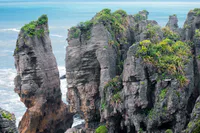
Weathering Wonders

Presentation
•
Science
•
6th Grade
•
Practice Problem
•
Medium
+7
Standards-aligned

Jeffrey Armsworth
Used 6+ times
FREE Resource
9 Slides • 4 Questions
1
Discover the fascinating effects of weathering on our planet's landscapes and structures.
2
Weathering Wonders
3
Multiple Choice
What are the two types of weathering?
Mechanical and chemical weathering
Temperature and moisture weathering
Wind and vegetation weathering
Soil formation and erosion weathering
4
Mechanical and Chemical Weathering
5
Mechanical Weathering
6
Multiple Choice
What is mechanical weathering?
The process of breaking down rocks into smaller pieces through physical forces
The process of breaking down rocks into smaller pieces through chemical reactions
The process of breaking down rocks into smaller pieces through biological activity
The process of breaking down rocks into smaller pieces through weather patterns
7
Mechanical Weathering
The process of breaking down rocks into smaller pieces through physical forces. Did you know that freeze-thaw cycles, abrasion, and root wedging are all examples of mechanical weathering? It's fascinating how these forces can shape our landscapes over time!
8
Chemical Weathering
9
Multiple Choice
What is weathering?
The process by which rocks and minerals are broken down and altered through chemical reactions.
The process of erosion and landscape changes.
The formation of new minerals through chemical reactions.
The presence of certain chemicals in rocks and minerals.
10
Weathering:
The process by which rocks and minerals are broken down and altered through chemical reactions. Did you know that weathering can be caused by factors such as temperature changes, water, wind, and even living organisms? It plays a crucial role in shaping the Earth's surface over time. Weathering can lead to the formation of new minerals and the release of important nutrients into the environment. It is an ongoing process that occurs everywhere, from mountains to coastlines.
11
Weathering and Erosion
Weathering and erosion are natural processes that shape the Earth's surface over time. Weathering refers to the breakdown of rocks and minerals into smaller pieces, while erosion involves the movement and transport of these weathered materials. Both processes are influenced by factors such as water, wind, ice, and gravity. Weathering and erosion play a crucial role in the formation of landscapes, including mountains, valleys, and coastlines. Understanding these processes helps us comprehend the dynamic nature of our planet's geology.
12
Multiple Choice
What are the factors that influence weathering and erosion?
Water, wind, ice, and gravity
Mountains, valleys, and coastlines
Rocks and minerals
Dynamic nature of our planet's geology
13
Factors Influencing Weathering and Erosion
Trivia: Water, wind, ice, and gravity are the primary forces that shape our planet's surface. These powerful agents break down rocks, transport sediments, and reshape landscapes. From the gentle erosion of coastlines to the dramatic carving of canyons, these factors continuously shape the dynamic nature of our planet's geology.
Discover the fascinating effects of weathering on our planet's landscapes and structures.
Show answer
Auto Play
Slide 1 / 13
SLIDE
Similar Resources on Wayground

10 questions
Introducing Storms: Tornadoes
Presentation
•
5th - 6th Grade
12 questions
Major Tectonic Plates
Presentation
•
6th Grade
12 questions
Rock Cycle
Presentation
•
6th Grade
11 questions
Sedimentary Rocks
Presentation
•
5th - 6th Grade
10 questions
Heredity & Punnett Squares
Presentation
•
7th Grade
9 questions
Air Pressure Inquiry
Presentation
•
6th Grade
13 questions
Microorganisms
Presentation
•
6th Grade
8 questions
Asexual Reproduction in Animals
Presentation
•
6th Grade
Popular Resources on Wayground
10 questions
Safety Day 2026 – Student Review

Quiz
•
9th Grade
21 questions
Continents and Oceans
Quiz
•
6th Grade
20 questions
Parts of Speech
Quiz
•
5th Grade
16 questions
Subject & Predicate
Quiz
•
5th Grade
25 questions
Multiplication Facts
Quiz
•
5th Grade
12 questions
Map Skills
Quiz
•
3rd Grade
22 questions
Continents and Oceans
Quiz
•
5th Grade
15 questions
Rounding Decimals
Quiz
•
5th Grade
Discover more resources for Science
20 questions
Elements, compounds, and mixtures
Quiz
•
6th Grade
10 questions
6.6D - Relative Density Review
Quiz
•
6th Grade
10 questions
Exploring Chemical and Physical Changes

Interactive video
•
6th - 10th Grade
20 questions
CONDUCTION,CONVECTION AND RADIATION
Quiz
•
6th Grade
20 questions
Rocks and The Rock Cycle
Quiz
•
6th Grade
19 questions
Describing and Classifying Matter
Presentation
•
6th Grade
21 questions
Waves and Wave Properties
Quiz
•
6th - 8th Grade
20 questions
Phases of the Moon
Quiz
•
6th Grade