

encryption

Presentation
•
Science
•
9th - 12th Grade
•
Practice Problem
•
Hard

Mehak Khan
Used 6+ times
FREE Resource
22 Slides • 9 Questions
1

Methods of Encryption
KS4 – Data Transmission
2
Retrieval Task
Starter Time – Retrieval Practice
What can you remember from last lesson?
➢Write information on the given sticky note – 3 mins
➢Pair up with your shoulder partner.
➢Exchange and discuss your notes - 2 mins
➢Don’t forget to Paste your sticky note on Notebook!!!
Recall and define the following terms from the previous lesson.
1.Check digits
2.Methods of check digits
3.ISBN Number
3

Lesson Objective:
To understand the concept of symmetric and asymmetric encryption.
Success Criteria:
Self assessment
AT
I can identify the purpose of encryption.
ABOVE
I can depict the concept of symmetric and asymmetric encryption.
ABOVE +
I can compare symmetric and asymmetric encryption.
Topic: Methods of Encryption
4

Keywords
Encrypt
ريفشت
Decrypt
ريفشت كف
Symmetric encryption
لثامتملا ريفشتلا
Cypher
رفياس
Asymmetric encryption
لثامتملا ريغ ريفشتلا
Public Key
ماعلا حاتفملا
Private Key
صاخلا حاتفملا
Sight words
1 minute challenge!!!
5

THINK ABOUT…
LO: We are learning to understand the concept of symmetric and asymmetric encryption.
Why is it advisable by UAE government to avoid
manual records and store confidential
information on physical documents?
The piece of paper can get
stolen, intercepted, or
recovered if it has not
been disposed of properly.
Laws might also be broken
regarding data privacy and
secrecy.
6

Purpose of encryption
LO: We are learning to understand the concept of symmetric and asymmetric encryption.
Encryption alters data into a form that is unreadable by anybody for whom the data is not intended. It cannot prevent the data being intercepted, but it stops it from making any sense to the eavesdropper. This is particularly important if the data is sensitive or confidential.
The original data being sent is known as plaintext. Once it has gone through an encryption algorithm, it
produces ciphertext.
Support Material:
7

Encryption
LO: We are learning to understand the concept of symmetric and asymmetric encryption.
Decrypt the text using
Caeser substitution
method
Open the given link:
CHALLENGE QUESTION??
Why is encryption essential in ensuring the security
of digital communication?
FNULXVN CX HNJA 10 LB

8

Encryption – Progress check
_________ is a way of securing Information on a network. An __________ is used to help decrypt messages. Taking a secret message and reproducing the original plain text is known as__________. Once the plain text gone through encryption algorithm, it produces a __________.
Plain Text
Encryption
Encryption Key
Decryption
Cypher Text
9
Fill in the Blanks
10
Fill in the Blanks
11
Fill in the Blanks
12

Lesson Objective:
To understand the concept of symmetric and asymmetric encryption.
Success Criteria:
Self assessment
AT
I can identify the purpose of encryption.
ABOVE
I can depict the concept of symmetric and
asymmetric encryption.
ABOVE +
I can compare symmetric and asymmetric
encryption.
Progress Check1:
SC1:I can understand the purpose of encryption.
Highlight the 1st
success criteria
13

Symmetric Encryption
LO: We are learning to understand the concept of symmetric and asymmetric encryption.
Symmetric encryption uses an encryption key; the same key is used to encrypt and decrypt the encoded
message. First, consider a simple system that uses a 10-digit denary encryption key (this gives 1 × 10¹⁰
possible codes); and a decryption key.
Plain text →cypher text
using 10-digit encryption
key
Now can you identify the 10 digit
encryption key used in this encryption.
Explain how it works.
Modern computers could ‘crack’ this encryption key in a matter of seconds. To try to combat this, we now use 256-bit binary encryption keys that give 2256 (approximately, 1.2 × 1077) possible combinations.
It is difficult to keep the encryption key a secret as it needs to be sent in an email or a text message which can be intercepted.
14

PAIR & SWAP
LO: We are learning to understand the concept of symmetric and asymmetric encryption.
➢ Students will work in Pairs.
➢ Teacher will Provide each pair with a
unique symmetric encryption key (a simple substitution key).
➢ One student in each pair creates
secret message and encrypts it using the provided key.
➢ The encrypted message is passed to other students, who decrypts it using the same key.
CHALLENGE:
Discuss the effectiveness and limitations of
symmetric encryption based on your experience.
15

Asymmetric Encryption
Asymmetric encryption was developed to overcome the security problems associated with symmetric
encryption. It makes use of two keys :
» public key- made available to everybody
» private key- only known to the computer user
LO: We are learning to understand the concept of symmetric and asymmetric encryption.
16

Asymmetric Encryption- Modeling
LO: We are learning to understand the concept of symmetric and asymmetric encryption.
17

CRITICAL THINKING
LO: We are learning to understand the concept of symmetric and asymmetric encryption.
Design a scenario where Tom is planning to have a communication of private information with 2 of her other friends.
Explain how Asymmetric Encryption will work
here?
18
Multiple Choice
Symmetric encryption is more secure than asymmetric encryption because it uses a single key.
TRUE
FALSE
19
Multiple Choice
In asymmetric encryption, the public key can be freely shared, but the private key must be kept secret.
TRUE
FALSE
20
Multiple Choice
Asymmetric encryption provides a higher level of security because even if the public key is intercepted, the private key is required to decrypt the data.
TRUE
FALSE
21

Lesson Objective:
To understand the concept of symmetric and asymmetric encryption.
Success Criteria:
Self assessment
AT
I can identify the purpose of encryption.
ABOVE
I can depict the concept of symmetric and
asymmetric encryption.
ABOVE +
I cancompare symmetric and asymmetric
encryption.
Progress Check2:
SC2:I can depict the concept of symmetric and asymmetric encryption.
Highlight the 2nd
success criteria
22

SYMMTERIC VS ASYMMETRIC
ENCRYPTION-CLIPS
➢Class is divided into 3 groups:
➢Each group will get one of the following
scenario.
•Secure Email Connection
•Online Shopping
•Data Transfer between two organization
➢Discus in groups and determine which
encryption method is more suitable for given scenario.
Your decision should be based on
following key points:
✓Confidentiality of data.
✓Speed of data Transfer
✓Authenticity of data.
CHALLENGE:
How effective is key generation and key distribution
method in Asymmetric encryption??
23

SYMMETRIC VS ASYMMETRIC
ENCRYPTION
Symmetric Encryption
Asymmetric Encryption
Symmetric encryption algorithms are generally faster and more efficient than asymmetric encryption algorithms.
Asymmetric encryption algorithms are slower than symmetric algorithms due to the complex
mathematical computations involved.
One of the main challenges in symmetric encryption is key distribution. If two parties
want to communicate securely, they need to
find a secure way to exchange the secret key.
Asymmetric encryption solves the key distribution problem. Public keys can be freely distributed, allowing anyone to encrypt messages that only the holder of the corresponding private key
can decrypt
Security risk is always there in this method.
More secure way of encryption.
Symmetric encryption is often used for
encrypting bulk data, such as files and
messages, where speed is essential.
Asymmetric encryption is used to create digital
signatures, ensuring the authenticity and
integrity of a message or document.
Support Material
24
Multiple Choice
When carrying out asymmetric encryption, which of the following users would keep the private key?
the sender
the receiver
both sender and receiver
all recipients of the message
25
Multiple Choice
In encryption, which of the following is the term used to describe the message before it is encrypted?
simple text
plaintext
no text
ciphertext
26
Multiple Choice
Which of the following is the biggest disadvantage of using symmetric encryption?
it is very complex and time consuming.
it is rarely used anymore
the value of the key reads the same in both directions
there is a security problem when transmitting the encryption key
27


28

Lesson Objective:
To understand the concept of symmetric and asymmetric encryption.
Success Criteria:
Self assessment
AT
I can identify the purpose of encryption.
ABOVE
I can depict the concept of symmetric and asymmetric encryption.
ABOVE +
I can compare symmetric and asymmetric encryption.
Progress Check3:
SC3:I can compare symmetric and asymmetric encryption.
Highlight the 3rd
success criteria
29

EXTENSION TASK- INOVATION
LO: We are learning to understand the concept of symmetric and asymmetric encryption.
You are part of a team working on a top-secret project for a government agency. The project involves sharing sensitive information between team members located in different countries. The challenge is to establish a secure communication channel to exchange critical data securely and efficiently.
Encryption Protocols Proposal:
Research and Innovate a combination of symmetric and asymmetric encryption
protocols that could be used for this secure communication channel. Think outside
the box and propose a method that minimizes the risks associated with data
integrity and security.
30
31
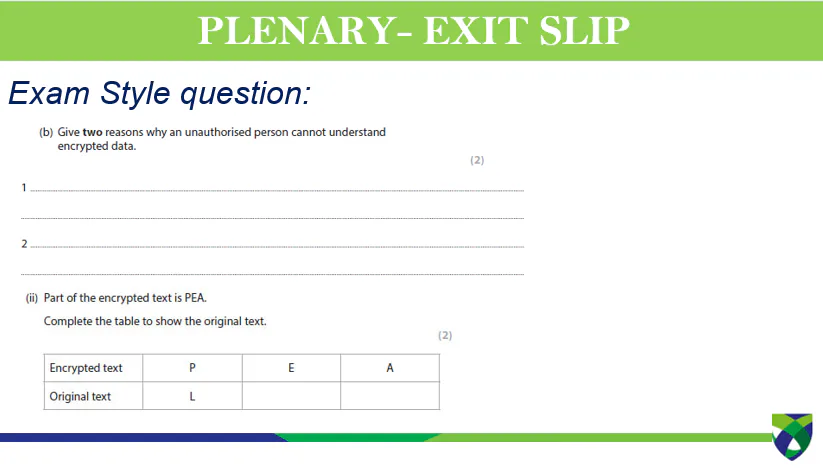
PLENARY - EXIT SLIP
Exam Style-past paper questions
Q1: Give two reason why unauthorised person can not understand encyrpted data?
______________________________________________________________________________________________________________________________________________________________________________________________________
Q2: Part of encrypted text is PEA. Complete the table to show the orignal text.

Methods of Encryption
KS4 – Data Transmission
Show answer
Auto Play
Slide 1 / 31
SLIDE
Similar Resources on Wayground

25 questions
Covalent bond polar vs non polar
Presentation
•
9th - 12th Grade
23 questions
Energy Sources LT 2&3 Lecture
Presentation
•
9th - 12th Grade
24 questions
Colombian exchange
Presentation
•
9th - 12th Grade
23 questions
Earths Movements
Presentation
•
9th - 12th Grade
25 questions
Periodic Trends
Presentation
•
10th - 12th Grade
21 questions
The Great Pacific Garbage Patch
Presentation
•
9th - 12th Grade
23 questions
Scientific Method
Presentation
•
9th - 12th Grade
Popular Resources on Wayground
20 questions
"What is the question asking??" Grades 3-5

Quiz
•
1st - 5th Grade
20 questions
“What is the question asking??” Grades 6-8
Quiz
•
6th - 8th Grade
10 questions
Fire Safety Quiz
Quiz
•
12th Grade
20 questions
Equivalent Fractions
Quiz
•
3rd Grade
34 questions
STAAR Review 6th - 8th grade Reading Part 1
Quiz
•
6th - 8th Grade
20 questions
“What is the question asking??” English I-II
Quiz
•
9th - 12th Grade
20 questions
Main Idea and Details
Quiz
•
5th Grade
47 questions
8th Grade Reading STAAR Ultimate Review!
Quiz
•
8th Grade
Discover more resources for Science
20 questions
Cell Biology and Biochemistry Quiz
Quiz
•
9th Grade
20 questions
Human Impact on the Environment Review #2
Quiz
•
9th Grade
20 questions
Balancing Chemical Equations
Quiz
•
9th Grade
26 questions
Cell Cycle and Cancer Retest
Quiz
•
9th Grade
20 questions
Mendelian Genetics Review
Quiz
•
9th Grade
10 questions
Exploring Light and Waves Concepts

Interactive video
•
6th - 10th Grade
10 questions
Evolution Review
Presentation
•
10th Grade
10 questions
Exploring Plant Structures and Adaptations
Interactive video
•
6th - 10th Grade