
T2T2 Reteach

Presentation
•
Science
•
8th Grade
•
Medium
+12
Standards-aligned

Jessica Culpepper
Used 2+ times
FREE Resource
9 Slides • 10 Questions
1
Unleashing Earth's Dynamic Forces
Explore the immense power and impact of Earth's dynamic forces, from earthquakes and volcanoes to plate tectonics and mountain formation. Discover the fascinating processes that shape our planet and influence its landscapes.
2
Convergent Boundaries
3
Multiple Choice
What are the three types of plboundaries?
Oceanic-oceanic, oceanic-continental, and continental-continental
Divergent, transform, and convergent
Subduction, collision, and spreading
Trench, ridge, and fault
4
Types of Convergent Boundaries
Trivia: Did you know that there are three types of plate boundaries? They are divergent, transform, and convergent. Divergent boundaries occur when two plates move apart, transform boundaries occur when two plates slide past each other, and convergent boundaries occur when two plates collide.
5
Earth's Dynamic Forces
6
Multiple Choice
What type of boundary is characterized by two tectonic plates moving away from each other?
Convergent Boundary
Transform Boundary
Divergent Boundary
Subduction Zone
7
Divergent Boundaries
Divergent boundaries occur when two tectonic plates move away from each other. This movement creates a gap where new crust is formed from molten material rising to the surface. Famous examples include the Mid-Atlantic Ridge and the East African Rift Valley. Volcanoes, earthquakes, and the creation of new oceanic crust are some of the fascinating phenomena associated with divergent boundaries.
8
Convection Currents:
Definition: The movement of heat within a fluid due to differences in temperature and density.
Driving Force: Heat transfer through convection causes fluid to rise or sink, creating circular motion.
Importance: Convection currents drive plate tectonics
9
Multiple Choice
What causes fluid to rise or sink and create circular motion?
Conduction
Radiation
Convection
Evaporation
10
Fluid Motion
Trivia: Fluid motion is caused by convection, where the fluid rises or sinks due to temperature differences. This creates circular motion, like in a boiling pot of water. Other options like conduction, radiation, and evaporation do not directly cause fluid motion.
11
Plate Movements
12
Multiple Choice
What are the three types of plate boundaries movements?
Convergent, divergent, and transfer
Colliding, moving apart, and sliding past
Mountains, rift valleys, and earthquakes
Tectonic plates, Earth's crust, and volcanoes
13
Plate Boundaries
Trivia: Plate boundaries are where tectonic plates interact. They can collide, move apart, or slide past each other. These interactions create mountains, rift valleys, and earthquakes. The three types of plate boundaries are convergent, divergent, and transform. Did you know? The movement of tectonic plates is responsible for shaping the Earth's surface over millions of years.
14
Multiple Choice

15
Multiple Choice

Which correctly identifies the geologic process that formed the Himalayan mountains (The World's Tallest Mountains, including Mt. Everest)?
Two continental plates converging
An earthquake in a subduction zone
A tectonic plate moving over a hot plate
Movement at a transform fault boundary
16
Multiple Choice

Volcanoes and Earthquakes typically occur _______________.
along plate boundaries
only under water
only in hawaii
where it is usually hot
17
Multiple Choice

What type of boundary is this?
Divergent
Convergent
Transform
18
Multiple Choice

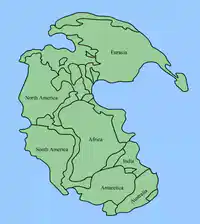
What evidence did Wegener use in his Continental Drift theory?
Continents and fossils fitting together/matching-up like puzzle pieces
Plant and animal fossils
mountain ranges and coal deposits line up across continents
all of the above
19
Multiple Choice

What type of Boundary is this? What event will occur at this boundary?
Transform / Earthquakes
Subduction / Volcano Eruption
Tornado / Rain
Mountain Building / Volcanism
Unleashing Earth's Dynamic Forces
Explore the immense power and impact of Earth's dynamic forces, from earthquakes and volcanoes to plate tectonics and mountain formation. Discover the fascinating processes that shape our planet and influence its landscapes.
Show answer
Auto Play
Slide 1 / 19
SLIDE
Similar Resources on Wayground

15 questions
Huang River/Shang Dynasty
Presentation
•
8th Grade
11 questions
Functions of Verbals
Presentation
•
8th Grade
15 questions
Waste Management
Presentation
•
9th Grade
16 questions
Theory of Plate Tectonics
Presentation
•
8th Grade
15 questions
Structures of the Earth
Presentation
•
8th Grade
15 questions
War of 1812
Presentation
•
8th Grade
19 questions
Physical and Chemical Changes
Presentation
•
8th Grade
14 questions
Chapter 2
Presentation
•
8th Grade
Popular Resources on Wayground
10 questions
HCS SCI 03 Summer School Assessment 1

Quiz
•
3rd Grade
15 questions
HCS SCI 05 Summer School Assessment 1 Review
Quiz
•
5th Grade
22 questions
Day 9 Equations and Inequalities Review
Quiz
•
9th Grade
10 questions
Writing and Identifying Ratios Practice
Quiz
•
5th - 6th Grade
7 questions
PYRAMID PERSPECTIVES part 1
Presentation
•
9th - 12th Grade
12 questions
Understanding the Fourth of July
Quiz
•
9th Grade
15 questions
Soccer World Cup Quiz Questions
Quiz
•
7th Grade