

Intro to Auto Loans

Presentation
•
Computers
•
12th Grade
•
Medium

Steven Howard
Used 1+ times
FREE Resource
24 Slides • 15 Questions
1

First Time Auto Buyer
Presented by
Brad Clegg
2

What do you need to get a loan?
◼
Credit is the most influential factor in a lender’s
decision to grant a loan.
3

What is Credit?
◼
Credit is your financial reputation.
4
Multiple Choice
The maximum amount of time over which an individual agrees to repay an auto loan. Typically ranges from 36 to 84 months.
Loan
Loan terms
Down payment
Annual percentage rate (APR)
5
Multiple Choice
A fixed amount of money, percentage of the selling price or item of value that is traded in to reduce the cost of purchasing a vehicle.
Credit history
Loan terms
Down payment
Annual percentage rate (APR)
6
Multiple Choice
A formal and extensive record of how good an individual is at maintaining their credit and paying their current and past debts in a timely manner.
Credit score
Loan terms
Lender
Credit history
7
Multiple Choice
Made by a bank or other lender to an individual so that person can purchase a new or used vehicle, using the vehicle as collateral for the loan.
Auto loan
Loan terms
Lender
Annual percentage rate (APR)
8

FICO Score
◼
FICO
–
Named for the score’s
developer, Fair Isaac Corporation.
◼
FICO score ranges from 350 to 850.
◼
Scores between 675
–
850 are
considered good credit.
◼
Scores less than 600 are considered
poor credit.
9

FICO Score
◼
You can buy your score from one of the three
major credit reporting companies:
◼
Equifax
◼
Experian
◼
TransUnion
10

How To Improve Your Score
◼
Establish credit by obtaining some form of loan.
◼
Be punctual and
CONSISTANT!
◼
Check credit report often.
◼
Keep debt in check.
◼
Avoid excessive inquiries.
◼
Keep accounts open.
◼
Keep a healthy mix (mortgage, credit card, a car loan,
and perhaps a retail card)
11
Multiple Choice
When making an automobile purchase decision, you always attempt to find the vehicle that provides the _____ price and the _____ quality.
lowest; lowest
highest; highest
lowest; highest
highest; lowest
12
Multiple Choice
When searching for a vehicle to purchase, which of the following variables is an important factor in the purchase decision-making process?
reliability
safety
cost efficiency
all of the choices are correct
13

How Mistakes Affect Your Score
14

Four C’s of Credit
◼
Capacity
–
annual income?
◼
Character
–
will you repay the loan?
◼
Collateral
–
do you have assets?
◼
Capital
–
what are you worth?
15

Advantages of Pre
-
Approval
◼
Gives you confidence and the upper
-
hand when
negotiating a price at the dealership.
◼
Ensures that you don’t buy more than you can
afford.
◼
Provides an opportunity to find the best interest
rate available
–
rather than relying on dealers who
have may have a hidden agenda.
16


RESOURCE 3: COMPARE - AUTO LOANS
Perhaps you think it will be easy to make
responsible decisions regarding auto loans in your
future. But, decision making can be tricky when
you’re considering your dream car. On the next
slide, follow the directions on the sheet to
complete the activity.
17
Multiple Choice
Why is it important to “haggle” when negotiating to buy a car?
Good hagglers save themselves an average of 10-15% on the price of the car.
Science proves that hagglers are more successful people in all aspects of life.
The video does not support haggling.
18

Buying a Car
Things to avoid while shopping for a car:
1. Do not show enthusiasm! Dealers take advantage.
2. Never buy a car in a hurry!
3. Do not give the salesman collateral.
4. Avoid being switched to a lease without doing your
homework.
5. Do not trade in your car without knowing its value
in advance.
6. Avoid financing automatically at a dealership.
19

Consider Buying a Used Car
Benefits of Used Cars
◼
Used cars do not depreciate as rapidly compared to
new cars.
◼
One year old vehicles are about 20
-
30% cheaper than
new ones.
◼
Used vehicles are sometimes still covered by extended
warranties.
◼
You can trace the history of the car using the Vehicle
Identification Number (VIN).
◼
Some CU’s offer new car rates on used vehicles.
20
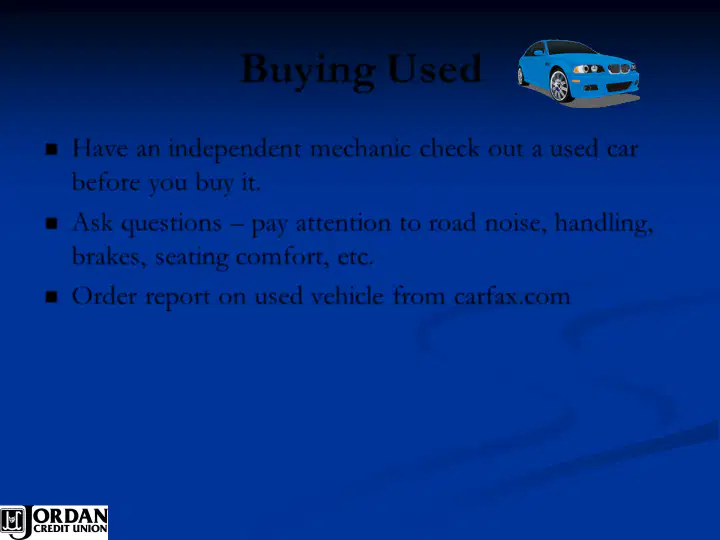
Buying Used
◼
Have an independent mechanic check out a used car
before you buy it.
◼
Ask questions
–
pay attention to road noise, handling,
brakes, seating comfort, etc.
◼
Order report on used vehicle from carfax.com
21
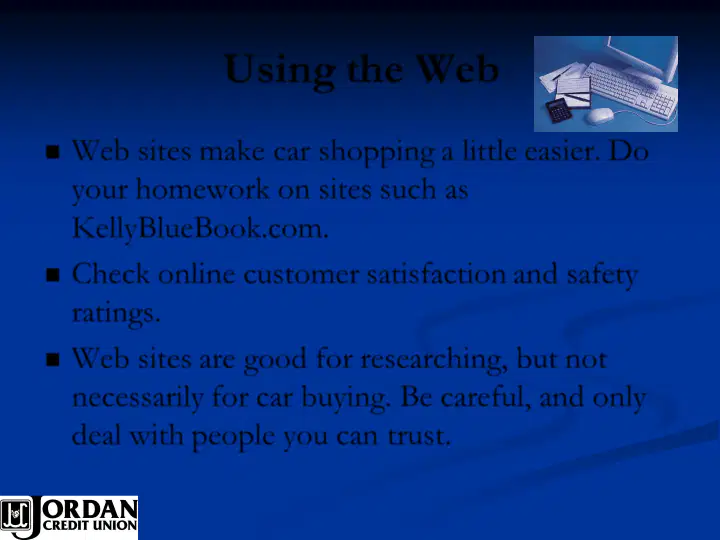
Using the Web
◼
Web sites make car shopping a little easier. Do
your homework on sites such as
KellyBlueBook.com.
◼
Check online customer satisfaction and safety
ratings.
◼
Web sites are good for researching, but not
necessarily for car buying. Be careful, and only
deal with people you can trust.
22

Auto Dealer Extras
◼
Extended Warranties
◼
Fabric and Paint Protection
◼
Rustproofing
◼
Maintenance Plans
◼
Ding Protection
◼
GAP Insurance
23

Everything is Negotiable
Consider asking for all these “Extras” for free…
24

You Can Always Buy “Extras”
Somewhere Else
◼
Extras at a car dealership are like extras at a
movie theater…they are WAY OVERPRICED!
Remember: You can always purchase extras
from your bank, credit union, or insurance agent
at about half the cost!
25

Beware of “Bait and Switch” Tactics
It’s not unusual for dealerships to use “bait and switch” tactics to
get consumers in the door, only to find that what they thought
was true, isn’t.
Things to watch for:
◼
0% Financing
◼
Manufacturer Rebate
◼
Outstanding prices
If it sounds too good to be true, it most likely is…
26

Insurance
First time auto buyers usually overlook the cost
of insurance when purchasing a vehicle. It can
be very expensive.
Sometimes your monthly
insurance payment can equal your car payment.
Remember the following coverages when
shopping for a new car…
Does not equal
27
Multiple Choice
28
Multiple Choice
29
Multiple Choice
30

Insurance Coverages
◼
Liability
(Required)
–
covers bodily injury, and damage to property
of others that you are found liable for in an accident. Make sure
you carry adequate limits. The minimum coverage required by the
state is often too low.
You are responsible for whatever your
insurance company does not pay.
◼
Collision
(may be required by your lender)
–
covers damage to
your vehicle, minus your deductible.
◼
Comprehensive
(may be required by your lender)
–
covers
miscellaneous damage to your vehicle, minus your deductible. For
example, if you hit a deer or if your car is stolen.
31

Cost of Insurance
Here are a few factors that affect the cost of
insurance:
◼
Gender (males cost more to insure)
◼
Residence (some cities have more accidents)
◼
Grades (you can get a good student discount)
◼
Type of vehicle (sporty models cost
a lot
more)
◼
Insurance coverage and limits
◼
Driving record
32
How to Decrease the Cost
◼
Shop around.
◼
Consider a higher deductible.
◼
Drop collision and/or comprehensive coverage
on vehicles worth $1,000 or less (check with
your lender first).
◼
Buy a low profile car.
◼
Take advantage of discounts (low mileage, auto
seat belts, airbags, multi
-
vehicle, no accidents,
driver training, good student, anti
-
lock brakes).
33
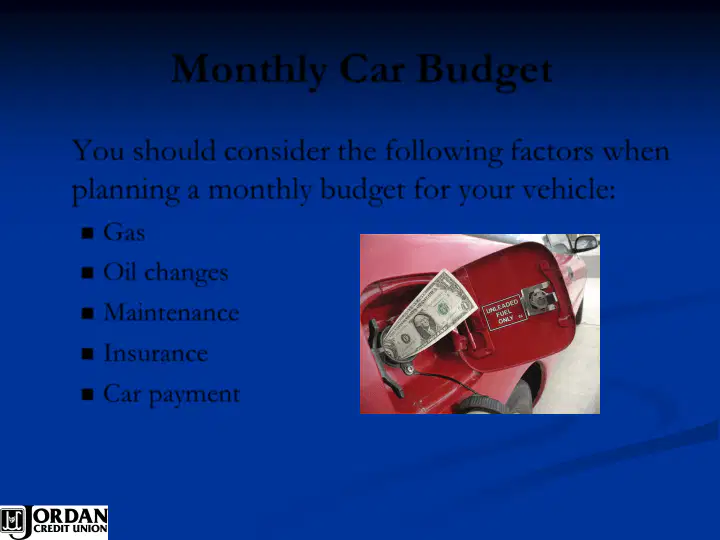
Monthly Car Budget
You should consider the following factors when
planning a monthly budget for your vehicle:
◼
Gas
◼
Oil changes
◼
Maintenance
◼
Insurance
◼
Car payment
34
Depreciation
Depreciation is the invisible cost of ownership.
In the first year of ownership, your vehicle may
lose 20% of its original value due to
depreciation. By the end of the fifth year, your
vehicle’s value drops by an average of 35%.
35
Multiple Choice
A unique number assigned by the automobile industry and used to identify an individual auto.
vehicle identification number (VIN)
manufacturer's suggested retail price (MSRP)
Buyers Guide sticker
sticker price
36
Multiple Choice
Placed on the window of a used car to explain the car's warranty coverage or lack of it.
vehicle identification number (VIN)
manufacturer's suggested retail price (MSRP)
Buyers Guide sticker
sticker price
37
Multiple Choice
Before buying a car, it is wise to ___________________ the car to see how well it handles in traffic, on the open road, and when starting, stopping, turning, and parking.
inspect
test-drive
read reviews
ask someone who owns that car
38
Multiple Choice
Which of the following is an expense that is not actually paid, but can represent a sizeable amount of money?
fuel
depreciation
registration
maintenance
39
Match
The ___________ of a loan is the amount of money borrowed.
A preapproved maximum amount that an individual can borrow is called a(n) _________.
__________ generally cost less to buy and insure.
For a used car to be ___________, it must have gone through a thorough mechanical and appearance inspection along with necessary repairs and replacements
The annual cost of credit a lender charges for extending credit is the ___________.
principal
line of credit
used
certified
annual percentage rate (APR)
principal
line of credit
used
certified
annual percentage rate (APR)
First Time Auto Buyer
Presented by
Brad Clegg
Show answer
Auto Play
Slide 1 / 39
SLIDE
Similar Resources on Wayground

33 questions
Chapter 5 - Morality
Presentation
•
11th Grade
34 questions
2.3 Computer Memory
Presentation
•
12th Grade
31 questions
ความรู้ทั่วไปเกี่ยวกับกฎหมาย
Presentation
•
12th Grade
31 questions
CSS 12 Quarter 3
Presentation
•
12th Grade
33 questions
MS EXCEL REVIEW
Presentation
•
University
35 questions
PRACTICAL RESEARCH 2- SSLM QTR1 WK3
Presentation
•
12th Grade
37 questions
Infographic
Presentation
•
11th Grade
32 questions
Hindi Shabdavali
Presentation
•
KG
Popular Resources on Wayground
10 questions
GPA Lesson
Presentation
•
9th - 12th Grade
7 questions
Albert Einstein

Quiz
•
3rd Grade
31 questions
Bridge A Review
Quiz
•
3rd Grade
6 questions
Blue Sue and Red Ruth
Quiz
•
3rd Grade
8 questions
(Day12 HW) Inverse Trig Ratios
Quiz
•
9th Grade
20 questions
Summer Geometry QUIZ (Week3)
Quiz
•
9th Grade
16 questions
Theme Practice
Quiz
•
7th Grade
20 questions
Taxes
Quiz
•
9th - 12th Grade