Search Header Logo
8.8.1-4-Light

8.8.1-4-Light

Assessment

Presentation

•

Mathematics

•

9th Grade

•

Medium

•
CCSS
RI.8.7, L.1.6, 8.G.A.3

+23

Standards-aligned

Created by

Jessica Freeman

Used 3+ times

FREE Resource

67 Slides • 72 Questions

1

Lesson 8.8.1-Light, Matter, and Color

Essential Questions:

1. What are some sources of light and how does light travel?
2. What happens to light that strikes matter?
3. Why do objects appear to have different colors?

2

Chapter 8
Light

3

​Light is made of vibrating electric and magnetic energy. This electromagnetic energy travels as a wave. These waves have frequency and amplitude. Light waves travel as transverse waves.

media

4

Multiple Select

Light energy moves as a wave made up of what kinds of energy?

1

electric energy

2

solar energy

3

thermal energy

4

magnetic energy

5

Multiple Choice

Light waves move as;

1

longitudinal waves

2

transverse waves

6

​Light energy travels with and without a medium, light can travel through the vacuum of space as well as travel through solids, liquids and gases.

media

7

​Light in a vacuum travels about 186,000 miles/s, but does slow down as it travels through mediums such as solids, liquids and gases. The more dense the medium the slower light will travel.

media

8

Multiple Choice

Light is unable to travel through solids.

1

True

2

False

9

Multiple Choice

Light energy moves slowest through;

1

solids

2

vacuums

3

liquids

4

gases

10

Multiple Choice

What is the speed of light?

1

186 miles per second

2

186,000 miles per minute

3

186 million miles per second

4

186,000 miles per second

11

Multiple Choice

___________ is a from of energy that we can see with our eyes.
1
shadow
2
light
3
energy
4
reflection 

12

Multiple Choice

Light travels in a straight line
1
True
2
False

13

Multiple Choice

Question image

_____?_____ materials allow some light to partially pass through, but not in a straight path.

1

Opaque

2

Transparent

3

Translucent

14

Multiple Choice

Question image

_____?_____ materials allow light waves to pass through easily.

1

Opaque

2

Transparent

3

Translucent

15

Multiple Choice

Question image

A mirror is ____________.

1

transparent

2

translucent

3

opaque

16

Multiple Choice

Question image

The image shows an object that is __________.

1

transparent

2

translucent

3

opaque

17

Multiple Choice

Question image
Which objects on the table are "Opaque"?
1
Pitcher; Supply Box; Pencil
2
Book; Pencil; Rock
3
Pencil; Book; Goggles

18

Multiple Choice

Question image

The image shows an object that is __________.

1

transparent

2

translucent

3

opaque

19

Multiple Choice

Question image

The image shows an object that is __________.

1

transparent

2

translucent

3

opaque

20

Multiple Choice

Question image
A student placed a pencil in a cup of water.  The pencil appears broken because light-
1
always travels in a straight line
2
bends when it passes through water
3
makes the water in the glass evaporate
4
reflects the pencil on the water's surface

21

Black and White Objects

  • When an object absorbs all light waves, it appears black

  • When an object reflects all light waves, it appears white

  • Any other color that you see is due to reflection of light waves

media

22

What determines what colors we see?

  • Remember the colors we can see are called visible light – Roy G. Biv

  • Light can be reflected or absorbed. Objects that appear a specific color are because those are the light waves that are reflected

  • Objects that are translucent or transparent can absorb, reflect, and transmit light waves.

media

23

Multiple Choice

What type of wave interaction is being described - The road becomes hot on a summer day due to matter taking in light waves.

1

absorption

2

reflection

3

refraction

4

scattering

24

Matter Can Reflect Light

  • Reflection – the bouncing of light off a surface; The Law of Reflection states that a light way striking a mirror will bounce off the mirror at the same angle

  • When light bounces off a smooth surface it reflects in a uniform way

  • When light bounces off a rough surface it scatters in many different directions

25

Matter can Absorb Light

  • Opaque – materials do not let any light pass through; they can reflect, absorb, or both

  • Absorption – transfer of light energy to matter (think like how a sponge soaks up water)

26

Matter can Transmit Light

  • Light is a type of electromagnetic wave, so it can travel through empty space

  • When light meets with a material, it can be passed through the material – we call this transmission

  • Transparent â€“ Matter that transmits light; you can see through them

  • Translucent â€“ light is scattered in different directions; you can't see all the way through

27

Multiple Choice

Question image

Which object refracted the laser beam?

1

Silver locket

2

Picture frame

3

Glass marble

4

Notebook

28

Multiple Choice

Which of the following is the best example of an object absorbing light?

1

A black sweater in the sun.

2

A clean window in the sun.

3

A curved mirror in the sun.

4

A long shadow in the sun.

29

Multiple Choice

Caleb is sitting near the window on a sunny day. When he closes the curtain, the room becomes darker. What property of the curtain allows it to make the room darker?

1

The curtain absorbs light.

2

The curtain is brightly colored.

3

The curtain folds easily.

4

The curtain is rectangular shape.

30

Multiple Select

Which of the following is an example of a wave interaction?

1

transmission

2

absorption

3

reflection

4

diffraction

31

media

32

media

33

Multiple Choice

Light waves move ___________ the light source

1

towards

2

away from

34

media

35

media

36

media

37

Multiple Choice

Question image

How would you describe this cup?

1

opaque

2

translucent

3

transparent

38

media

39

Lesson 8.8.2-Reflection and Mirrors

Essential Questions:

1. How does light reflect from smooth surfaces and rough surfaces?
2. What happens to light when it strikes a concave mirror?
3. Which types of mirrors can produce a virtual image?

40

Reflection of Light

A ray diagram shows how light travels, including what happens when it reaches a surface. In a ray diagram, you draw each ray as:


a straight line with an arrowhead pointing in the direction that the light travels


Remember to use a ruler and a sharp pencil.

41

media

42

Multiple Choice

Question image

Which is the reflected ray?

1

A

2

B

3

C

4

D

43

Multiple Choice

Question image

Which is the reflected ray?

1

A

2

B

3

C

4

D

44

Multiple Choice

Question image

Which is the reflected ray?

1

A

2

B

3

C

4

D

45

Multiple Choice

Question image

Which is the reflected ray?

1

A

2

B

3

C

4

D

46

Multiple Choice

Question image

In the diagram, which letter represents the angle of incidence?

1

A

2

B

3

C

4

D

47

Multiple Choice

Law of reflection state that - The angle of incidence is .................. to the angle of reflection.
1
equal
2
double
3
half

48

Multiple Choice

Question image

In the diagram, which letter show reflected light?

1

A

2

B

3

C

4

D

49

Multiple Choice

Question image

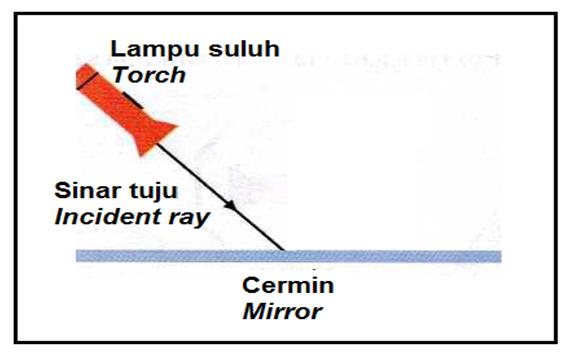
The following diagram shows the ray diagram when a torch light is torched towards a mirror. Which of the following is the correct reflected ray?

1
2
3

50

Multiple Choice

Mirrors work by

1

Absorbing the light

2

Refracting the light

3

Reflecting the light

4

Letting the light through

51

Learning Objectives


I can identify two kinds of reflections.


I can describe the types of images produced by plane, concave, and convex mirrors.

media

52

There are 2 ways in which a surface can reflect light: Regular Reflection and Diffuse Reflection.

  • Regular Reflection: occurs when parallel rays of light hit a smooth surface. All rays reflect at the same angle and produce a clear image.

  • Diffuse Reflection: occurs when parallel rays of light hit an uneven surface and reflect at diferent angles producing an unclear image.

53

  • Top Image: Regular Reflection

  • Bottom Image: Diffuse Reflection

media

54

Multiple Choice

Question image

What type of reflection will this image produce?

1

Regular Reflection

2

Diffuse Reflection

55

What is an image?

  • An Image is a copy of the object formed by reflected or refracted light rays.

  • There are two types of Images: Virtual and Real

media

56

Virtual Images:

  • Virtual images are right side up

  • Virtual images have the left and right side reversed.

  • Virtual images form where light seems to come from (like behind the mirror)

  • Virtual images cannot be projected onto a screen

media

57

Real Images

  • Real images are upside down

  • Real images form at the focal point where light rays meet

  • Real images can be projected onto a screen

media

58

Multiple Choice

What type of image is upside down?

1

real

2

virtual

59

Multiple Choice

What type of image can be projected onto a screen?

1

real

2

virtual

60

Multiple Choice

Which type of image is right side up but left and right are reversed?

1

real

2

virtual

61

Types of Mirrors

There are three types of mirrors that we will discuss: Plane, Concave, and Convex.

media

62

Plane Mirrors

Flat mirrors like the one you have in your bathroom. Creates an image that is:

Virtual and Same Size as the object

media

63

Concave Mirrors

  • Curved (like the inside of a spoon)

  • Real or Virtual Images

  • (Virtual Image when object is between the focal point and the mirror)

  • (Real Image when object is beyond the focal point)

  • Size can be larger, smaller, or same (the closer to the focal point the larger it will appear)

media

64

65

Convex Mirrors

  • virtual image smaller than the object

  • advantage is that it allows you to see a larger area but disadvantage is the image is reduced in size.

  • Used in driver side mirrors and on ceilings in stores for security.

media

66

67

Overview

  • There are two types of reflections: Regular and Diffuse

  • There are three types of mirrors (Plane, Concave, and Convex)

  • These mirrors can produce two types of images: Real or Virtual

  • Virtual Images are right side up

  • Real Images are upside down

media

68

Multiple Choice

Now I get it! There are two types of reflections: __________ and ____________

1

Diffuse and Regular

2

Real and Virtual

69

Multiple Choice

An ___________ is a copy of an object formed by the reflected or refracted rays of light.

1

Image

2

Convex

3

concave

4

plane

70

Multiple Choice

A ___________ mirror can produce both real and virtual images.

1

plane

2

concave

3

convex

71

Multiple Choice

What kind of image does a convex mirror produce?

1

real but smaller

2

virtual but smaller

72

Multiple Choice

What kind of image does a plane mirror produce?

1

real and same size

2

virtual and same size

73

Lesson 8.8.3-Refraction & Lenses

Essential Questions:

1. What happens to light as it moves between transparent substances?
2. How do concave lenses and convex lenses affect light?
3. How does the eye detect light and color?

74

Refraction

media

75

As a light wave moves from one medium into another, its speed changes

media

76

Multiple Choice

As a light wave moves from a faster medium to a slower medium, its speed

1

does not change

2

slows down

3

speeds up

77

If the wave enters the new medium at an angle, the wave will change direction

media

78

media

79

media

80

Multiple Choice

When a wave enters a new medium AT AN ANGLE the wave

1

continues in the same direction

2

changes direction

81

Multiple Choice

When a light wave enters a new medium straight (at a 90o angle) the wave

1

continues in the same direction

2

changes direction

82

Refraction

the change in direction of a wave as it changes speed while moving from one medium to another

83

84

Multiple Select

Choose all examples of refraction

1
2
3
4

85

media

86

media

87

Poll

Question image

Position A is where the fish is actually located. Because of refraction, where does the fish APPEAR to be?

A

B

C

88

Other examples of refraction

prisms

media

89

Diamonds

media
media

90

Rainbow

media
media

91

Refraction and lenses

​A lens is a transparent object with at least one curved side that causes light to change direction.

media

92

media

Convex Lens: Light rays that move through a convex lens come together or converge. Convex lenses are also called converging lenses.

93

media

​Convex lens images

94

media

Concave Lens: as light rays move through a concave lens, they spread apart, or diverge. Concave lenses are often called diverging lenses.

95

media
media

​Concave lens images

96

97

Multiple Choice

The point where light rays converge to a point is called the

1

middle point

2

critical point

3

focal point

98

Multiple Choice

A __________ lens DOES produce a focal point but a __________ lens DOES NOT.

1

concave

convex

2

opaque

translucent

3

convex

concave

99

100

Lesson 8.8.4-Optical Technology

Essential Questions:

1. What do devices such as telescopes, microscopes, and cameras have in common?
2. What is laser light and how is it used?
3. How do optical fibers work and how are they used?

101

Uses of Light

media

102

Refraction vs. Reflection

Refraction​

  • Bending of light

  • Happens when you change Medium

  • Lens

  • Rainbows​

media
media

Reflection

  • Bouncing back of light

  • Mirrors​

103

Multiple Choice

_____ bends light

1

Refraction

2

Reflection

104

Multiple Choice

_____ is when light bounces back.

1

Refraction

2

Reflection

105

Fiber Optics

  • Use Total Internal Reflection

  • Small glass strand for light to travel

  • Used by internet & doctors to perform surgeries​

media
media

106

LASERS

  • ONE color or wavelength of light

  • Used to....

    • Cut metal

    • Surgery (ex. Lasic eye surgery)

    • Bar code Scanner

    • DVD player

    • Laser printers

media
media
media
media

107

Multiple Choice

Question image

This is an example of ____

1

Fiber optics

2

Mirror

3

Laser

4

Lens

108

Multiple Choice

Question image

This is an example of ____

1

Fiber optics

2

Mirror

3

Laser

4

Lens

109

Multiple Choice

Question image

Internet cables use light in the form of _____

1

Fiber optics

2

Mirror

3

Laser

4

Lens

110

Multiple Choice

Question image

Bar code scanners use light in the form of ____

1

Fiber optics

2

Mirror

3

Laser

4

Lens

111

Multiple Choice

_____ work by total internal reflection of light

1

Lasers

2

Fiber optics

3

Mirrors

4

Lens

112

Multiple Select

Which of the following are uses of LASERS? (Choose ALL that apply)

1

Internet

2

Eye surgery

3

Bar code scanners

4

DVD players

5

Cut metal

113

Mirrors

  • REFLECT light

  • Light bounces off at the same angle it enters

media

114

Multiple Choice

Mirrors____ light.

1

Refract

2

Reflect

3

Absorb

4

Diffract

115

Multiple Choice

If light strikes a plane mirror at a 45o angle, what angle will it reflect?

1

145o

2

90o

3

45o

4

180o

116

Types of Mirrors

  • Concave

  • Convex

  • Plane

media

117

Concave Mirror

  • Curves INWARD

  • Images are upside down

  • Used in...Makeup mirrors, dental equipment, car headlights

media

118

Convex Mirror

  • Curves OUTWARD

  • Images are smaller than actual size

  • Used in...passenger car mirror, stores (for security)

media

119

Plane Mirror

  • FLAT

  • Images are opposite

media

120

media

121

Multiple Choice

Which type of mirror is curved outward?

1

Concave

2

Convex

3

Plane

122

Multiple Choice

Which type of mirror is curved inward?

1

Concave

2

Convex

3

Plane

123

Multiple Choice

Which type of mirror is flat?

1

Concave

2

Convex

3

Plane

124

Multiple Choice

Question image

Which type of mirror is this?

1

Concave

2

Convex

3

Plane

125

Multiple Choice

Question image

Which type of mirror is this?

1

Concave

2

Convex

3

Plane

126

Multiple Choice

Question image

Which type of mirror is this?

1

Concave

2

Convex

3

Plane

127

Lenses

  • REFRACT light

  • Light bends as it passes through a different medium

media

128

Multiple Choice

Lenses____ light.

1

Refract

2

Reflect

3

Absorb

4

Diffract

129

Multiple Choice

Question image

As the light passes through this prism it is refracted. This means---

1

It bounces back to make colors

2

It is absorbed into the air

3

It bends based on the color's wavelength

130

Types of Lenses

  • Concave

  • Convex

media

131

Concave lenses

  • Curve INWARD

  • Spreads out light

  • Used in....binoculars, spy hole in doors, flashlights, and glasses

media

132

Convex lenses

  • Curves OUTWARD

  • Focuses light together

  • Used in....YOUR EYE, magnifying glasses, telescopes, Microscopes, glasses

media

133

Multiple Choice

Which type of lens is curved outward?

1

Concave

2

Convex

134

Multiple Choice

Which type of lens is curved inward?

1

Concave

2

Convex

135

Multiple Choice

Question image

Which type of lens is this?

1

Concave

2

Convex

136

Multiple Choice

Question image

Which type of lens is this?

1

Concave

2

Convex

137

Multiple Choice

Question image

Which type of lens is this?

1

Concave

2

Convex

138

Multiple Choice

Question image

Which type of lens is this? (Curved outward)

1

Concave

2

Convex

139

Multiple Choice

Question image

Which type of lens is this? (Curved inward)

1

Concave

2

Convex

Lesson 8.8.1-Light, Matter, and Color

Essential Questions:

1. What are some sources of light and how does light travel?
2. What happens to light that strikes matter?
3. Why do objects appear to have different colors?

Show answer

Auto Play

Slide 1 / 139

SLIDE