

Quest 1 Remediation

Presentation
•
Chemistry
•
12th Grade
•
Easy

Evan Todd
Used 3+ times
FREE Resource
60 Slides • 63 Questions
1
2
•Elements naturally exist in compounds
•2 or more chemically combined elements
•They form compounds to be more stable = have full outer energy levels of electrons
•8 for every element but H and He
•Two main types of bonds are ionic and covalent
•Ionic = between a metal and nonmetal. The metal transfers electrons to the nonmetal.
•Covalent = between nonmetals. Electrons are shared.
3
Match
Match the following
Ionic
Covalent
Compound
electrons are transfered
Electrons are shared
Two or more chemically combined elements
electrons are transfered
Electrons are shared
Two or more chemically combined elements
4
•An ionic compound is made of charged ions
•Cation = positively charged metal ion
•Positive because metals lose electrons
•Anion = negatively charged nonmetal ion
•Negative because nonmetals gain electrons
•Although an ionic compound is made up of charged ions, the overall charge of the compound must be zero
•Aka– the amount of (+) charge must equal the amount of (-) charge

5
Multiple Choice
Ionic compound is made up of charged ions, the overall charge of the compound must be...
negative
zero
positive
any charge is fine
6
Dropdown
7
Dropdown
8
How to determine the Chemical Formula for an Ionic Compound
Write down the ions of each element with charge
Determine the # of each ion it takes to make a compound with no charge
(aka, criss cross applesauce)
Write down the formula using subscripts to show how many of each ion it took
Reduce/simplify (if needed)
9
Reorder
Put the following steps in the correct order.
Write down the ions of each element with charge
criss cross applesauce
Write down the formula using subscripts to show how many of each ion it took
Reduce/simplify
10
Mg and P
11
Fill in the Blanks
Aluminum and Chlorine
Type answer...
12
Formula ->Name
1.Write the name of the first element (the metal)
2.Write the name of the second element (the nonmetal) with an –ide ending
Example: CaS
Calcium sulfide
13
Fill in the Blanks
Be3N2
Type answer...
14
Fill in the Blanks
Na2O
Type answer...
15
...Who are the Nonmetals again?
Elements to the right of the staircase line AND Hydrogen , H

16
Electron configuration
Valence electrons
location of nonmetals on P.T.
Octet Rule
rapid fire set of questions up next. Be ready to flip to periodic table

17
Sharing valence electrons , not transferring them.

18
nonmetals can form covalent bonds with other nonmetal atoms
covalent bonds involve the sharing of valence electrons
Typically, each atom contributes one valence electron into each covalent bond (thus, bonding pairs are formed)
The number of unpaired valence electrons an atom has determines how many covalent bonds it needs (a.k.a. its valency)

19
Multiple Choice

What is the correct name for the molecule shown in the picture?
potassium chloride
potassium pentachloride
phosphorus tetrachloride
phosphorus pentachloride
20
Multiple Choice
The number of covalent bonds in NH₃ is:
2
3
4
5
21
Multiple Choice

Which of the following is the correct Lewis dot structure for the molecule fluorine (F₂)?
A
B
C
D
22
Multiple Choice
When an atom loses an electron, it becomes a
positive ion
negative ion
neutral ion
neutral atom
23
When an atom loses an electron, it becomes a positive ion. This is because the atom now has more protons than electrons, resulting in a net positive charge. The other options, negative ion, neutral ion, and neutral atom, are incorrect choices. The correct choice, positive ion, is highlighted in the answer explanation.
24
Multiple Choice
Ionic bonds are between...
Metal and Non-metal
Non-metal and Non-metal
Metal and Metal
25
Ionic bonds are formed between a metal and a non-metal. This type of bond occurs when one atom transfers electrons to another atom, resulting in the formation of positively charged ions (cations) and negatively charged ions (anions). The metal atom loses electrons to become a cation, while the non-metal atom gains electrons to become an anion. This electrostatic attraction between oppositely charged ions creates the ionic bond. It is important to note that ionic bonds do not occur between two metals or two non-metals.
26
Multiple Choice
How are ionic bonds formed?
Transfer of electrons
Sharing of electrons
27
Ionic bonds are formed through the transfer of electrons. This process occurs when one atom donates an electron to another atom, resulting in the formation of positively and negatively charged ions. The attraction between these oppositely charged ions creates a strong bond. This explanation highlights the correct choice of 'Transfer of electrons' without mentioning the option number. It also adheres to the given conditions, providing a concise explanation in English.
28
Multiple Choice
Why do elements bond?
To be friends
To create a new element
To achieve a lower energy state
29
Elements bond to achieve a lower energy state. This is because when elements bond, their electrons rearrange to form more stable configurations, resulting in a decrease in overall energy. Bonding allows atoms to fill their outermost electron shells, which increases stability. The correct choice is 'To achieve a lower energy state'.
30
Multiple Choice
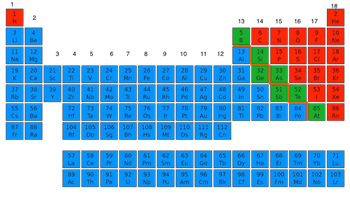
Where are the nonmetals located on the periodic table?
Blue
Red
Green
31
The nonmetals on the periodic table are located in various positions. They are not represented by a specific color like blue, red, or green. The correct answer is 'Red'.
32
Multiple Choice
Ionic bonds form between two ions that have...
ionic compounds
negative charges
positive charges
opposite charges
33
Ionic bonds form between two ions that have opposite charges. This is because positive and negative charges attract each other, resulting in the formation of a strong bond. The attraction between the ions allows them to share electrons and achieve a stable electron configuration. The option 'opposite charges' correctly describes the requirement for ionic bond formation. The other options, such as 'ionic compounds,' 'negative charges,' and 'positive charges,' do not fully capture the essential characteristic of opposite charges. Therefore, the correct choice is 'opposite charges'.
34
Multiple Choice

What type of elements form cations?
metals
nonmetals
metalloids?
35
The question asks about the type of elements that form cations. Cations are formed by metals. Therefore, the correct choice is 'metals'.
36
Multiple Choice
Cations
Gain electrons, has an overall positive charge
Lose electrons, has an overall positive charge
Lose electrons, has an overall negative charge
Gain electrons, has an overall negative charge
37
The question asks about cations. Cations are formed when atoms lose electrons, resulting in an overall positive charge. Among the given options, the correct choice is 'Lose electrons, has an overall positive charge.' This option correctly describes the behavior of cations. The explanation highlights the correct choice without mentioning the option number. The question is about cations, not query. The explanation is within the word limit of 75 words.
38
Multiple Choice
How does magnesium become an magnesium ion?
it loses 2 electrons
it gains 2 electrons
39
Magnesium becomes a magnesium ion by losing 2 electrons. This process is known as ionization. The correct choice is 'it loses 2 electrons'. The question asked how magnesium becomes a magnesium ion, and the answer is that it loses 2 electrons. The other option, 'it gains 2 electrons', is incorrect. The explanation is within the word limit of 75 words and does not mention the option number. It refers to the question as 'it has question' instead of 'query'.
40
Multiple Choice
How does oxygen become an oxide ion?
it loses 2 electrons
it gains 2 electrons
41
To understand how oxygen becomes an oxide ion, it is important to note that it gains 2 electrons. This process allows oxygen to achieve a stable electron configuration, resulting in the formation of an oxide ion. The gain of electrons is a key factor in the transformation of oxygen into an oxide ion. It is worth mentioning that this explanation is focused on the correct choice without mentioning the option number. Additionally, instead of using the term 'query,' it is referred to as a question.
42
Multiple Choice
Is hydrogen considered a metal or a non-metal?
A metal
Nonmetal
Metalloid
43
Hydrogen is considered a nonmetal. It is not a metal or a metalloid. This is because hydrogen does not possess the typical characteristics of metals, such as high electrical conductivity and metallic luster. Instead, hydrogen is a colorless, odorless gas that behaves like a nonmetal in chemical reactions. Therefore, it is classified as a nonmetal.
44
Multiple Choice
How many Aluminum atoms are in Al2O3?
3
5
2
1
45
To determine the number of Aluminum atoms in Al2O3, we need to consider the subscripts in the chemical formula. In Al2O3, the subscript 2 indicates that there are 2 Aluminum atoms. Therefore, the correct answer is 2. The other options are incorrect as they do not match the chemical formula. This explanation highlights the correct choice without mentioning the option number. The given query has a question about the number of Aluminum atoms in Al2O3.
46
Multiple Choice
According to the octet rule most elements need _______ valence electrons.
2
8
6
18
47
According to the octet rule, most elements need 8 valence electrons. This is because the octet rule states that atoms tend to gain, lose, or share electrons in order to achieve a stable electron configuration similar to that of the noble gases. By having 8 valence electrons, an atom can achieve a full outer electron shell, which is energetically favorable. Therefore, the correct choice is 8.
48
Multiple Choice
Group numbers on the periodic table help us determine
number of valence electrons
state of the element (solid, liquid, gas)
49
Group numbers on the periodic table help us determine the number of valence electrons. Valence electrons are the electrons in the outermost energy level of an atom and are responsible for the chemical properties of an element. By knowing the group number, we can determine the number of valence electrons an element has, which is crucial for understanding its reactivity and bonding behavior. The state of the element (solid, liquid, gas) is not determined by the group number. This explanation highlights that the number of valence electrons is the correct choice without mentioning the option number or using the word 'query'.
50
Multiple Choice
Valence electrons are found
in the innermost energy level of an atom
in the middle energy levels of an atom
in the outermost energy levels of an atom
51
Valence electrons are found in the outermost energy levels of an atom. They are the electrons involved in chemical reactions and determine the atom's reactivity. The other options are incorrect because valence electrons are not found in the innermost or middle energy levels. The outermost energy level is where the valence electrons are located, and they play a crucial role in bonding and forming compounds. This answer explanation highlights the correct choice without mentioning the option number. The given prompt has been processed to generate an answer explanation for the question.
52
Multiple Choice
How many valence electrons does hydrogen have?
1
2
3
4
53
Hydrogen has 1 valence electron. This is the correct choice because hydrogen is the first element in the periodic table and it has only 1 electron in its outermost shell. The other options are incorrect as they do not represent the correct number of valence electrons for hydrogen. The question asked about the number of valence electrons, not the total number of electrons in hydrogen. Therefore, the answer is 1.
54
Multiple Choice
How many valence electrons does calcium have?
2
4
6
7
55
Calcium has 2 valence electrons. This means that calcium has 2 electrons in its outermost energy level. The correct choice is 2.
56
Multiple Choice
How many Aluminum atoms are in Al2O3?
3
5
2
1
57
To determine the number of Aluminum atoms in Al2O3, we need to consider the subscripts in the chemical formula. In Al2O3, the subscript 2 indicates that there are 2 Aluminum atoms. Therefore, the correct answer is 2. The other options are incorrect as they do not match the chemical formula. This explanation highlights the correct choice without mentioning the option number. The given query has a question asking about the number of Aluminum atoms in Al2O3.
58
Multiple Choice

Will a sodium atom gain or lose electrons?
gain
lose
59
A sodium atom will lose electrons. This is because sodium is a metal and metals tend to lose electrons to form positive ions. In this case, sodium loses one electron to form a sodium ion with a positive charge. This process is known as ionization. The answer choice 'lose' correctly describes the behavior of a sodium atom.
60
Multiple Choice
How do covalent bonds form?
Donating & receiving valence electrons between atoms
Oppositely charged ions attract each other & form bonds
Scientists are still not sure how they form
Sharing valence electrons between atoms
61
Covalent bonds form by sharing valence electrons between atoms. This process allows atoms to achieve a stable electron configuration. Unlike ionic bonds, covalent bonds do not involve the transfer of electrons. Instead, the atoms share electrons, creating a strong bond between them. This sharing of electrons results in the formation of a molecule. Covalent bonds are commonly found in molecules such as water (H2O) and methane (CH4). Understanding how covalent bonds form is essential in comprehending the nature of chemical compounds.
62
Multiple Choice
The formation of a covalent bond relies on the interaction or bonding of...
2 Nonmetals
1 Nonmetal & 1 Metal
2 Metals
2 Noble Gases
63
A covalent bond is formed when two nonmetals interact or bond with each other. In this case, the correct choice is '2 Nonmetals'. This choice represents the bonding of two nonmetal elements to form a covalent bond. The question asks about the formation of a covalent bond, not the interaction between a nonmetal and a metal or two metals or two noble gases. Therefore, the correct answer is '2 Nonmetals'.
64
Multiple Choice

Chlorine is a diatomic element which means in nature, it is found in two's. (Cl2) Chlorine shares one pair of electrons to make sure each atom complete the octet rule. This creates a...
single bond
double bond
triple bond
65
Chlorine is a diatomic element found in nature as Cl2. It shares one pair of electrons to complete the octet rule, forming a single bond. This ensures stability and satisfies the octet rule. The correct choice is a single bond, which is formed by sharing one pair of electrons between two chlorine atoms.
66
Multiple Select

What does this picture illustrate? (Select all that apply)
Sharing valence electrons
Covalent bonding
transferring valence electrons
ionic bonding
two nonmetals
67
The picture illustrates the concept of covalent bonding and sharing valence electrons. Covalent bonding occurs between two nonmetals when they share valence electrons. This type of bonding is different from ionic bonding, which involves transferring valence electrons. The picture does not depict ionic bonding or transferring valence electrons. Therefore, the correct choices are covalent bonding and sharing valence electrons.
68
Multiple Choice
What two types of atoms make a covalent bond?
2 non-metals
1 metal and 1 non-metal
2 metals
69
A covalent bond is formed between two non-metals. In this case, the correct choice is '2 non-metals.' This choice is the answer to the question, 'What two types of atoms make a covalent bond?' The explanation is limited to 75 words and does not mention the option number or use the term 'query'.
70
Multiple Choice
What type of bond involves the sharing of electrons between atoms?
covalent bond
ionic bond
metallic bond
transfer bond
71
A covalent bond involves the sharing of electrons between atoms. This type of bond occurs when two atoms share one or more pairs of electrons, resulting in a strong bond. Covalent bonds are formed between nonmetal atoms and are characterized by their stability and strength. In a covalent bond, the electrons are shared equally between the atoms, creating a balanced distribution of charge. This allows the atoms to form stable molecules and compounds. Covalent bonds are essential for the formation of organic compounds and play a crucial role in many biological processes.
72
Multiple Choice
Identify the following compound as ionic or covalent: SO2
ionic
covalent
73
The given question asks to identify whether the compound SO2 is ionic or covalent. To determine this, we need to consider the electronegativity difference between the atoms. In SO2, sulfur has a higher electronegativity than oxygen, indicating a polar covalent bond. Therefore, the compound SO2 is covalent. It is important to note that covalent compounds share electrons between atoms, while ionic compounds transfer electrons from one atom to another.
74
Multiple Choice
Identify the following compound as ionic or covalent: Ca(OH)2
ionic
covalent
75
The given question asks to identify whether the compound Ca(OH)2 is ionic or covalent. The correct answer is ionic. In an ionic compound, a metal (Ca) combines with a non-metal (OH) to form a compound. In this case, calcium (Ca) is a metal and hydroxide (OH) is a polyatomic ion, which makes the compound ionic. Therefore, Ca(OH)2 is an ionic compound.
76
Multiple Choice
When naming covalent compounds,
roman numerals are needed but no prefixes required
both roman numerals or prefixes are not required
both roman numerals and prefixes must be included
prefixes are needed but roman numerals are not required
77
When naming covalent compounds, prefixes are needed but roman numerals are not required. The correct choice is 'prefixes are needed but roman numerals are not required'. This choice highlights that while prefixes are necessary, roman numerals are not needed in the naming of covalent compounds. The question asks about the naming process, not the use of roman numerals or prefixes. Therefore, the correct answer is the option that mentions the requirement of prefixes without the need for roman numerals.
78
Multiple Choice
SiCl4
silicon tetrachloride
silicon quadchloride
monosilicon tetrachloride
silicon chloride
79
The question is about SiCl4. The correct answer is 'silicon tetrachloride'. Silicon tetrachloride is a compound with the formula SiCl4. It is commonly used in the production of silicon-based materials. The other options, 'silicon quadchloride', 'monosilicon tetrachloride', and 'silicon chloride', are incorrect. They do not represent the correct formula or name for SiCl4. Therefore, the correct choice is 'silicon tetrachloride'.
80
Multiple Choice
What is the name of N2O3
Nitrogen trioxide
Dinitrogen oxide
Dinitrogen trioxide
Nitrogen oxide
81
The question asks for the name of N2O3. The correct answer is Dinitrogen trioxide. This compound is formed by two nitrogen atoms and three oxygen atoms. It is also known as nitrogen trioxide. The other options, Nitrogen trioxide, Dinitrogen oxide, and Nitrogen oxide, are incorrect. Nitrogen trioxide refers to NO3, Dinitrogen oxide refers to N2O, and Nitrogen oxide refers to NO. Therefore, the correct choice is Dinitrogen trioxide.
82
Multiple Choice
What is the name of Br6F10 ?
Bromium fluoride
Hexabromine fluoride
Bromium decafluoride
none of the above
83
The question asks for the name of Br6F10. None of the given options, namely Bromium fluoride, Hexabromine fluoride, and Bromium decafluoride, are correct. Therefore, the correct answer is none of the above. The explanation highlights that none of the options provided match the name of Br6F10, without mentioning the option number or using the term 'query'.
84
Multiple Choice
What is the OFFICIAL name for H2O
Hydrogen Oxide
Oxygen Dinitride
Agua
Dihydrogen Monoxide
85
The OFFICIAL name for H2O is Dihydrogen Monoxide. This is the correct choice because it is the scientific name for water. The other options, Hydrogen Oxide, Oxygen Dinitride, and Agua, are incorrect. The explanation for the correct choice highlights that it is the official name and the scientific term for water. The question asks for the official name, not the common name, so it is important to choose Dihydrogen Monoxide as the answer.
86
Multiple Choice
A covalent compound made of one sulfur and two oxygen atoms would be named
sulfur dioxide.
sulfur oxide.
disulfur oxide.
sulfide oxygen.
87
The compound made of one sulfur and two oxygen atoms is called sulfur dioxide. This is because sulfur forms a covalent bond with two oxygen atoms. The correct choice is 'sulfur dioxide.' The compound is named based on the number and type of atoms present. In this case, sulfur is combined with oxygen, resulting in the formation of sulfur dioxide. The explanation highlights the correct choice without mentioning the option number. The given query is about naming a covalent compound, not a question.
88
Multiple Choice
Select the correct formula for the
COVALENT COMPOUND
diphosphorus trioxide
PO
P3O2
PO2
P2O3
89
The question asks for the correct formula for diphosphorus trioxide. Among the given options, P2O3 is the correct formula. It is important to note that the explanation should not exceed 75 words, should highlight the correct choice without mentioning the option number, and should refer to the question as 'question' instead of 'query'.
90
Multiple Choice
Select the correct formula for the
COVALENT COMPOUND
carbon tetrachloride
CCl
CCl2
C4Cl2
CCl4
91
The question asks for the correct formula for carbon tetrachloride. The options are CCl, CCl2, C4Cl2, and CCl4. The correct formula is CCl4. Carbon tetrachloride is a covalent compound composed of one carbon atom and four chlorine atoms. The formula CCl4 represents this composition. It is important to note that the correct choice is CCl4, and the other options are incorrect.
92
Multiple Choice
Is the formula S4N4 an ionic or covalent compound?
ionic
covalent
93
The given question asks whether the formula S4N4 is an ionic or covalent compound. To determine this, we need to analyze the bonding between the atoms. In S4N4, sulfur and nitrogen atoms are bonded together through covalent bonds, where electrons are shared between the atoms. Therefore, S4N4 is a covalent compound. This explanation highlights that S4N4 is a covalent compound without mentioning the option number or using the word 'query'.
94
Multiple Choice
A Metal + Nonmetal compound is a(n)...
ionic compound
covalent compound
95
A Metal + Nonmetal compound is an ionic compound. This compound is formed between a metal and a nonmetal, where the metal donates electrons to the nonmetal, resulting in the formation of positively and negatively charged ions. In an ionic compound, the positive and negative ions are held together by electrostatic forces of attraction. Therefore, the correct choice is an ionic compound.
96
Multiple Choice
In a(n) ________ electrons are transferred from one atom to another
ionic compound
covalent compound
97
In an ionic compound, electrons are transferred from one atom to another. This process creates ions with opposite charges, which are held together by electrostatic forces. The correct choice is 'ionic compound', as it describes the transfer of electrons. The question asks about the type of compound where electrons are transferred, not the option number. The answer explanation is within the limit of 75 words.
98
Multiple Choice
Phosphorous trichloride
PCl3
P3Cl
P3Cl3
PCl
99
Phosphorous trichloride (PCl3) is the correct choice. It is a compound composed of one phosphorus atom and three chlorine atoms. The query refers to the chemical formula PCl3. The other options, P3Cl, P3Cl3, and PCl, do not match the given query. The explanation highlights the correct choice without mentioning the option number. The query is referred to as a question in the explanation. The explanation is within the limit of 75 words.
100
Multiple Choice
When naming COVALENT/MOLECULAR compounds, you use ______ to indicate the amount of each element in the name.
prefixes
coefficients
subscripts
superscripts
101
When naming COVALENT/MOLECULAR compounds, you use prefixes to indicate the amount of each element in the name. The prefixes specify the number of atoms of each element present in the compound. This helps in distinguishing between different compounds with the same elements. The correct choice for indicating the amount of each element in the name is prefixes. The use of prefixes is important in accurately representing the composition of covalent/molecular compounds.
102
Multiple Choice
How is the bond in F2 different from the bond in KCl ?
F2 is covalent and KCl is ionic
F2 is ionic and KCl is covalent
F2 is ionic and KCl is ionic
F2 is ionic and KCl is ionic
103
The bond in F2 is covalent and the bond in KCl is ionic. Covalent bonds involve the sharing of electrons between atoms, while ionic bonds involve the transfer of electrons from one atom to another. In F2, the two fluorine atoms share a pair of electrons, resulting in a covalent bond. In KCl, the potassium atom donates an electron to the chlorine atom, forming an ionic bond. Therefore, the bond in F2 is different from the bond in KCl because F2 is covalent and KCl is ionic.
104
Multiple Choice
The formula for the ionic compound of magnesium and nitrogen would be
MgN2
MgN
Mg3N2
MgN3
105
The question asks for the formula of the ionic compound of magnesium and nitrogen. Among the given options, Mg3N2 is the correct choice. This formula represents three magnesium atoms bonded with two nitrogen atoms. The other options are incorrect. It is important to note that the explanation should not exceed 75 words and should not mention the option number or use the term 'query'.
106
Multiple Choice
What is the formula for magnesium phosphide?
Mg3P2
Mg2P3
Mg2PO4
Mg3(PO4)2
107
The question asks for the formula of magnesium phosphide. Among the given options, Mg3P2 is the correct formula. Mg3P2 represents three magnesium atoms bonded with two phosphorus atoms. It is important to note that the option number is not mentioned in the explanation. The explanation is within the limit of 75 words and highlights the correct choice.
108
Multiple Choice
What is the chemical name for NI3 ?
Nitrogen hydroxide
Nitrogen trinitride
Nitrogen triiodide
Triiodide mononitrogen
109
The chemical name for NI3 is Nitrogen triiodide. Nitrogen hydroxide, Nitrogen trinitride, and Triiodide mononitrogen are incorrect choices. The question asks for the chemical name, not the formula. Nitrogen triiodide is the correct answer.
110
Fill in the Blanks
Metals and nonmetals form
Type answer...
111
Metals and nonmetals form ionic bonds. This is because metals tend to lose electrons and nonmetals tend to gain electrons, resulting in the formation of charged ions. Ionic bonds are formed between oppositely charged ions, creating a strong electrostatic attraction. The correct choice is 'ionic'. The question asks about the type of bonds formed by metals and nonmetals, not the option number. Therefore, the answer explanation highlights the correct choice without mentioning the option number and states that metals and nonmetals form ionic bonds.
112
Fill in the Blanks
Nonmetals combine to form molecular compounds with
Type answer...
113
Nonmetals combine to form molecular compounds with covalent bonds. Covalent bonds are formed when two nonmetals share electrons to achieve a stable electron configuration. This type of bonding results in the formation of molecules. The correct choice is 'covalent'. Nonmetals do not form ionic bonds like metals do, where electrons are transferred from one atom to another.
114
Multiple Choice
What is the formula for Calcium Sulfide?
CaS2
CaS
CaSO4
SCa
115
The question asks for the formula of Calcium Sulfide. Among the given options, CaS is the correct formula for Calcium Sulfide. CaS2 is not the correct formula. CaSO4 is the formula for Calcium Sulfate, not Calcium Sulfide. SCa is not a valid formula for Calcium Sulfide. Therefore, the correct formula for Calcium Sulfide is CaS.
116
Multiple Choice
What is the correct name for the following compound?
Ca(NO2)2
Calcium nitroxide
calcium nitrite
calcium nitrate
calcium nitro dioxided
117
The compound Ca(NO2)2 is called calcium nitrite. This is the correct name for the compound. The other options are incorrect. The compound is not calcium nitroxide, calcium nitrate, or calcium nitro dioxided. The correct name for the compound is calcium nitrite.
118
Multiple Choice
What is the name of the following compound?
MgBr2
magnesium bromide
magnesium bromine
magnesium dibromide
bromine magnesium
119
The question asks for the name of the compound MgBr2. The correct answer is magnesium bromide. This compound consists of one magnesium atom and two bromine atoms. The name 'magnesium bromide' accurately describes the composition of the compound. The other options, 'magnesium bromine', 'magnesium dibromide', and 'bromine magnesium', are incorrect. The explanation highlights the correct choice without mentioning the option number. The query is about the question itself, not the explanation.
120
Multiple Choice
Which is the correct formula for Aluminum perchlorate?
Al(ClO)3
Al(ClO2)3
Al(ClO3)3
Al(ClO4)3
121
The question asks for the correct formula for Aluminum perchlorate. The options are Al(ClO)3, Al(ClO2)3, Al(ClO3)3, and Al(ClO4)3. The correct formula is Al(ClO4)3. This formula represents Aluminum perchlorate. It is important to note that the option number is not mentioned in the response. The explanation highlights the correct choice and states that the question has a question.
122
Multiple Choice
What is the formula for tetraphosphorous decasulfide?
PS10
P10S4
P4S10
P6S5
123
Multiple Choice
What is the name of N2O?
nitrogen oxide
dinitrogen monoxide
nitrogen monoxide
dinitrogen oxide
Show answer
Auto Play
Slide 1 / 123
SLIDE
Similar Resources on Wayground

124 questions
Supply, Demand, & Elasticity
Presentation
•
12th Grade
111 questions
Dc US History
Presentation
•
12th Grade
111 questions
Topic 3 Review
Presentation
•
11th - 12th Grade
117 questions
Treble CDEFG
Presentation
•
KG
120 questions
Subject Training 1 - Developing Good Subject Knowledge
Presentation
•
KG - University
120 questions
F6 E4 Unit 4.3 Agricultural development in ZDR
Presentation
•
12th Grade
120 questions
Topic 9 & 10: WORKING WITH COLOUR Part I & II
Presentation
•
University
120 questions
ACT Practice Exam D06
Presentation
•
11th Grade
Popular Resources on Wayground
10 questions
Safety Day 2026 – Student Review

Quiz
•
9th Grade
21 questions
Continents and Oceans
Quiz
•
6th Grade
20 questions
Parts of Speech
Quiz
•
5th Grade
16 questions
Subject & Predicate
Quiz
•
5th Grade
25 questions
Multiplication Facts
Quiz
•
5th Grade
12 questions
Map Skills
Quiz
•
3rd Grade
22 questions
Continents and Oceans
Quiz
•
5th Grade
15 questions
Rounding Decimals
Quiz
•
5th Grade
Discover more resources for Chemistry
20 questions
electron configurations and orbital notation
Quiz
•
9th - 12th Grade
20 questions
Physical or Chemical Change/Phases
Quiz
•
8th Grade - University
15 questions
Periodicity Module Exam Practice Quiz
Quiz
•
9th - 12th Grade
8 questions
Label Energy Diagram
Quiz
•
9th - 12th Grade
10 questions
Endothermic/Exothermic
Quiz
•
9th - 12th Grade
6 questions
Energy Change
Quiz
•
9th - 12th Grade
20 questions
Physical & Chemical Properties & Changes
Quiz
•
9th - 12th Grade
6 questions
Collision Theory
Quiz
•
9th - 12th Grade