Search Header Logo
Meiosis

Meiosis

Assessment

Presentation

Biology

10th Grade

Easy

NGSS
HS-LS3-2, HS-LS1-4, HS-LS3-1

+1

Standards-aligned

Created by

Blake Peterson

Used 9+ times

FREE Resource

23 Slides • 20 Questions

1

media
media
media
media
media
media

MEIOSIS

2

media
media
media
media
media

Human body cells have 46 chromosomes

Meiosis - General Overview

Sexual Reproduction and Genetics

Each parent contributes 23 chromosomes

Meiosis takes place in sex cells called gametes:

Egg from Female and sperm from Male

One cell becomes 4 NON-IDENTICAL cells

3

Multiple Choice

Question image

What is the scientific term that refers to sex cells?

1

autosome

2

gamete

3

karyotype

4

chromosome

4

Multiple Choice

The process that creates genetically unique sex cells

1

Mitosis

2

Reproduction

3

Meiosis

4

Budding

5

Multiple Choice

The process that creates genetically identical daughter cells

1

Meiosis

2

Mitosis

3

Sexual Reproduction

4

Krebs Cycle

6

media
media
media
media
media

What are:
● Chromosomes
● Homologous chromosomes
● Centromeres
● Sister Chromatids

○ Identify on board as a

class

7

media
media
media
media
media
media

Chromosomes and Chromosome Number

Meiosis – Homologous Chromosomes

Sexual Reproduction and Genetics

Same length

Same centromere position

Carry genes that control the

same inherited traits

One is from mother, one is
from father = a matching set

8

Multiple Choice

These are two pairs of chromosomes at the same location

1

Chromatin

2

Sister Chromatids

3

Homologous Chromosomes

4

Twin DNA

9

media
media
media
media
media

Haploid and Diploid Cells

Human gametes contain 23 chromosomes.

Sexual Reproduction and Genetics

A cell with n chromosomes is called a haploid cell.

A cell that contains 2n chromosomes is called a diploid cell.

Meiosis

An organism produces gametes to maintain the
same number of chromosomes from generation to generation.

10

Multiple Choice

Question image

The term that refers to a cell that has its full or complete number of chromosomes is

1

N

2

gamete

3

haploid

4

Diploid

11

Multiple Choice

Question image

This term refers to half the normal chromosome number

1

haploid

2

2N

3

diploid

4

3N

12

media
media
media
media
media
media

Meiosis I

The sexual life cycle in
animals involves
meiosis.

Sexual Reproduction and Genetics

Meiosis produces
gametes.

Meiosis

● When gametes combine in fertilization, a zygote is

formed and the number of chromosomes is restored.

13

media
media
media
media
media
media

Meiosis I

Sexual Reproduction and Genetics

Meiosis

Interphase

Chromosomes replicate.

Chromatin condenses.

Interphase

14

media
media
media
media
media
media

Meiosis I

Sexual Reproduction and Genetics

Meiosis

Prophase I

Pairing of homologous
chromosomes occurs.

Each chromosome consists of two chromatids.

The nuclear membrane breaks down.

Spindles form.

Prophase I

15

media
media
media
media
media
media

Meiosis I

Sexual Reproduction and Genetics

Meiosis

Prophase I continued...

Crossing over produces exchange of genetic info. (Tetrad)
▪Crossing over—chromosomal segments are
exchanged between a pair of homologous
chromosomes. (aka recombination)

16

media

​When Crossing over occurs, we get an exchange of genetic material. Parts of each chromosome actually switch places.


We call this process Recombination

17

Multiple Choice

The process of trading genetic information from one chromosome to another during Prophase 1

1

Crossing Over

2

Trade off

3

Switcharoo

4

Genetic displacement

18

Multiple Choice

Question image

Crossing over happens when part of the genetic information of one chromosome switches places with the genetic information from another chromosome. Another term for this process is known as

1

genetic recombination

2

genetic reduction

3

a mutation

4

nondisjunction

19

media
media
media
media
media
media

Meiosis I

Sexual Reproduction and Genetics

Meiosis

Metaphase I

Chromosome
centromeres attach to
spindle fibers.

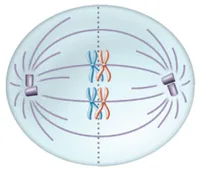
Homologous chromosomes line up in the
middle of the cell.

Metaphase I

20

media
media
media
media
media
media

Meiosis I

Sexual Reproduction and Genetics

Meiosis

Anaphase I

Anaphase I

Homologous chromosomes
separate and move

to opposite sides of the cell.

21

media

Mendel's law of independent assortment states that the alleles of two (or more) different genes get sorted into gametes independently of one another. In other words, the allele a gamete receives for one gene does not influence the allele received for another gene.

The Law of Independent Assortment

22

Multiple Choice

Each trait is individual; gene that determines one trait does not determine the others

1

Monohybrid

2

Dominant

3

Homozygous

4

Law of Independent Assortment

23

Multiple Choice

This law describes how each homologous pair separates independently of any other pairs during Anaphase I of meiosis

1

Law of Segregation

2

Law of Independent Assortment

3

Law of Gravity

4

Law of Mathematical Order

24

media
media
media
media
media
media

Meiosis I

Sexual Reproduction and Genetics

Meiosis

Telophase I

The spindles break down.

Chromosomes uncoil and form two nuclei.

The cell divides.

○ This is called cytokinesis

Telophase I

25

media
media
media
media
media
media

Meiosis II

Prophase II

Sexual Reproduction and Genetics

Meiosis

A second set of phases (Meiosis II) begins
as the spindle apparatus forms and the
chromosomes condense.

Prophase II

26

media
media
media
media
media
media

Meiosis II

Metaphase II

Sexual Reproduction and Genetics

Meiosis

Chromosomes line up
in the middle of the
cells.

Metaphase II

27

media
media
media
media
media
media

Meiosis II

Sexual Reproduction and Genetics

Meiosis

Anaphase II

Anaphase II
The sister chromatids are

pulled apart at the centromere by spindle
fibers and move toward the opposite poles of the cell.

28

media
media
media
media
media
media

Sexual Reproduction and Genetics

Meiosis

Meiosis II

Telophase II

The chromosomes reach the poles, and the nuclear membrane and nuclei reform.

Telophase II

29

media
media
media
media
media
media

Meiosis II

Sexual Reproduction and Genetics

Cytokinesis results in four haploid cells, each with n number of chromosomes.

Meiosis

Cytokinesis

30

media
media
media
media
media

The Importance of Meiosis

Meiosis consists of two sets of divisions

Sexual Reproduction and Genetics

Produces four haploid daughter cells that are not identical

Meiosis

Results in genetic variation

31

media
media
media
media
media
media

Sexual Reproduction and Genetics

Meiosis Provides Variation

Depending on how the
chromosomes line up at the
equator, four gametes with
four different combinations of chromosomes can result.

Genetic variation also is
produced during crossing
over and during fertilization,
when gametes randomly
combine.

Meiosis

32

media
media
media
media
media
media

MITOSISVS MEIOSIS

33

media
media
media
media
media

- 4 genetically different Sperm cells, all of which could

be used to fertilize an egg


Or

- 4 genetically different Egg cells, only 1 of which can

fully develop and be fertilized, the other three are called Polar Bodies and are used as nutrients and support for the single egg cell.

End Product of Meiosis

34

Multiple Choice

Question image

At the end of meiosis, how many complete/operational sex cells are created for each original cell?

1

2 for males; 2 for females

2

1 for males; 4 for females

3

4 for males; one for females

4

1 for males; 1 for females

35

Multiple Choice

Sperm and egg cells are

1

Somatic

2

Diploid

3

Gametes

4

Body cells

36

Multiple Choice

This type of reproduction creates genetic diversity

1

Sexual

2

Asexual

3

Solo

4

Polyp

37

Multiple Choice

Question image

The stage of meiosis where crossing over or the exchange of genetic information happens between pairs of chromosomes

1

Prophase II

2

Telophase I

3

Metaphase II

4

Prophase I

38

Multiple Choice

The end result of mitosis is _______________

1

2 identical diploid cells

2

2 genetically unique diploid cells

3

4 identical haploid cells

4

4 different haploid cells

39

Multiple Choice

The alleles for different traits are sorted separately and don't affect one another.

1

Law of Dominance

2

Law of Independent Assortment

3

Law of Conservation of Matter

4

Law of Segregation

40

Multiple Choice

Question image

What is another term for body cells?

1

somatic cells

2

gamete

3

stem cell

4

neural cell

41

Multiple Choice

The end result of meiosis is ______________

1

2 identical diploid cells

2

2 unique diploid cells

3

4 identical haploid cells

4

4 unique haploid cells

42

Multiple Choice

Question image

The exchange of genetic information that insures that every gamete is unique is referred to as

1

mitosis

2

meiosis

3

reduction division

4

crossing over

43

Multiple Choice

Question image

Sea turtles have 56 chromosome in their somatic cells. How many chromosomes are in their gametes?

1

28

2

56

3

112

4

46

media
media
media
media
media
media

MEIOSIS

Show answer

Auto Play

Slide 1 / 43

SLIDE