

6.3 First Law of Thermodynamics

Presentation
•
Mathematics
•
12th Grade
•
Practice Problem
•
Medium

Karl McMurtry
Used 6+ times
FREE Resource
15 Slides • 12 Questions
1
2
Recall that: W = Fd
Pressure is defined as force per area, so F = PA
This means that W = PAd , but Ad = ΔV = Vf − Vi
Finally, we say that W = P (Vf−Vi)
This equation relates the work done by a gas to the pressure and the change in volume, but where does the heat come in?
3
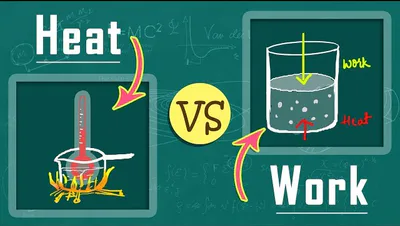
Heat energy is measured in joules, and so is work.
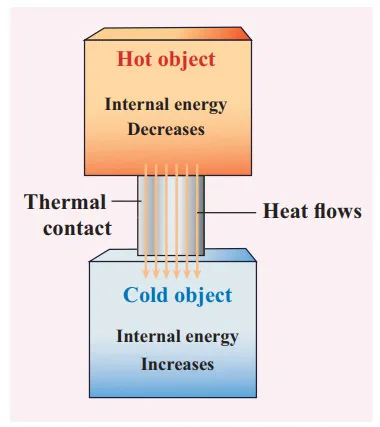
They both affect the internal energy, U , of a substance in a system.
Internal energy is the sum of the kinetic, potential, chemical, electrical, nuclear, and all other forms of energy associated with the atoms and molecules of the system.
Let's illustrate all of this with an example.
4
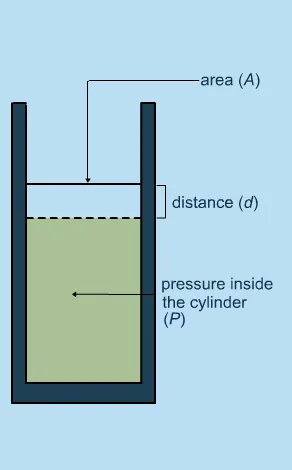
Suppose we have a gas in a closed cylinder with a piston at one end.
If we had an external heat source (Q), it would increase the gas molecules' kinetic energy (ΔQ), so the gas expands and pushes the piston through a distance, d.
The change in internal energy of the system is equal to the heat flow into the system minus the work done by the system
Mathematically: ΔU = Q − W
5
The equation that we just found in the example is the mathematical description of the First Law of Thermodynamics. (ΔU = Q − W )
The first law is basically just a restatement of the conservation of energy for a specific thermodynamic process.
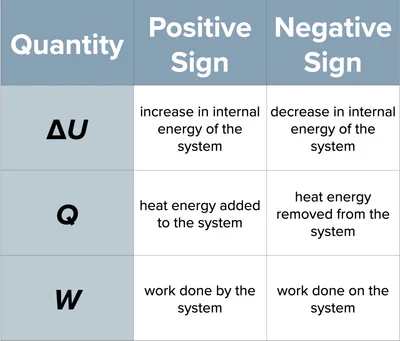
Each of the quantities in the equation can be either positive or negative, but what does their sign mean?
6
Open Ended
What do you think that the sign of the various quantities in the First Law of Thermodynamics mean?
7
Let's look at what the signs of the quantities of the First Law of Thermodynamics mean about the system:
Do these make sense?
8
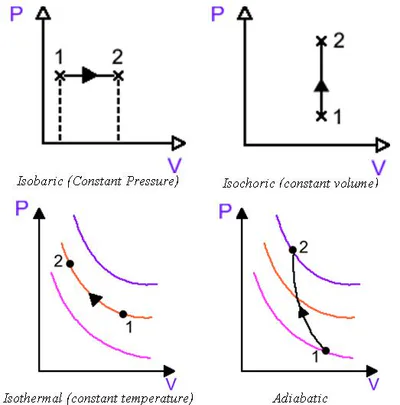
Now that we have learned the First Law of Thermodynamics, we want to use it to look at four types of thermodynamic processes.
While we discuss these processes, take note of the names and their meaning to help you understand what is happening.
You can then relate this to the variable that is held constant.
9
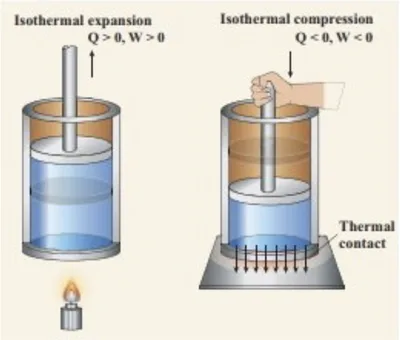
In an isothermal process, temperature remains constant throughout the system.
This implies that the internal energy is also constant, so ΔU = 0
This means that Q = W
During an isothermal process, the piston moves slowly while the system is held in thermal contact with a heat reservoir at a fixed temperature.
10
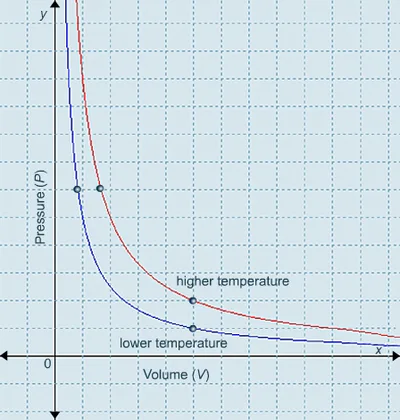
For an isothermal process, PV = constant.
This actually is derived from the ideal gas law PV = nRT
Each point on the curve represents a specific value of the pressure and volume (the state of the system).
11
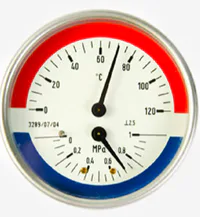
An isobaric process is one in which the pressure remains constant throughout the system.
The volume is allowed to change (expand or contract), and therefore the temperature will also change.
As the internal energy changes, work is done by the system (expansion) or work is done on the system (compression).
Therefore, none of the quantities in the first law of thermodynamics ever reduces to zero.
12
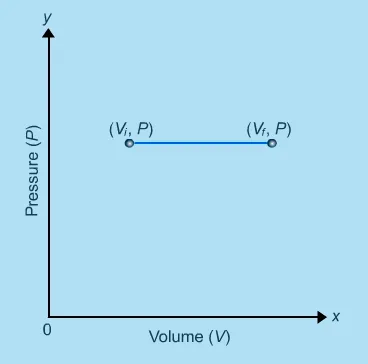
If a system undergoes expansion, then it does work on its surroundings.
This is represented by a horizontal line on a PV diagram.
If the system undergoes compression (where the surroundings do work on the system) that's also represented by a horizontal line on the PV diagram.
The only difference is that Vi > Vf
13
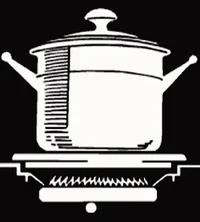
An isovolumetric (sometimes called isometric or isochoric) process is one in which the volume remains constant throughout the system
Since the volume is constant, W = 0
This means that ΔU = Q
When heat is added to the system, the internal energy increases, and the pressure on the walls increases.
If heat is removed from the system, internal energy decreases and the pressure on the walls decreases.
14
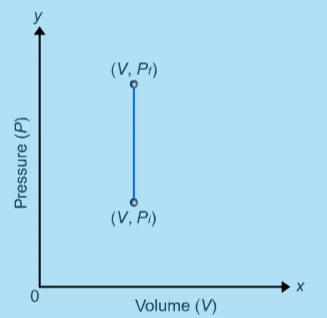
In an isovolumetric process, the volume is kept constant and the pressure is allowed to vary.
This leads to a vertical line on the PV graph.
Since there is no change in volume, no work is done.
The graph of an isovolumetric process can easily be confused with the graph of an isobaric process.
15
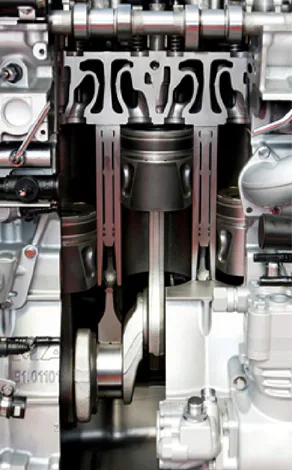
In an adiabatic process, no heat transfers into or out of the system.
A system that expands under adiabatic conditions does positive work so the internal energy decreases along with the temperature.
A system that contracts under adiabatic conditions does negative work so the internal energy increases along with the temperature.
Mathematically: ΔU = −W
16
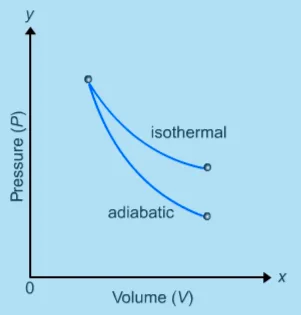
During an adiabatic process, no heat is allowed into or out of the system.
This process follows a curve where PV = constant.
In an adiabatic process, the pressure drops off more than in an isothermal process that occurs between the same two volumes.
The adiabatic path is steeper because the gas loses internal energy as it does work.
17
Multiple Choice
40J of work is done by a gas when the system has an increase in internal energy of 125J. What energy is needed to do so?
205J
Can't accomplish
18
Multiple Choice
1200 J of heat are added to a sample of gas while 400 J of work is done by the gas. What is the change in internal energy of the gas?
-1600 J
-800 J
19
Multiple Choice
What does the "U" stand for the formula ΔU = Q − W ?
Temperature
20
Multiple Choice
Calculate the heat transfer to the environment if the system produces a work of 45 kJ and receives 9 kJ in the way of heat. The enthalpy (internal energy) difference of the system is equal to 55 kJ.
19 kJ
91 kJ
21
Multiple Choice
The product of the pressure and volume of a system has the same SI units as which one of the following choices?
Distance (m)
Temperature (C)
Work (J)
Time (s)
22
Multiple Choice
When applying the first law of thermodynamics to a system, when is heat a positive quantity?
When work is done on the system
When the system
23
Multiple Choice
What is the name of the process in which pressure remains constant.
isochoric process
24
Multiple Choice
For an isothermal process, which of the following statements is correct?
Work and heat balance each other, so that there is no change in internal energy.
Work, heat, and internal energy all undergo changes.
No work is done; internal energy change is due to heat.
No energy is transferred as heat; internal energy change is due to work.
25
Multiple Select
Which of these processes have a straight line when plotted on a PV graph?
Isothermal process
26
Multiple Choice
The PV diagram for an adiabatic process looks similar to the PV diagram for...
isovolumetric process
adiabatic process
27
Multiple Choice
In an adiabatic process, what equals zero?
T
Q
W
ΔU
Show answer
Auto Play
Slide 1 / 27
SLIDE
Similar Resources on Wayground

21 questions
Addition and Subtraction
Presentation
•
KG
18 questions
Fractions Intro
Presentation
•
KG - 12th Grade
22 questions
Classifying Polynomials
Presentation
•
11th - 12th Grade
19 questions
9.3 - The Natural Base, e
Presentation
•
11th - 12th Grade
20 questions
Polynomials and Polynomial Functions
Presentation
•
10th Grade
20 questions
fast food
Presentation
•
KG
21 questions
Compound Inequalities (A1 1-6)
Presentation
•
7th - 10th Grade
24 questions
Adding and Subtracting Rational Expressions
Presentation
•
11th - 12th Grade
Popular Resources on Wayground
10 questions
How much do you know about our Portrait of an Eagle?

Quiz
•
10th Grade
10 questions
Fast Food Slogans
Quiz
•
6th - 8th Grade
21 questions
Continents and Oceans
Quiz
•
6th Grade
20 questions
Parts of Speech
Quiz
•
5th Grade
16 questions
Subject & Predicate
Quiz
•
5th Grade
25 questions
Multiplication Facts
Quiz
•
5th Grade
12 questions
Map Skills
Quiz
•
3rd Grade
22 questions
Continents and Oceans
Quiz
•
5th Grade
Discover more resources for Mathematics
10 questions
Identifying equations
Quiz
•
KG - University
12 questions
Identify Rigid Transformations
Quiz
•
8th - 12th Grade
15 questions
2.3 (b) Domain & Range Lesson Check
Quiz
•
9th - 12th Grade
20 questions
Classifying Real Numbers
Quiz
•
6th - 12th Grade
31 questions
Unit 2 Test Review
Quiz
•
9th - 12th Grade
14 questions
Independent vs Dependent Variable
Quiz
•
9th - 12th Grade
21 questions
Arithmetic Sequences
Quiz
•
9th - 12th Grade
20 questions
Literal Equations
Quiz
•
9th - 12th Grade