
The Journey of Water

Presentation
•
Science
•
4th Grade
•
Practice Problem
•
Hard

C Maccow
Used 2+ times
FREE Resource
10 Slides • 19 Questions
1
The Water Cycle
Water moves through the Earth's atmosphere, land, and oceans, undergoing various processes such as evaporation, condensation, and precipitation.
Water is always moving through something called the water cycle or the hydrological cycle.
The nature of water cycle is Water is recycled
The energy for our own water cycle on earth comes from the power of the sun.
2
Multiple Choice
True/False: Water Cycle is the continuous movement of water
from the ocean to the atmosphere to the land and back to the ocean.
False
True
3
Multiple Choice
Water is always moving through the Water Cycle or .........
Carbon Cycle
Hydrological
Cycle
Nitrogen Cycle
4
Multiple Choice
What is the nature/purpose of the water cycle:
Make new water
recycle water
heat the water
5
Multiple Choice
Where does the energy for the water cycle come from?
The Sun
6
Water: different forms
Water can be a solid like ice.
It can be a liquid like you drink.
It can also be a gas or vapor.
Some water molecules have are moving fast enough (have enough energy) to change state into gas
7
Multiple Choice
What are the different forms of water?
8
The Water Cycle
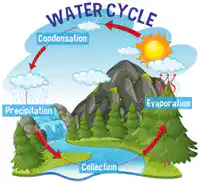
1. Evaporation: Water changes from a liquid to a gas and rises into the atmosphere. 2. Condensation: Water vapor cools and turns back into liquid droplets, forming clouds. 3. Precipitation: Water falls from the clouds as rain, snow, sleet, or hail. 4. Accumulation: Water collects in bodies of water, such as lakes, rivers, and oceans.
9
The Water Cycle
1. Evaporation: Water heats up and turns into vapour.
2. Condensation: Vapour cools down and forms clouds.
3. Precipitation: Water falls from clouds as rain, snow, or hail.
10
Multiple Choice
What are the Stages of the Water Cycle (in the correct order)?
Condensation, Collection/Accumulation, Evaporation, Precipitation
Precipitation, Evaporation, Collection/Accumulation, Condensation
Evaporation, Condensation, Precipitation, Collection/Accumulation
11
Multiple Choice
Which stage of the water cycle involves water changing from a liquid to a gas and rising into the atmosphere?
Evaporation
Condensation
Precipitation
Accumulation
12
Multiple Choice
Three examples of Precipitation:
13
Water Cycle: Evaporation
During evaporation, water changes from a liquid to a gas and rises into the atmosphere. This process is essential for the water cycle, as it helps to replenish the moisture in the air and form clouds. Without evaporation, there would be no rain or snowfall, affecting the entire ecosystem.
14
Multiple Choice
What happens when water vapor is cooled?
It changes back (condenses) into liquid water.
15
Multiple Choice
True/False: The molecules of boiling water are moving faster
False
True
16
Multiple Choice
How does water at room temperature become a gas?
Some water molecules have are moving fast enough (have enough energy) to change state.
Some water molecules are moving slow
None of the above
17
Water Cycle: Condensation
Condensation is the process in which water vapor in the air cools down and changes back into liquid water. It forms clouds in the sky and is a crucial step in the water cycle. Other stages include evaporation, precipitation, and collection. Condensation plays a vital role in maintaining Earth's water balance.
18
Multiple Choice
What is the second stage in the water cycle?
Evaporation
Condensation
Precipitation
Accumulation/
Collection
19
Water Accumulation/Collection
After water accumulates/collects, it forms rivers, lakes, or other bodies of water. This is an important step in the water cycle as it provides a source of water for various ecosystems. The accumulated water can also seep into the ground and replenish underground water sources. Water accumulation plays a crucial role in maintaining the Earth's water balance.
20
Multiple Choice
What is “collection” in the rain cycle?
the process of water evaporating into the atmosphere
the process of water turning into ice
Liquid water is collected from the sky collecting on land and bodies of water such as oceans, lakes, and rivers.
21
Water Cycle: Accumulation
Water accumulation in the water cycle plays a crucial role in replenishing underground water sources. This process ensures a sustainable supply of water for ecosystems and human consumption. It also helps maintain the balance of underground water levels, supporting the health of plants, animals, and communities.
22
Multiple Choice
What is the important role of water accumulation in the water cycle?
Formation of rivers and lakes
Source of water for ecosystems
Replenishment of underground water sources
Regulation of atmospheric temperature
23
Water Cycle Fun Facts
Fact 1: The water you drink everyday is the same water that has been around since the Jurassic Period!
Fact 2: The sun is necessary in the water cycle: no sun means no evaporation.
Fact 3: Only 2.5% of the world’s water is freshwater .
24
Multiple Choice
True/False: Only 2.5% of the world’s water is ocean water .
True
False
25
Multiple Choice
True/False: The water you drink everyday is the same water
that has been around since the Jurassic Period!
True
False
26
Vocabulary
Groundwater - water located below Earth's surface (acquifers)
Surface water - water found on the surface of the Earth (lakes, ponds rivers, oceans)
Transpiration - water vapor given off by plants through photosynthesis
Percolation - process by which water moves downward through the soil through gravitational forces
27
Multiple Choice
Water below the Earth's Surface is called ......
Groundwater
Surface Water
Tap water
28
Multiple Choice
The process where water vapor given off by plants is called .....
Perspiration
Percipitation
Transpiration
29
Multiple Choice
The process by which water moves downward through
the soil through gravitational forces is called ....
Perspiration
Percipitation
Percolation
The Water Cycle
Water moves through the Earth's atmosphere, land, and oceans, undergoing various processes such as evaporation, condensation, and precipitation.
Water is always moving through something called the water cycle or the hydrological cycle.
The nature of water cycle is Water is recycled
The energy for our own water cycle on earth comes from the power of the sun.
Show answer
Auto Play
Slide 1 / 29
SLIDE
Similar Resources on Wayground

19 questions
Natural Resources and Conservation
Presentation
•
4th Grade
23 questions
P4 Properties of light
Presentation
•
4th Grade
22 questions
Interactions in an Ecosystem
Presentation
•
4th Grade
22 questions
Ecosystems and Food Chains
Presentation
•
4th Grade
22 questions
Sun, Earth, and Moon
Presentation
•
4th Grade
21 questions
Light
Presentation
•
4th Grade
23 questions
Moon Phases
Presentation
•
4th - 5th Grade
21 questions
POLLINATION
Presentation
•
4th Grade
Popular Resources on Wayground
6 questions
Secondary Safety Quiz
Presentation
•
9th - 12th Grade
10 questions
MyPath Diagnostic Overview
Presentation
•
6th - 8th Grade
20 questions
Lab Safety Quiz

Quiz
•
6th Grade
21 questions
Continents and Oceans
Quiz
•
6th Grade
20 questions
Adding and Subtracting Decimals
Quiz
•
5th Grade
20 questions
Parts of Speech
Quiz
•
5th Grade
16 questions
Subject & Predicate
Quiz
•
5th Grade
21 questions
Lab Safety
Quiz
•
10th Grade
Discover more resources for Science
17 questions
Science Tools and Safety
Quiz
•
4th Grade
10 questions
States and Properties of Matter

Interactive video
•
3rd - 5th Grade
14 questions
Scientific Method
Quiz
•
4th Grade
20 questions
Science Safety
Quiz
•
4th - 5th Grade
10 questions
What Type of Scientist Am I?
Quiz
•
3rd - 4th Grade
17 questions
Potential and Kinetic Energy
Quiz
•
4th Grade
16 questions
Chapt 1- Onward We Go
Quiz
•
4th Grade
51 questions
Earth, Moon, and Seasons
Quiz
•
3rd - 5th Grade