

Culturally and Linguistically Diverse Learners and Special Education

Presentation
•
Other
•
KG - Professional Development
•
Hard

Kimberly Garcia
Used 2+ times
FREE Resource
20 Slides • 8 Questions
1

Culturally and Linguistically
Diverse Learners and Special
Education
Ch.12
EDMS 4102
Kimberly Garcia, Georgina Flores, Krisztina Lindsley, Yesenia Rodriguez
2


Who are CLD Learners?
●
●
●
Vestibulum conue
Culturally and Linguistically
Diverse (CLD) refers to
students who have a language
other than English who may or
may not be participating in ESL
services.
CLD students have been
disproportionately
represented in special
education
There are CLD students
with special needs and
identifying the issue is
complex
The term also includes
students who come from a
home, community or
school environment where
another language has had
a real and significant
impact on the student’s
development of English
language proficiency.
https://www.shutterstock.com/image-photo/close-preteen-friends-park-smiling-camera-735971812
3
Multiple Choice
Which of the following is true about CLD students with special needs?
Identifying their needs is complex.
They are always overrepresented in special education.
They do not require any additional support.
None of the above.
4

Scenarios & Issues
Essential Questions:
●How can these student’s
language acquisition, cultural
adjustment and emotional/
motivational difficulties be
distinguished from learning
problems?
●How can these problems be
addressed?
●How can a school district avoid
inappropriate referrals and
placements, AND ensure
access for CLD learners who
are learning disabled?
5th grade, Sonia
A native Spanish speaker from
Domin. Repub., did not attend
school until 2nd grade, learned
to read in Spanish, but now
does not have access to Span.
instruction. She now has low
reading skills, should she be
referred to SPED?
4th grade, Luke
Student who emigrated from
Romania, doesn’t want to
come to school, rather be at
home working, does his poor
performance at school
indicate a learning disability?
4th grade, Tran
Immigrant from isolated village in
Vietnam who’s parents want him
to learn only English, but parents
work all day and he spends
afternoons with Vietnamese
speaking grandma. His dual
personality in school leaves his
teacher wondering if he has a
learning disability.
5th grade, José Luis
New arrival students at
Kaylor elementary are
considered “fresh meat”
for gangs around the
neighborhood. José Luise
comes to school fearful
and never speaks at
school. Should he be
referred for help?
5
Principles in the Education of English Learners
There are five principal domains that characterise fair and effective processes for determining the
education services appropriate for CLD learners who may be experiencing learning difficulties.
Responsibility of
Students
ELL need to become
self-responsible and active
students who know how to
learn.
Student’s Need for
Self-Knowledge
Students need to
understand their own
learning styles, preferences,
and discover their strengths
Goals for
Instruction
Students need relevant
language and academic
goals that promote
effective communication in
social and academic areas
Need for Informed
Decision Making
Educational decisions about
CLD learners should involve
specialist, parents, and other
professionals, using fair
assessments of the child’s
language, culture, needs,
talents
Relationship of
Educational Services to
Mainstream Instruction
Any education setting
must provide educational
content and approaches
that facilitate a smooth
transition to mainstream
6

7

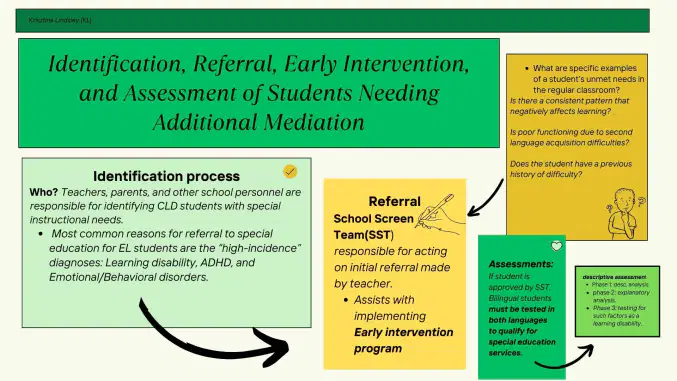
Testing for Special Education
Testing or evaluations will need to show a student’s strengths and challenges.
●Involves attention to linguistic as well as cultural factors that may interfere with students
academic performance. Krisztina Lindsley (KL)
Phase 1:
Descriptive
analysis.
Observations of
the student in
the classroom of
Oral dialogue,
and monologue
to see if student
has a
communication
deficiency
problem.
If Yes:
The student may
be referred to a
speech/language
therapist for
additional
mediation in
language
development
OR
the student may be referred for
additional interventions in language
development and the evaluation process
may continue, indicating that the student
has a communicative proficiency
problem as well as other problems.
8
Fill in the Blanks
Type answer...
9

Testing for Special Education continued
Krisztina Lindsley( KL)
If there is evidence of a learning problem phase 2 can begin:
Phase 2:
Explanatory Analysis
The examiner checks for extrinsic
factors, such as cultural or ethnic
background or level of acculturation
that determine if normal
second-language-acquisition or
crosscultural phenomena can
account for the student’s learning
difficulties.
Phase 3:
If the factors in phase 2
do not account for the
described difficulties,
then testing for Intrinsic
factors may begin
Check for Learning
disabilities.
●Teacher- family
conferences are a vital
component of
sustaining support for
the student.
●Teacher needs to have
student work samples
to share with parents
for context- does it
meet grade level? If
not family may be
more open to getting
additional support for
their student.
10
Multiple Choice
Which of the following is an example of an extrinsic factor that may affect a student's academic performance?
Family background
Cultural background
Language proficiency
All of the above
11

Collaboration among ELD Resource teachers &
Special Educators Yesenia R.
If a school has the funds to hire
an ELD specialist, this
professional engages in planning
content instruction while
imbedding English language
development skills with:
●Mainstream, bilingual, and
Special educators
Additionally, collaboration that is
done very close is refer to the
co-teaching model and it consists
of 2 teachers splitting classroom
duties or rotating roles of lead
and support teacher.
Collaborative relationships with an
interpreter may be helpful for
teachers whose primary language is
different from that of the student
under consideration.
Bilingual instructional aides shouldn't
be pressured to act as interpreters
or translators; instead, skilled
professionals should provide
interpretation.
The teacher should first meet with the
interpreter before meeting with the
parent. Then during the interaction,
the teacher should watch and listen to
the parent's nonverbal cues and
affective responses, as well as pay
attention to their body language,
facial expressions, and voice
intonations.
Throughout the initial intervention,
testing, and recommendation stages of a
special education referral, ELD services
are a constant resource for students.
An ELD teacher may choose to assist a
student directly by carrying out early
intervention strategies or indirectly
through collaborating with other
educators. parents, and peers.
Furthermore, the ELD teacher helps
write the student's Individualized
Education Plan (IEP).
To create and approve an IEP that will
lead to academic progress, cooperation
between ELD, special educators, the
classroom teacher, parents, and the
student is essential.
It is crucial that professionals treat one another with equality, collaborate freely, and share
responsibility for participation, decision-making, resources, and results. Ultimately, finding the
most effective classroom setting for a student is a shared goal.
12

Teaching Strategies for the CLD Special Learners
KrisztinaLindsley (KL)
Adaptive Listening Tasks
Before: Directly instruct listening
strategies.
Arrange information in short, logical,
well-organized segments.
Model ways to pay attention.
During:Actively involve students in
rehearsing, summarizing, and taking
notes.
Use purposeful, curriculum-related
listening activities.
Model listening behavior and use peer
models. After:
Discuss content. Use teacher questions
and prompts to cue student response
(e.g., “Tell me more”).
Adaptive Reading Tasks
Before:
●Check student’s reading level
●Find versions of the reading so reading level will match
students with below reading level.
●Bridge to students’ existing knowledge or help create new
schemata
●Teach new Vocabulary that will connect to the reading.
●Provide students with outlines or summaries
●Simpler versions may be read with peers or one on one with
an aid/paraprofessional.
During: Help students to focus by providing a noise free listening
area. Provide pictures or other multimodal input to supplement
reading.
After: Discuss and Clarify content. Review key vocabulary to solidify
comprehension.Use formative assessment to ask comprehension
questions one-on-one with students.
13



Strategies for Writing Conventions
krisztinaLindsley
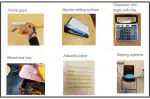
To help CLD learners with spelling, display a word bank on a classroom wall with commonly used words that native speakers would already know.
●Help students select the most comfortable method of writing (i.e., cursive or manuscript).
● To improve handwriting, make available an optional calligraphy center where students can practice elegant forms of handwriting, with correct models available of cursive styles.
●Allow for group written responses
Use Assistive Techonlogy: Technology can help CLD students work along side their mainstream peers.
-Large Print formats for the visually impaired
-Tablets and computers to help with monitoring students progress and performance in real-time.
-Keyboards and touch screens
-Screen readers that read aloud the content on the screen-
-Use preformatted templates after reading to help students fill out questions regarding plot, setting, characters. These can help guide students to write their own stories by assisting
students with organizing and expressing their thoughts.
Adapting Homework Tasks
-Allow students to have more time to complete work by giving a longer due date
-Create Shorter assignments
-Create alternative formats and options for students * for example oral rather than written format)
14

Assessing Student Performance in the Mainstream
Classroom
Yesenia R.
➔
A key feature of instruction for inclusion is continuous student assessment.
➔
A variety of means are available to assess the success of the student in response to the
curriculum, instructional strategies, and social aspects of the inclusion environment.
Methods of Assessing the
Success of Included
Students
Direct observation
and analysis of
student products are
two ways to assess
the success of
included students.
Assessing Student’s Work
Before an IEP is approved, the
grading process for students with a
modified curriculum needs to be
addressed.
Districts establishing alternative
grading systems must make sure that
all rules and practices related to
grading are inclusive.
For students with disabilities, most
teachers consider pass-fail and
checklist ratings is more useful than
letter and number grades.
Using the Results of
Assessment
Continuous evaluation tracks the
degree to which the student's IEP
is being met. When the IEP is
approved, the assessment
activities must be quite specific so
that everyone in the collaborative
team knows exactly what their
duties and responsibilities are. The
results of the assessment are
promptly compared to the
performance goals outlined in the
IEP.
15

Assessing Student Performance in the Mainstream
Classroom Continued
Yesenia R.
➔
Under the 2004 reauthorization of the Individuals with Disabilities Education Act (IDEA), states
must have guidelines in place for assessment accommodations and must report the number of
students using accommodations during state and district assessments.
➔
The purpose of these assessments accommodations is to more accurately measure the student’s
knowledge and skills.
Type of Accomodation
Examples
●Informational
presentation
●Equipment and material
●Response
●Setting
●Timing/ scheduling
●Use large print, braille, repeat
or read aloud directions
●Use a calculator, amplification
equipment, manipulatives
●Point, mark answers in book,
scribe, or record responses
●Use an individual carrel, student’s
home, or a separate room
●Provide extended time, frequent
breaks
Categories of Assessment Accommodations
16
Multiple Select
Which of the following is an example of a response accommodation?
17

Universal Design for Special Populations of English
Learners - Kim
The purpose for Universal Instructional Design (UID) is to “give each student meaningful
access to the curriculum” (Pg. 355)
UID is based off UD which stands for Universal Design.
Who is the “Special Population”?
EL’s with special needs include students with learning disabilities and vision, hearing, and mobility
impairments.
18
Fill in the Blanks
Type answer...
19

Universal Design for Special Populations of English
Learners - Kim
Universal Design was more physical access like wheelchair ramps and translators.
Universal Instructional Design ensures accessibility to learning resources and tools.
Universal Design seven
principles are:
1.Equitable
2. Flexibility
3. Simple and intuitive use
4. Perceptible information
5. Tolerance for error
6. Low physical effort
7.Size and space for approach and use
20

Principles of Universal Instructional Design
Applied to ELs with Special Needs
Principle
Definition
Application
Inclusiveness
A classroom climate that impacts all students
Use multiple forms to communicate. Welcome aides.
Physical access
Equipment and activities that minimize
continual physical effort, and accommodate
those with limited physical abilities
Use assistive technologies for deaf and hearing-impaired
students.
Delivery methods
Lessons given in multiple ways so all students
are provided the lesson.
Use audiovisuals like powerpoint, online read alongs, audio
recorders, provide copy of notes.
Information access
Use of captioned videos and accessible
electronic formats.
Information should be understandable and complete, not to
complex, key points should stand out and give clear criterias
for tests and assignments.
Interaction
Everyone should be able to access the
information without accommodations. Many
ways for students to participate.
Heterogeneous groups students work with other students who
are at different reading levels than them. In a homogeneous
group student's work with students who are at the same
reading level that they are.
Feedback
Prompting during an activity and constructive
comments after.
Have formative assessments for ongoing feedback
Demonstration of Knowledge
Many ways to show knowledge –group work,
demonstrations, portfolios and presentations.
Offer to whole class so that special needs students don’t feel
singled out.
21






English Learners with Communication
Challenges
Teachers should receive some sort of
training working with blind students
because visual teaching is our main way
of teaching.
Students with hearing impairments have
a different challenge and that is they are
from three communities; their ethnic
backgrounds, the Deaf community, and
the mainstream hearing people.
22





How to Help
Blind English
Learners
ELs with Hearing
Impairments
-Ask for access to a braille textbook. Or
create a group that can read for the
student.
-USE TECHNOLOGY. Text-to-speech and
voice recognition are both already
provided of Chromebooks.
-Teacher will need to be more vocal and
repeat words on board
-Classroom effort to give instruction
• Captioned when showing videos.
• Learn sign language as a class
• Increase the use of visual materials
• Speak face-to-face using natural
speech.
• Group work
• Use gestures to help understanding
when teaching.
• Use peer buddies
23
Multiple Choice
How can we support ELs with a visual impairment?
24






Children with Autism Spectrum Disorder
White Children 1 of 83
Latino Children 1 of 127
African American Children 1 of 98
25



• Behavioral Training
• Speech and language therapy
• One-on-One work
• ELD Services like RSP
Classroom intervention
26
Multiple Choice
It is easier for student with impairments because they receive more services and accommodations than the general population of students?
True
False
27

Bilingual Special Education primary goal:
Teachers should be actively involved
throughout the assessment process,
with assessment-based curricular
adaptations becoming a major part of
the intervention process before a new
student is referred for special education
services, and a diagnostic teaching
model put in place instead of a remedial
approach
Classroom should
conform to the needs
of students rather than
students conforming to
the classroom
Efforts should be
made to increase
academic
performance of CLD
special education
students
28
Multiple Choice
Bilingual Special Education primary goal:
Culturally and Linguistically
Diverse Learners and Special
Education
Ch.12
EDMS 4102
Kimberly Garcia, Georgina Flores, Krisztina Lindsley, Yesenia Rodriguez
Show answer
Auto Play
Slide 1 / 28
SLIDE
Similar Resources on Wayground

20 questions
Ludwig Van Beethoven
Presentation
•
6th - 8th Grade
22 questions
FIRST AID
Presentation
•
9th Grade
18 questions
Baking Basics and Quick Breads Review
Presentation
•
9th - 12th Grade
20 questions
Unit 5B: Lesson 2- Blood Vessels: Arteries & Veins 1/11-1/12
Presentation
•
10th - 12th Grade
21 questions
Cold War Intro
Presentation
•
KG
22 questions
Emotional Intelligence
Presentation
•
6th - 8th Grade
20 questions
Digital Ethics
Presentation
•
9th Grade
Popular Resources on Wayground
10 questions
HCS SCI 03 Summer School Review 4

Quiz
•
3rd Grade
11 questions
HSMS - Standard Response Protocol
Quiz
•
6th - 8th Grade
16 questions
1.1-1.2 Quiz Review
Quiz
•
9th - 12th Grade
12 questions
Exponent Expressions
Quiz
•
6th Grade
20 questions
Adding and Subtracting Integers
Quiz
•
6th - 7th Grade
11 questions
Northeast States
Quiz
•
3rd - 4th Grade
10 questions
Characterization
Quiz
•
3rd - 7th Grade
10 questions
Common Denominators
Quiz
•
5th Grade
Discover more resources for Other
10 questions
HCS SCI 03 Summer School Review 4
Quiz
•
3rd Grade
11 questions
HSMS - Standard Response Protocol
Quiz
•
6th - 8th Grade
16 questions
1.1-1.2 Quiz Review
Quiz
•
9th - 12th Grade
12 questions
Exponent Expressions
Quiz
•
6th Grade
20 questions
Adding and Subtracting Integers
Quiz
•
6th - 7th Grade
11 questions
Northeast States
Quiz
•
3rd - 4th Grade
10 questions
Characterization
Quiz
•
3rd - 7th Grade
10 questions
Common Denominators
Quiz
•
5th Grade