
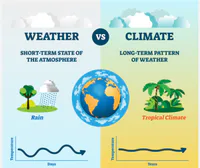
Understanding Climate and Weather

Presentation
•
Science
•
6th Grade
•
Practice Problem
•
Medium
+7
Standards-aligned

Ma Cecilia Balagbagan
Used 3+ times
FREE Resource
9 Slides • 4 Questions
1
A concise overview of climate and weather, exploring the relationship between the two and their impact on our daily lives.
2
Factors Affecting Climate
Distance from the ocean, distance from a river, amount of precipitation, and snowfall all play a part in determining a region's climate. The tilt of Earth also influences climate and weather, resulting in cold, snowy winters in Canada and mild, cool winters in Florida.
3
Multiple Choice
Which factor influences climate and weather?
Distance from the ocean
Distance from a river
Amount of precipitation
Snowfall
4
Factors Affecting Climate
Trivia: Did you know that the distance from the ocean is a major factor influencing climate and weather? Other factors include the amount of precipitation and snowfall. The proximity to a river also plays a role. These factors collectively determine the unique climate conditions experienced in different regions.
5
Understanding Climate and Weather
Energy from the sun must go through the atmosphere before it reaches the Earth's surface. Factors such as latitude, altitude, ocean currents, and prevailing winds influence climate and weather. Human activities, particularly burning fossil fuels, have had the most significant impact on Earth's atmosphere. Other activities like polluting the oceans, cutting down forests, and mining the land also contribute to environmental changes.
6
Multiple Select
What factors influence climate and weather? Choose all that applies.
Latitude and altitude
Ocean currents and prevailing winds
Burning fossil fuels
Polluting the oceans and cutting down forests
7
Climate Factors
Trivia: Did you know that latitude and altitude are two major factors that influence climate and weather? The higher the altitude, the colder the climate. And the closer to the equator, the hotter the climate. These factors play a crucial role in determining the temperature and weather patterns of a region.
8
The Greenhouse Effect
Gases in the atmosphere trap some heat near Earth's surface and allow some heat to escape into space. This natural process helps regulate Earth's temperature, making it suitable for life. However, human activities have increased greenhouse gas concentrations, leading to global warming and climate change. Understanding the greenhouse effect is crucial for addressing these environmental challenges.
Key Points:
Greenhouse gases: Carbon dioxide (CO2), methane (CH4), and water vapor are the main greenhouse gases.
Heat trapping: These gases absorb and re-emit infrared radiation, trapping heat in the atmosphere.
Balance: The greenhouse effect is necessary for maintaining a stable climate, but excessive greenhouse gas emissions disrupt this balance.
9
Multiple Choice
Which gases are the main greenhouse gases?
Carbon dioxide (CO2), methane (CH4), and water vapor
Oxygen (O2), nitrogen (N2), and argon (Ar)
Hydrogen (H2), helium (He), and neon (Ne)
Sulfur dioxide (SO2), nitrogen dioxide (NO2), and carbon monoxide (CO)
10
Main Greenhouse Gases
11
Climate and Weather
Gases in the atmosphere reflect visible light away from Earth and trap radiation near Earth's surface. The primary reason for the difference in temperatures between the poles and the equator is latitude. The distance from the sun, altitude, and prevailing winds also play a role. Human activities, such as the use of aerosol products, contribute to the depletion of the ozone layer.
12
Multiple Choice
What is the primary reason for the difference in temperatures between the poles and the equator?
Latitude
Distance from the sun
Altitude
Prevailing winds
13
Temperature Difference
Trivia: The primary reason for the difference in temperatures between the poles and the equator is the distance from the sun. The equator receives direct sunlight, resulting in higher temperatures, while the poles receive indirect sunlight, leading to lower temperatures. Other factors like latitude, altitude, and prevailing winds also contribute to temperature variations.
A concise overview of climate and weather, exploring the relationship between the two and their impact on our daily lives.
Show answer
Auto Play
Slide 1 / 13
SLIDE
Similar Resources on Wayground

10 questions
Inner and Outer planets
Presentation
•
6th Grade
10 questions
Rock and Rock cycle
Presentation
•
5th Grade
9 questions
Types of Energy MELTS Lesson
Presentation
•
5th Grade
10 questions
Sedimentary Rock
Presentation
•
6th Grade
9 questions
Muscles and Roots
Presentation
•
6th Grade
12 questions
Estuaries
Presentation
•
6th Grade
10 questions
6th Grade Science
Presentation
•
6th Grade
11 questions
Reflection and refraction
Presentation
•
6th Grade
Popular Resources on Wayground
10 questions
How much do you know about our Portrait of an Eagle?

Quiz
•
10th Grade
10 questions
Fast Food Slogans
Quiz
•
6th - 8th Grade
21 questions
Continents and Oceans
Quiz
•
6th Grade
20 questions
Parts of Speech
Quiz
•
5th Grade
16 questions
Subject & Predicate
Quiz
•
5th Grade
25 questions
Multiplication Facts
Quiz
•
5th Grade
12 questions
Map Skills
Quiz
•
3rd Grade
22 questions
Continents and Oceans
Quiz
•
5th Grade
Discover more resources for Science
10 questions
6.6D - Relative Density Review
Quiz
•
6th Grade
20 questions
Claim, Evidence and Reasoning (CER)
Quiz
•
6th - 8th Grade
20 questions
Density
Quiz
•
6th Grade
10 questions
Exploring Chemical and Physical Changes

Interactive video
•
6th - 10th Grade
20 questions
Food Chains & Food Webs
Quiz
•
5th - 7th Grade
18 questions
Interpreting Distance/Time Graphs
Quiz
•
6th Grade
10 questions
Decoding the Periodic Table of Elements
Interactive video
•
6th - 10th Grade
15 questions
Potential and Kinetic Energy
Quiz
•
6th Grade