Search Header Logo
Midterm Study Guide and Practice

Midterm Study Guide and Practice

Assessment

Presentation

Science

12th Grade

Medium

NGSS
MS-ESS1-1, MS-LS1-7, MS-LS2-4

+21

Standards-aligned

Created by

Robert Oliver

Used 3+ times

FREE Resource

16 Slides • 33 Questions

1

media

​5.1

2

Multiple Select

Under ideal conditions with unlimited resources, a population will grow __________.

Choose the term and the correct graph.

1
2
3

logistically

4

exponentially

3

Multiple Select

_________________ occurs when a population’s rapid growth slows and then stops.

Choose the term and the correct graph

1
2
3

Exponential growth

4

Logistic growth

4

Multiple Choice

The maximum number of individuals of a particular species that a particular environment can support is __________.

1

exponential growth

2

logistic growth

3

carrying capacity

4

density and distribution

5

media

​5.2

6

Multiple Choice

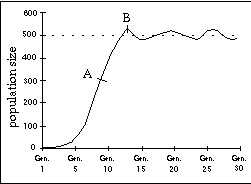
Question image
What is the carrying capacity of the graph?
1

around 500

2

more than 500

3

less than 500

4

around 600

7

Multiple Select

Which of the following are density-dependent limiting factors?

1

competition

2

severe weather

3

overcrowding

4

disease

8

Multiple Choice

An environmental factor such as storms and extreme heat or cold that decrease a population are considered to be. 
1

density- dependent factor

2

population density

3

dispersion

4

density- independent factor

9

media

​6.1

​6.1

10

Multiple Choice

where an organism lives and what it does "for a living"; an organism's "role" within an ecosystem

1

habitat

2

niche

3

competition

4

biome

11

Reorder

Question image

Reorder the following - Start with a Rise in the Prey Population

Rise in Prey Population

Rise in Predator Population

Drop in Prey Population

Drop in Predator Population

1
2
3
4

12

Multiple Choice

If bees were removed from an ecosystem it would make the ecosystem unstable and affect all organisms living there. For this reason bees are considered to be a _____ species.

1

crucial

2

keystone

3

primary

4

secondary

13

media

​4.1

14

Drag and Drop

Photosynthesis converts ​
and water into ​​
and oxygen using energy from ​
Drag these tiles and drop them in the correct blank above
carbon dioxide
sunlight
fertilizer
glucose

15

Match

Match the following

Only eat plants

Only eat animals

Eat plants or animals

Herbivores

Carnivores

Omnivores

16

media

​4.2

17

Multiple Choice

Question image

How many paths get energy from algae to the Largemouth bass?

1

one

2

two

3

more than two

18

Multiple Choice

About how much energy gets moved up to the next level of an energy pyramid?

1

5%

2

10%

3

50%

4

depends on the biomass

19

media

​4.3

20

Match

Match the following

moves carbon from the biosphere to the geosphere

moves carbon from atmosphere to biosphere

moves carbon from biosphere to atmosphere

Decomposition

Photosynthesis

Respiration

21

Multiple Select

Which human activities add CO2 to the atmosphere?

1

breathing

2

burning fossil fuels

3

burning wood

4

hugging trees

22

media

23

Multiple Select

How can you reduce your ecological footprint?

Select all that are correct

1

use public transportation instead of a car

2

buy vegetables grown locally

3

only make local phone calls

4

turn off lights and appliances when they aren't being used

24

Multiple Choice

Which of these would reduce a family's ecological footprint?

1

spending more money on resources every month

2

spending less money on resources every month

3

producing less solid waste (plastic, metal, glass, etc)

4

switching from wind energy to solar energy to power their home

25

media

26

Multiple Choice

Reducing the amount of greenhouse gases would likely...

1

increase the rate of global warming

2

decrease the rate of global warming

3

not affect global warming

27

Multiple Select

Burning fossil fuels is thought to be responsible for which of these?

Select all correct answers

1

acid rain

2

deforestation

3

global warming

4

depletion of ozone layer

28

media

29

Multiple Choice

In the 1990's most countries banned CFC's based on evidence from scientists. What change has this caused?

1

increase in greenhouse gases

2

decrease in greenhouse gases

3

increase in ozone layer

4

decrease in ozone layer

30

media

31

Match

Match the following

ecosystem's ability to handle changes

won't replace themselves quickly

nature replaces these quickly

growth that doesn't affect future generations

resilience

nonrenewable resources

renewable resources

sustainable development

32

media

Learning Objectives

Describe why ATP is useful to cells.
Describe what happens during the process of

photosynthesis.

​9.1

33

Multiple Choice

Which of these is a way that cells can STORE energy?

(Read carefully!)

1

Making ATP

by adding a phosphate to ADP

2

Making ADP

by removing a phosphate from ATP

3

Making ADP

by adding a phosphate to ATP

4

Making ATP

by removing a phosphate from ADP

34

Multiple Choice

How is the energy from sugar used in cells?

1

to make ATP

2

to make ADP

3

to transport ions through the cell membrane

4

to move around

35

media

Learning Objectives

Explain the role of pigments in the process of

photosynthesis.

Describe the role of electron carrier molecules.
Identify the reactants and products of photosynthesis.

​9.2

36

Labelling

Label the equation for photosynthesis.

Drag labels to their correct position on the image

6O2

C6H12O6

6H2O

6CO2

37

Drag and Drop

Question image
In the light ​
reaction, ​ ATP is made in the ​
.

In the light ​
reaction, ​
is made in the ​
.
Drag these tiles and drop them in the correct blank above
dependent
thylakoid
independent
sugar
stroma

38

media

Learning Objectives

Identify how organisms get energy.
Explain how cellular respiration works.
Explain the relationship between photosynthesis and

cellular respiration.

​10.1

39

Drag and Drop

Cellular respiration is a process of energy conversion that
releases ​
from food in the presence of ​
.
Drag these tiles and drop them in the correct blank above
energy
oxygen
glucose
carbon dioxide

40

Multiple Select

Question image

What happens during glycolysis?

Choose TWO

1

glucose is broken into two

2

carbon dioxide is released

3

oxygen is used

4

water is released

5

energy is released

41

Multiple Select

Question image

What happens during Krebs cycle?

Choose TWO

1

glucose is broken into two

2

carbon dioxide is released

3

oxygen is used

4

water is released

5

energy is released

42

Multiple Select

Question image

What happens during electron transport?

Choose THREE

1

glucose is broken into two

2

carbon dioxide is released

3

oxygen is used

4

water is released

5

energy is released

43

media

Learning Objectives

Explain how organisms get energy in the absence of

oxygen.

Identify the pathways the body uses to release energy

during exercise.

​10.3

44

Multiple Choice

What's the main difference between cellular respiration (with Krebs cycle) and fermentation?

1

fermentation requires oxygen

2

fermentation does not need oxygen

3

fermentation requires light

4

fermentation does not require food molecules

45

Multiple Choice

Question image

Fermentation starts with the same step as Cellular Respiration. What is that step?

1

Glycolysis

2

Krebs Cycle

3

Calvin Cycle

4

Electron Transport

46

media
media

47

Multiple Select

What are the two main purposes of carbohydrates?

1

energy

2

storing genetic information

3

structure

4

hormones

5

speeding up reactions

48

media
media

49

Multiple Select

Question image

What two effects do enzymes have on a reaction?

1

raise activation energy

2

lower activation energy

3

speed up the reaction

4

slow down the reaction

media

​5.1

Show answer

Auto Play

Slide 1 / 49

SLIDE