

SW2 Review

Presentation
•
Science
•
12th Grade
•
Practice Problem
•
Medium
+14
Standards-aligned

Robert Mathews
Used 5+ times
FREE Resource
24 Slides • 17 Questions
1

Newton’s
Laws
2

What is Force?
This Photo by Unknown Author is licensed under CC BY-NC-ND
3

Mass is…
■ The amount of matter in an
object.
■ Measured in kilograms.
■ NOT a force.
■ The same at any location,
even on another planet.
Not influenced by gravity.
4

Mass is…
We can think of Mass as
a measure of inertia.
The more Mass
something has, the more
inertia it has.
5

A Force is…
■ Measured in Newtons (N) in the
metric (SI) system and pounds
(lbs) in the English system
■ A vector quantity requiring
magnitude and direction to
describe it
■ Represented by drawing
arrows on a diagram
6

Types of Forces
(that we will study now – there are many
more)
■ Weight - force of gravity
■ Friction - resistance force that opposes
motion
■ Applied force - force you exert, push or
pull
■ Net force – total vector sum of all forces
■ Balanced forces – equal and opposite
forces
■ Unbalanced forces – not equal and
opposite
7

Newton’s 1stLaw
(Law of Inertia)
An object at rest will stay at rest,
and an object in motion will stay in
motion at a constant velocity unless
acted on by an unbalanced or net
force.
This statement contradicted Aristotle’s teaching but
supported Galileo’s idea of inertia. Newton proposed that
there was an unrecognized force of resistance between
objects that was causing them to stop in the absence of an
applied force to keep them moving. This new unseen
resistance force became known as “friction”.
8
Multiple Choice
Suppose that an astronaut throws a baseball in outer space at a location far from significant influences of gravity and air resistance. One would expect that the baseball would ____.
eventually stop since all objects ultimately "lose their steam"
eventually stop as its inertia slowly becomes used up
continue in motion with the same speed and direction
either a, b, or c -- depending on whether the astronaut continues to push it
9
Multiple Choice
Inertia depends on ______
Velocity
Speed
Distance
Mass
10
Multiple Choice
Inertia is the tendency of an object to resist a change in its ___________.
temperature
shape
size
motion
11

Force
Symbol
Definition
Direction
Applied
Force
Fapp
The force being
applied to an object,
either a push or a pull
Parallel to the
surface and in
the direction of
movement.
Friction
Ff
The contact force that
acts to oppose sliding
motion between
surfaces
Parallel to
surface &
opposite
direction of
sliding
Normal
FN
The contact force
exerted by a surface
on an object
Perpendicular to
& away from the
surface
Weight
Fg
A long-range force
due to gravitational
attraction between
two objects, generally
Straight down
toward center
of Earth
12

Normal Force (FN)
Defined as the force of a
surface pushing back on an
object.
Always directed
perpendicular to the
surface.
This is a contact force. No
contact…no normal force.
NOT always equal to weight.
Examples:
FN
Table
W
a
l l
FN
13

Newton’s 2ndLaw
Fnet = ma
If an unbalanced force acts on a
mass, that mass will accelerate in
the direction of the force.
Newton’s 1stLaw says that without an unbalanced
force objects will remain at constant velocity
(a=0)…so it seems logical to say that if we apply a
force we will see an acceleration.
2 N
8 N
a
Since 8N is greater than 2N,
the unbalanced force (6N) is to
the right so the acceleration is
to the right.
14
Math Response
A bat hits a 0.5 kilogram ball with a force of 500 Newtons. What is the acceleration of the ball?
15
Math Response
A 6800 kilogram school bus hits the brakes and slows down at an accleration of −2.5 s2m . What was the net force on the school bus from the brakes?
16
Multiple Choice
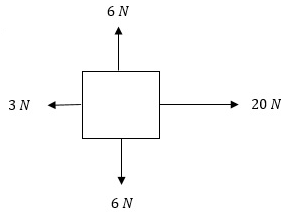
What is the NET FORCE of this diagram?
17 N, right
17 N, left
23 N, right
12 N, up
17
Multiple Choice

18
Multiple Choice
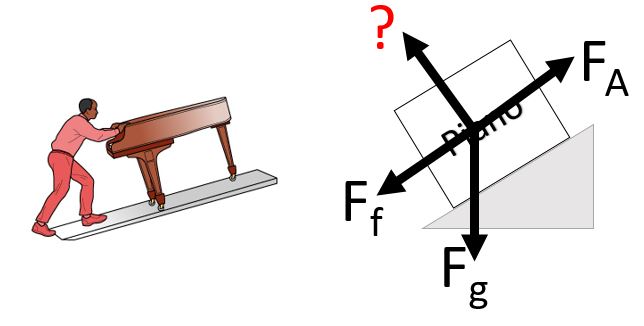
19

Newton’s 3rdLaw
Action - Reaction
For every action force there is
an equal and opposite
reaction force.
Example: If you punch a wall with your fist in anger,
the wall hits your fist with the same
force. That’s why it hurts!
Action-reaction forces cannot balance each
other out because they are acting on
different objects. The forces acting on an
object determine their motion.
20

Projectile Motion
21

Assumptions we make…
We assume NO AIR RESISTANCE! The path of a
projectile is a parabola.
Horizontal motion is constant velocity.
Vertical motion is in “free-fall”.
Vertical velocity at the top of the path is zero
Time is the same for both horizontal and
vertical motions.
0
constant
=
=
x
x
a
v
down
ay
,
m/s
8.9
2
=
0
top=
yv
𝑡𝑥 = 𝑡𝑦
22

How are the formulas different for
projectiles? They must be applied
along only one axis at a time.
horizontal or “x” – direction
vertical or “y” – direction
𝑣𝑦𝑓 = 𝑣𝑜𝑦 + 𝑔𝑡
𝑑𝑦 = 𝑣𝑜𝑦 + 𝑣𝑦𝑓
2
𝑡
𝑑𝑦 = 𝑣𝑜𝑦𝑡 + ൗ
1 2 𝑔𝑡2
𝑣𝑦𝑓2= 𝑣𝑜𝑦2+ 2𝑔𝑑𝑦
Remember that for projectiles, the horizontal (x) and vertical (y) motions must
be separated and analyzed independently.
𝑣𝑓𝑥 = 𝑣𝑜𝑥 + 𝑎𝑥𝑡
𝑑𝑥 = 𝑣𝑜𝑥 + 𝑣𝑓𝑥
2
𝑡
𝑑𝑥 = 𝑣𝑜𝑥𝑡 + 1
2 𝑎𝑥𝑡2
𝑣𝑓𝑥2= 𝑣𝑜𝑥2+ 2𝑎𝑥𝑑𝑥
0
0
0
23
Multiple Select
A ball rolls off a table and follows a parabolic path (projectile motion). Which quantities are zero?
initial vertical velocity
horizontal acceleration
vertical acceleration
horizontal displacement
initial horizontal velocity
24
Match
Match the following angles to their situations
90°
45°
0°
Maximum vertical displacement
Maximum horizontal and vertical displace
Maximum horizontal displacement
Maximum vertical displacement
Maximum horizontal and vertical displace
Maximum horizontal displacement
25

Circular Motion
26

The Circle
One of the first
things you need
to know is how to
calculate the
circumference of
a circle.
𝐶 = 2𝜋𝑟 = 𝜋𝑑
This Photo by Unknown Author is licensed under CC BY-NC-ND
27

Centripetal Velocity
Imagine there is a ball spinning around on a string over
your head. We know the length of the string and the
time it takes for the ball to make one turn. We can find
how fast the ball is moving using some simple math.
𝑉𝑡 =
2𝜋𝑟
𝑡=
𝜋𝑑
𝑡
Note, this is tangential velocity. Angular velocity is related, but
we’re not going to dive into that.
This Photo by Unknown Author is licensed under CC BY-SA
28

Centripetal Force
Picture that spinning ball again. What is the
string providing for the ball?
The string is “pulling” the ball back towards
the center, providing what is called a
Centripetal Force.
𝐹𝐶 =
𝑚∗𝑉2
𝑟
29

Centripetal Acceleration
Now that we know how fast something is moving, and
the forces involved, we can figure out the acceleration.
How do we know there is an acceleration though?
Because the ball is changing direction
The string is “pulling” the ball and not allowing it to go flying off
𝑎𝐶 =
𝑉2
𝑟
30
Math Response
A ball is swung in a horizontal circle at a constant speed. Each circle takes 0.85 seconds to complete and the rope is 0.40 m long. What is the centripetal acceleration?
31
Fill in the Blanks
What direction does the centripetal acceleration point?
Type answer...
32

Universal
Gravitation
33

Newton’s Law of Universal
Gravitation
Every object attracts every other
object with a force that is directly
proportional to the product of the
masses of the objects and
inversely proportional to the
square of the distance between
them.
34

r
m1
m2
Fg
Fg
Mathematically…
Fg = gravitational force or weight
or force of attraction, N
G = universal constant of
gravitation (= 6.67 x 10 -11Nm2/kg2)
m1, m2 = masses of objects, kg
r = distance from center of one
object to center of other object,
m
F𝑔= G
𝑚1 𝑚2
𝑟2
35

What this means Physically…
I have gravity
You have gravity
The Earth, Sun, Moon, and
planets have gravity
EVERYTHING HAS
GRAVITY!!!
Gravity is an attractive
force, so…
36

Change of
Gravitational
Force with
Distance
■ Law of universal
gravitation is
known as an
inverse square
law.
37
Multiple Choice
If I doubled the mass of two objects, what is the new Force of Gravity between them?
38
Multiple Choice
Doubling the distance between two objects does what to the Force of Gravity between them?
39
Multiple Choice
How does the Force of Gravity change if I triple the mass of one object and triple the distance between them?
increase by a factor of 3
decreases by a factor of 9
decreases by a factor of 1/9
40
Fill in the Blanks
How does the Force of Gravity relate to the distance between two objects?
Type answer...
41
Math Response
Determine the gravitational force of attraction between two 3.5 kg bowling balls whose centers are exactly 2.0 meters from each other. Write your answer in scientific notation.
Newton’s
Laws
Show answer
Auto Play
Slide 1 / 41
SLIDE
Similar Resources on Wayground

39 questions
Unit 2 Lesson 2: Vectors, Equilibrium,Support Force,&Friction
Presentation
•
12th Grade
34 questions
Atoms: Structure and Average Atomic Mass
Presentation
•
11th - 12th Grade
33 questions
Matter and Energy in Ecosystems
Presentation
•
12th Grade
32 questions
Light waves behavior
Presentation
•
12th Grade
38 questions
Business Organizations
Presentation
•
12th Grade
33 questions
Origin of Life forms 2021
Presentation
•
11th - 12th Grade
38 questions
Lake turnover
Presentation
•
12th Grade
36 questions
Directional Terms, Cavities and Regional Names
Presentation
•
12th Grade
Popular Resources on Wayground
10 questions
How much do you know about our Portrait of an Eagle?

Quiz
•
10th Grade
10 questions
Fast Food Slogans
Quiz
•
6th - 8th Grade
21 questions
Continents and Oceans
Quiz
•
6th Grade
20 questions
Parts of Speech
Quiz
•
5th Grade
16 questions
Subject & Predicate
Quiz
•
5th Grade
25 questions
Multiplication Facts
Quiz
•
5th Grade
12 questions
Map Skills
Quiz
•
3rd Grade
22 questions
Continents and Oceans
Quiz
•
5th Grade
Discover more resources for Science
22 questions
Periodic Table Review
Quiz
•
9th - 12th Grade
7 questions
Newton's Laws Video Quiz

Interactive video
•
9th - 12th Grade
17 questions
Unit 3A: Cells Vocab
Quiz
•
9th - 12th Grade
89 questions
Unit 1 (Ch 2 & 3) Test Review - Water/Ocean Currents
Quiz
•
9th - 12th Grade
58 questions
Biomolecule Test Corrections
Quiz
•
9th - 12th Grade
20 questions
Unit 2: Cell Energy Review
Quiz
•
9th - 12th Grade
17 questions
Explore Newton's Laws of Motion
Quiz
•
8th - 12th Grade
35 questions
Directional Terms, Body Cavities, Body Planes
Quiz
•
11th - 12th Grade