
Adaptations for Gas Exchange

Presentation
•
Science
•
12th Grade
•
Practice Problem
•
Hard

Dawn Davis
Used 6+ times
FREE Resource
11 Slides • 5 Questions
1
An overview of adaptations in organisms for efficient gas exchange.
2
Gas Exchange in Humans
3
Multiple Choice
Which organ is responsible for gas exchange in humans?
Liver
Kidney
Lungs
Heart
4
Lungs
The lungs are responsible for gas exchange in humans. They are a pair of spongy organs located in the chest cavity. Oxygen from the air we breathe enters the bloodstream through tiny air sacs called alveoli, while carbon dioxide, a waste product, is expelled. The lungs also help regulate the body's pH balance and play a role in vocalization.
5
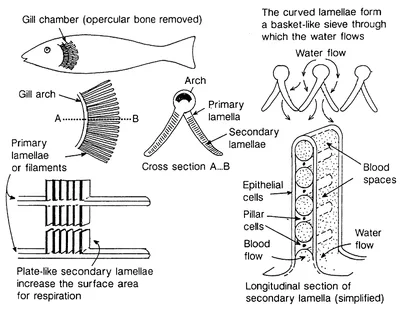
Adaptations of Fish Gills
Fish gills are specialized organs for gas exchange in water.
Gills have a large surface area for efficient oxygen absorption.
They are made up of thin filaments called gill lamellae.
Gill lamellae are rich in blood vessels to transport oxygen.
Water flows over the gills, allowing oxygen to diffuse into the bloodstream.
6
Multiple Choice
What are gills specialized for?
Oxygen absorption
Carbon dioxide absorption
Water filtration
Food digestion
7
Trivia: Gills and Carbon Dioxide
Gills are specialized organs in aquatic animals that allow them to extract oxygen from water and release carbon dioxide. They are highly efficient in absorbing oxygen due to their large surface area. Interestingly, gills can extract up to 85% of the oxygen present in water, while humans can only extract about 20% from the air we breathe. Gills are essential for the survival of many underwater creatures!
8
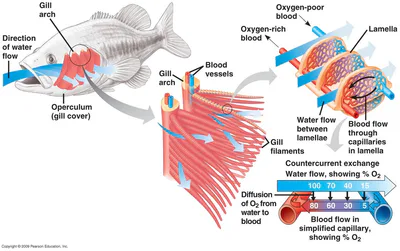
Countercurrent Exchange in Fish Gills
Adaptation for efficient gas exchange
Occurs in fish gills
Maximizes oxygen uptake and carbon dioxide removal
Water flows opposite to blood flow
Creates concentration gradient for efficient exchange
9
Multiple Choice
What adaptation in fish gills maximizes oxygen uptake and carbon dioxide removal?
Water flows opposite to blood flow
Creates concentration gradient for efficient exchange
Maximizes oxygen uptake and carbon dioxide removal
Occurs in fish gills
10
Fish Gills:
Maximizing Oxygen Uptake - Water flows opposite to blood flow - Creates concentration gradient for efficient exchange - Occurs in fish gills - Maximizes oxygen uptake and carbon dioxide removal
11
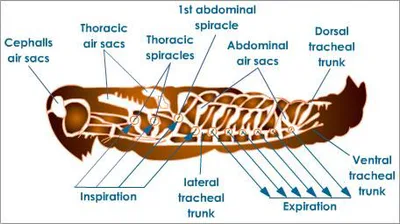
Gas Exchange in Insects
Spiracles: Tiny openings on the body of insects that allow air to enter and exit
Tracheae: A network of tubes that transport oxygen directly to cells
Adaptations: Spiracles and tracheae enable efficient gas exchange in insects
12
Multiple Choice
What adaptations enable efficient gas exchange in insects?
Spiracles
Tracheae
Gills
Lungs
13
Efficient Gas Exchange in Insects
Trivia: Insects have a unique respiratory system called tracheae. These are a network of tiny tubes that deliver oxygen directly to the cells, allowing for efficient gas exchange. Unlike humans, insects do not have lungs or gills. Instead, they rely on spiracles, small openings on their body, to let air in and out. This adaptation helps insects thrive in diverse environments.
14
Gas Exchange Adaptations
15
Multiple Choice
What is the main function of the respiratory system?
Gas exchange
Transporting oxygen
Producing sound
Regulating body temperature
16
Respiratory System:
Gas exchange is the main function of the respiratory system. It allows oxygen to enter the bloodstream and carbon dioxide to be expelled. Without this vital process, our cells would not receive the oxygen they need to function properly. The respiratory system is a complex network of organs and tissues that work together to ensure our survival.
An overview of adaptations in organisms for efficient gas exchange.
Show answer
Auto Play
Slide 1 / 16
SLIDE
Similar Resources on Wayground

13 questions
materi ajar Berkenalan dengan Bumi Kita
Presentation
•
11th Grade
10 questions
untitled
Presentation
•
KG
10 questions
Exchange in Fish and Insects
Presentation
•
12th Grade
13 questions
Understanding Ammonia in Fish Ponds
Presentation
•
12th Grade
11 questions
Pertumbuhan dan perkembangan
Presentation
•
12th Grade
13 questions
Convection
Presentation
•
11th Grade
14 questions
Conduction, Convection, and Radiation in the Atmosphere
Presentation
•
KG - University
14 questions
Conduction Convection Radiation Worksheet
Presentation
•
KG - University
Popular Resources on Wayground
10 questions
Safety Day 2026 – Student Review

Quiz
•
9th Grade
21 questions
Continents and Oceans
Quiz
•
6th Grade
20 questions
Parts of Speech
Quiz
•
5th Grade
16 questions
Subject & Predicate
Quiz
•
5th Grade
25 questions
Multiplication Facts
Quiz
•
5th Grade
12 questions
Map Skills
Quiz
•
3rd Grade
22 questions
Continents and Oceans
Quiz
•
5th Grade
15 questions
Rounding Decimals
Quiz
•
5th Grade
Discover more resources for Science
7 questions
Newton's Laws Video Quiz

Interactive video
•
9th - 12th Grade
35 questions
Cell Transport/Enzyme/Cell/Macro Review
Quiz
•
9th - 12th Grade
13 questions
Explore Enzyme Functions and Interactions
Quiz
•
9th - 12th Grade
10 questions
Fact or Fiction: Microbes
Quiz
•
9th - 12th Grade
10 questions
Understand Cell Functions and Organelles
Quiz
•
9th - 12th Grade
19 questions
Explore Macromolecules in Living Organisms
Quiz
•
9th - 12th Grade
15 questions
Layers of Atmosphere passage

Passage
•
9th - 12th Grade
22 questions
Quiz Review Day 5 Water and Macromolecules
Quiz
•
9th - 12th Grade