
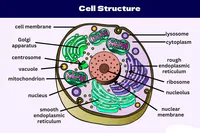
Cell Organelles: Exploring the Building Blocks of Life

Presentation
•
Science
•
12th Grade
•
Practice Problem
•
Hard
+10
Standards-aligned

Dawn Davis
Used 1+ times
FREE Resource
11 Slides • 5 Questions
1
Exploring the Building Blocks of Life
2
Cell Organelles
3
Multiple Choice
Which cell organelle is responsible for producing energy in the form of ATP?
Nucleus
Endoplasmic Reticulum
Mitochondria
Lysosomes
4
Mitochondria:
Mitochondria is the powerhouse of the cell, responsible for producing energy in the form of ATP. It is often referred to as the 'cellular power plant'. Without mitochondria, our cells would not be able to generate the energy needed for various cellular processes.
5
The Nucleus:
6
Multiple Choice
What is the control center of the cell?
Mitochondria
Nucleus
Ribosomes
Endoplasmic Reticulum
7
Nucleus
The control center of the cell is the nucleus. It contains the cell's genetic material, DNA, which determines the cell's characteristics and activities. The nucleus also regulates the cell's functions and coordinates cell division. Without the nucleus, the cell would not be able to function properly. Fun fact: The nucleus was first discovered by Robert Brown in 1831.
8
Mitochondria: Powerhouses of the Cell
9
Multiple Choice
What is the primary function of mitochondria?
Cell division
Protein synthesis
Energy generation
Waste removal
10
Energy Generation
Mitochondria are often referred to as the powerhouses of the cell. They produce energy in the form of ATP through a process called cellular respiration. Without mitochondria, our cells wouldn't have the energy they need to function properly. So, thank your mitochondria for keeping you energized!
11
Endoplasmic Reticulum
12
Multiple Choice
What is the main function of the Endoplasmic Reticulum (ER) in eukaryotic cells?
Protein synthesis
Energy production
Cell wall formation
DNA replication
13
Endoplasmic Reticulum:
Trivia: Did you know that the main function of the Endoplasmic Reticulum (ER) in eukaryotic cells is protein synthesis? It plays a crucial role in the production, folding, and transport of proteins within the cell. Without the ER, our cells wouldn't be able to function properly!
14
Cell Membrane
15
Multiple Choice
What is the main function of the cell membrane?
Protection of the cell
Regulation of substances in and out of the cell
Energy production within the cell
Storage of genetic material
16
Cell Membrane:
Trivia: The main function of the cell membrane is the regulation of substances in and out of the cell. It acts as a selective barrier, allowing essential molecules to enter and waste products to exit. The cell membrane is made up of a phospholipid bilayer and various proteins that aid in transport and communication.
Exploring the Building Blocks of Life
Show answer
Auto Play
Slide 1 / 16
SLIDE
Similar Resources on Wayground

12 questions
Prepositions
Presentation
•
3rd Grade
11 questions
Listrik
Presentation
•
12th Grade
11 questions
Medical terminology - Lesson 3
Presentation
•
12th Grade
10 questions
FORMATION OF LIGHT AND HEAVY ELEMENTS
Presentation
•
12th Grade
11 questions
Week 12 - 12/23 - Final Project Intro 2
Presentation
•
12th Grade
10 questions
Otomotif
Presentation
•
12th Grade
13 questions
Speed v. Velocity
Presentation
•
8th Grade
13 questions
Renewable and Nonrenewable Resources
Presentation
•
12th Grade
Popular Resources on Wayground
10 questions
How much do you know about our Portrait of an Eagle?

Quiz
•
10th Grade
10 questions
Fast Food Slogans
Quiz
•
6th - 8th Grade
21 questions
Continents and Oceans
Quiz
•
6th Grade
20 questions
Parts of Speech
Quiz
•
5th Grade
16 questions
Subject & Predicate
Quiz
•
5th Grade
25 questions
Multiplication Facts
Quiz
•
5th Grade
12 questions
Map Skills
Quiz
•
3rd Grade
22 questions
Continents and Oceans
Quiz
•
5th Grade
Discover more resources for Science
22 questions
Periodic Table Review
Quiz
•
9th - 12th Grade
7 questions
Newton's Laws Video Quiz

Interactive video
•
9th - 12th Grade
17 questions
Unit 3A: Cells Vocab
Quiz
•
9th - 12th Grade
89 questions
Unit 1 (Ch 2 & 3) Test Review - Water/Ocean Currents
Quiz
•
9th - 12th Grade
58 questions
Biomolecule Test Corrections
Quiz
•
9th - 12th Grade
20 questions
Unit 2: Cell Energy Review
Quiz
•
9th - 12th Grade
17 questions
Explore Newton's Laws of Motion
Quiz
•
8th - 12th Grade
35 questions
Directional Terms, Body Cavities, Body Planes
Quiz
•
11th - 12th Grade