6A/ 6G
Presentation
•
Biology
•
10th Grade
•
Medium
+1
Standards-aligned
MADIE SIMMS
Used 8+ times
FREE Resource
8 Slides • 12 Questions
1
2
3
Multiple Choice
The shape of DNA is called:
Helix
Double helix
Triple helix
Ladder
4
Multiple Choice
What is the monomer of DNA?
Amino acid
Glucose
Fatty acid
Nucleotide
5
Multiple Choice
What part of the DNA molecules carries the code for specific traits?
The sequence of nitrogen bases
Sugar-phosphate backbone
"Sides" of the ladder
The phosphate
6
Multiple Choice
6A: Students are given data from an investigation that identified some of the chemical elements present in four different samples. Which sample was most likely DNA?
Sample 1
Sample 2
Sample 3
Sample 4
7
8
9
Multiple Choice
In DNA only, Adenine always pairs with:
Thymine
Cytosine
Uracil
Guanine
10
Multiple Choice
What is the bond between nitrogen bases?
Carbon
Nitrogen
Hydrogen
Oxygen
11
Multiple Choice
6A A segment of a DNA strand is shown.
3’ AGGTCAGGT 5’
Which of these is the correct complementary DNA strand for the segment shown?
5’ AGGTCAGGT 3’
5’ ACCUGAGGU 3’
5’ TGGACTGGA 3’
5’ TCCAGTCCA 3’
12
13
14
Multiple Choice
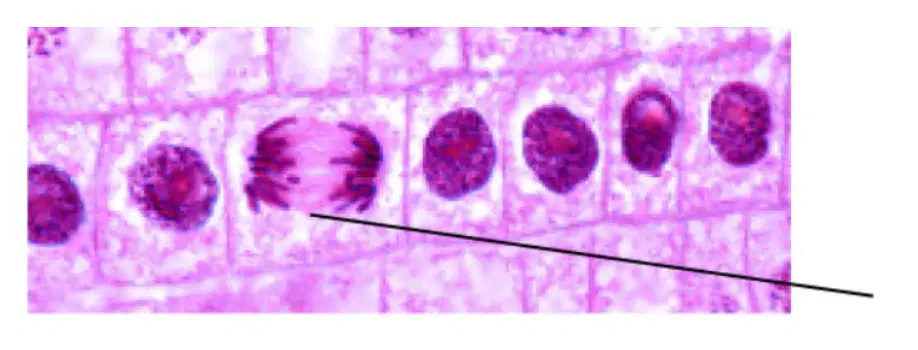
This image shows a photomicrograph of an onion root tip. In what phase of mitosis is the indicated cell?
Telphase
Interphase
Prophase
Anaphase
15
16
17
Multiple Choice
6G: Which diagram demonstrates how crossing-over contributes to genetic variety during meiosis?
18
Multiple Choice
A diagram of crossing over in meiosis is shown. What is the significance of crossing over in meiosis?
Genes in the gametes recombine to increase genetic variation.
Gametes duplicate and alter the number of chromosomes present at the end of meiosis.
Gametes begin with 48 chromosomes and still have 48 at the end of meiosis
Genes replicate and ensure that the offspring have the same traits as the parents.
19
Multiple Select
Meiosis creates: Select all that apply.
haploid cells
diploid cells
gamete cells
somatic cells
different cells
20
Multiple Choice
6G Human body cells each have 46 chromosomes in their nuclei. Meiosis is necessary in order to ensure that each gamete produced in the human body has —
12 chromosomes
23 chromosomes
46 chromosomes
92 chromosomes
Show answer
Auto Play
Slide 1 / 20
SLIDE

Similar Resources on Wayground
16 questions
Sex-linked traits
Presentation
•
10th Grade
17 questions
Mitosis y meiosis
Presentation
•
10th Grade
12 questions
Pedigrees
Presentation
•
10th Grade
17 questions
Cell Division
Presentation
•
9th - 10th Grade
19 questions
The study of cells using the Microscope
Presentation
•
10th Grade
18 questions
The Scientific Method
Presentation
•
10th Grade
18 questions
Mendel's Laws
Presentation
•
9th - 10th Grade
15 questions
SuperBugs: Antibiotic Resistance
Presentation
•
10th - 11th Grade
Popular Resources on Wayground
10 questions
Safety Day 2026 – Student Review
Quiz
•
9th Grade
21 questions
Continents and Oceans
Quiz
•
6th Grade
20 questions
Parts of Speech
Quiz
•
5th Grade
16 questions
Subject & Predicate
Quiz
•
5th Grade
25 questions
Multiplication Facts
Quiz
•
5th Grade
12 questions
Map Skills
Quiz
•
3rd Grade
22 questions
Continents and Oceans
Quiz
•
5th Grade
15 questions
Rounding Decimals
Quiz
•
5th Grade
Discover more resources for Biology
20 questions
Cell organelles and functions
Quiz
•
10th Grade
20 questions
Cell Transport
Quiz
•
9th - 12th Grade
8 questions
DNA vs. RNA
Presentation
•
9th - 12th Grade
20 questions
Macromolecules
Quiz
•
10th Grade
20 questions
Characteristics of Life
Quiz
•
9th - 10th Grade
15 questions
Photosynthesis and Cellular Respiration
Quiz
•
10th Grade
15 questions
DNA Structure and Replication
Quiz
•
9th - 12th Grade
20 questions
Ecological Succession Review
Quiz
•
9th - 12th Grade