

Chapter 10-Short Term Business Decisions

Presentation
•
Computers
•
12th Grade
•
Easy

Steve Howard
Used 1+ times
FREE Resource
63 Slides • 18 Questions
1


Horngren’s Financial & Managerial
Accounting
Eighth Edition
Chapter 10
Short-Term Business
Decisions
Copyright © 2024, 2020, 2017 Pearson Education, Inc. All Rights Reserved
2



Copyright © 2024, 2020, 2017 Pearson Education, Inc. All Rights Reserved
Learning Objectives (1 of 2)
10.1 Identify information
that is relevant for making
short-term decisions
10.2 Make regular and
special pricing decisions
3



Copyright © 2024, 2020, 2017 Pearson Education, Inc. All Rights Reserved
Learning Objectives (2 of 2)
10.3 Make decisions about
dropping a product, product
mix, and sales mix
10.4 Make outsourcing and
processing further decisions
4


Copyright © 2024, 2020, 2017 Pearson Education, Inc. All Rights Reserved
Learning Objective 10.1
Identify information that is
relevant for making short-
term decisions
5


Copyright © 2024, 2020, 2017 Pearson Education, Inc. All Rights Reserved
How Is Relevant Information Used to
Make Short-Term Decisions?
Exhibit M:10-1 How Managers Make Decisions
6


Copyright © 2024, 2020, 2017 Pearson Education, Inc. All Rights Reserved
Relevant Information (1 of 2)
• When managers make decisions, they focus on
information that is relevant to the decision.
• Relevant information is expected future data that
differs among alternatives.
• Relevant costs are costs that are relevant to a
particular decision.
• Relevant revenues are revenues that are relevant to
a particular decision.
7
Multiple Choice

8


Copyright © 2024, 2020, 2017 Pearson Education, Inc. All Rights Reserved
Relevant Information (2 of 2)
• Irrelevant costs and irrelevant revenues are costs and
revenues that do not affect a decision.
– They are not in the future or do not differ among
alternatives.
• Sunk costs are costs that were incurred in the past and
cannot be changed, regardless of which future action is
taken.
– Examples: Depreciation, original purchase price of an
asset
9

10
Multiple Choice
Income taxes are a
Controllable cost
Uncontrollable cost
11

12
Open Ended
Which cost do you think hurts a company more, sunk or out of pocket? Why?
13
Multiple Choice
Sunk costs are...
Costs that were part of a cruise ship that sunk
Costs that will end in a product
What a producer pays to supply a product to a market
Costs that cannot be recovered
14
Multiple Choice
Marginal Cost is?
The highest amount that customers will pay for a good
The lowest amount that customers will pay for a good
The cost of producing one additional good
The cost of producing 2 additional goods
15
Multiple Choice

16


Copyright © 2024, 2020, 2017 Pearson Education, Inc. All Rights Reserved
Relevant Nonfinancial Information
Nonfinancial, or qualitative, factors play a role in managers’
decisions and, as a result, can be relevant. For example:
• Closing plants and laying off employees can hurt morale.
• The decision to outsource may reduce control over
delivery time or product quality.
• Offering discount prices to select customers may upset
regular customers and tempt them to take their business
elsewhere.
17
Multiple Choice

18


Copyright © 2024, 2020, 2017 Pearson Education, Inc. All Rights Reserved
Differential Analysis (1 of 2)
• A common approach to making short-term business
decisions is called differential analysis.
• Short-term decisions include:
– Regular and special pricing
– Dropping unprofitable products and segments,
product mix, and sales mix
– Outsourcing and processing further
19
Multiple Choice

20


Copyright © 2024, 2020, 2017 Pearson Education, Inc. All Rights Reserved
Differential Analysis (2 of 2)
As you study these decisions, keep in mind the two keys in
analyzing short-term business decisions:
1. Focus on relevant revenues, costs, and profits.
2. Use a contribution margin approach that separates
variable costs from fixed costs.
21
Multiple Choice

22



Copyright © 2024, 2020, 2017 Pearson Education, Inc. All Rights Reserved
Learning Objective 10.2
Make regular and special
pricing decisions
23
Multiple Choice

24


Copyright © 2024, 2020, 2017 Pearson Education, Inc. All Rights Reserved
Setting Regular Prices (1 of 3)
Managers must consider three questions when setting
regular prices:
• What is the company’s target profit?
• How much will customers pay?
• Is the company a price-taker or a price-setter for this
product or service?
25
Multiple Choice

26


Copyright © 2024, 2020, 2017 Pearson Education, Inc. All Rights Reserved
Setting Regular Prices (2 of 3)
The question “Is the company a price-taker or a price-setter
for this product or service?” requires consideration of
whether the company is a:
• Price-taker with little control over pricing
• Price-setter with more control over pricing
27
Multiple Choice

28


Copyright © 2024, 2020, 2017 Pearson Education, Inc. All Rights Reserved
Setting Regular Prices (3 of 3)
Exhibit M:10-2 Price-Takers Versus Price-Setters
Companies Are Price
Takers for a Product When:
• Product lacks uniqueness
• There is intense
competition
• Pricing approach
emphasizes target pricing
Companies Are Price Setters
for a Product When:
• Product is more unique
• There is less competition
• Pricing approach emphasizes
cost plus pricing
29
Multiple Choice

30


Copyright © 2024, 2020, 2017 Pearson Education, Inc. All Rights Reserved
Target Pricing (1 of 6)
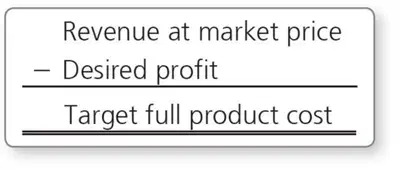
• When a company is a price-taker, it emphasizes a target-
pricing approach to managing costs and profits.
• Target pricing starts with the market price of the product
and then subtracts the company’s desired profit to
determine the maximum allowed target full product cost.
31
Multiple Choice
Which function of marketing determines how much gross profit a business will make on a good or service?
Pricing
Distribution
Promotion
Risk Management
32
Multiple Choice
Pricing techniques that help create an illusion for customers.
Price
Sales Revenue
Break-Even Point
Demand Elasticity
Psychological Pricing
33
Multiple Choice
It is most typical for producers who use captive-product pricing to set the price of the main product ________ and set ________ on the supplies necessary to use the product.
low; low markups
high; low markups
low; high markups
high; high markups
moderately; moderate markups
34
Multiple Choice
With target costing, marketers will first ________ and then ________.
build the marketing mix; identify the target market
identify the target market; build the marketing mix
design the product; determine its cost
use skimming pricing; use penetrating pricing
determine a selling price; target costs to ensure that the price is met
35
Multiple Choice

36


Copyright © 2024, 2020, 2017 Pearson Education, Inc. All Rights Reserved
Target Pricing (2 of 6)
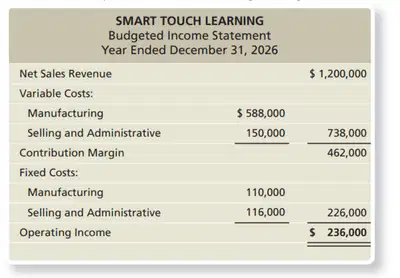
Exhibit M:10-3 Smart Touch Learning’s Budgeted Income Statement
37


Copyright © 2024, 2020, 2017 Pearson Education, Inc. All Rights Reserved
Target Pricing (3 of 6)
• In setting regular sales prices, companies must cover all costs—
whether the costs are product or period, fixed or variable.
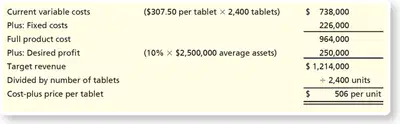
• The desired profit is
(
)
$250,000 $2,500,000 average assets 10% .
• The target full product cost at the current sales volume of 2,400
tablets is calculated as follows:
38


Copyright © 2024, 2020, 2017 Pearson Education, Inc. All Rights Reserved
Target Pricing (4 of 6)
What options does Smart Touch Learning have?
1. Accept the lower operating income of $236,000, which
is a 9.44% return on investment ($236,000 operating
income / $2,500,000 average assets), not the 10%
target return required by stockholders.
2. Reduce fixed costs by $14,000 or more.
3. Reduce variable costs by $14,000 or more.
39


Copyright © 2024, 2020, 2017 Pearson Education, Inc. All Rights Reserved
Target Pricing (5 of 6)
Smart Touch Learning’s options (continued):
4. Attempt to increase sales volume. If the company
has excess manufacturing capacity, making and
selling more units would only affect variable costs;
however, it would mean that current fixed costs are
spread over more units.
5. Change or add to its product mix (covered later in
the chapter).
40


Copyright © 2024, 2020, 2017 Pearson Education, Inc. All Rights Reserved
Target Pricing (6 of 6)
Smart Touch Learning’s options (continued):
6. Attempt to differentiate its tablet computer from the
competition to gain more control over sales prices
(become a price-setter).
7. A combination of the above strategies that would
increase revenues and/or decrease costs by $14,000.
41


Copyright © 2024, 2020, 2017 Pearson Education, Inc. All Rights Reserved
Cost-Plus Pricing (1 of 3)
• Price-setters emphasize a cost-plus approach to pricing.
• Cost-plus pricing starts with a company’s full product
costs and adds its desired profit to determine a cost-plus
price.
42


Copyright © 2024, 2020, 2017 Pearson Education, Inc. All Rights Reserved
Cost-Plus Pricing (2 of 3)
Using a cost-plus pricing approach, assuming the current
level of sales, and a desired profit of 10% of average
assets, the cost-plus price is $506, calculated as follows:
43


Copyright © 2024, 2020, 2017 Pearson Education, Inc. All Rights Reserved
Cost-Plus Pricing (3 of 3)
For cost-plus pricing decisions, the decision rule follows:
44


Copyright © 2024, 2020, 2017 Pearson Education, Inc. All Rights Reserved
Special Pricing (1 of 4)
• A special pricing decision occurs when a customer requests a
one-time order at a reduced sales price.
• Management must consider:
– Does the company have the excess capacity available to
fill the order?
– Will the reduced sales price be high enough to cover the
differential costs of filling the order?
– Will the special order affect regular sales in the long run?
45


Copyright © 2024, 2020, 2017 Pearson Education, Inc. All Rights Reserved
Special Pricing (2 of 4)
Exhibit M:10-4 Smart Touch Learning’s Budgeted Income Statement—
Traditional and Contribution Margin Formats
46


Copyright © 2024, 2020, 2017 Pearson Education, Inc. All Rights Reserved
Special Pricing (3 of 4)
Exhibit M:10-5 Differential Analysis of Special Pricing Decision
47


Copyright © 2024, 2020, 2017 Pearson Education, Inc. All Rights Reserved
Special Pricing (4 of 4)
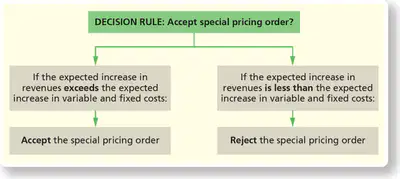
For special pricing decisions, the decision rule follows:
48


Copyright © 2024, 2020, 2017 Pearson Education, Inc. All Rights Reserved
Learning Objective 10.3
Make decisions about
dropping a product, product
mix, and sales mix
49


Copyright © 2024, 2020, 2017 Pearson Education, Inc. All Rights Reserved
How Do Managers Decide Which
Products to Produce and Sell?
Deciding which products to produce and sell is a major
managerial decision.
• If manufacturing capacity is limited, managers must
decide which products to produce.
• Managers must also decide whether to drop products,
departments, or territories that are not as profitable as
desired.
50


Copyright © 2024, 2020, 2017 Pearson Education, Inc. All Rights Reserved
Dropping Unprofitable Products and
Segments (1 of 2)
Management’s considerations when dropping a product or
business segment include:
• Does the product or segment provide a positive contribution
margin?
• Will fixed costs continue to exist, even if the company drops the
product or segment?
• Are there any direct fixed costs that can be avoided if the
company drops the product or segment?
• Will dropping the product or segment affect sales of the
company’s other products?
• What would the company do with the freed manufacturing
capacity or store space?
51


Copyright © 2024, 2020, 2017 Pearson Education, Inc. All Rights Reserved
Exhibit M:10-6 Budgeted Income
Statement by Product
52


Copyright © 2024, 2020, 2017 Pearson Education, Inc. All Rights Reserved
The Effect of Fixed Costs (1 of 3)
• In the short term, many fixed costs remain unchanged in
total, regardless of how they are allocated to products or
other cost objects.
• Allocated fixed costs are irrelevant.
• The following questions help determine what is relevant:
1. Will the fixed costs continue to exist even if the
product is dropped?
2. Are there any direct fixed costs of the Premium
Tablets that can be avoided if the product is
dropped?
53


Copyright © 2024, 2020, 2017 Pearson Education, Inc. All Rights Reserved
The Effect of Fixed Costs (2 of 3)
Exhibit M:10-7 Differential Analysis of Dropping a Product When Fixed
Costs Will Not Change
54


Copyright © 2024, 2020, 2017 Pearson Education, Inc. All Rights Reserved
The Effect of Fixed Costs (3 of 3)
Exhibit M:10-8 Differential Analysis of Dropping a Product When Fixed
Costs Will Change
55


Copyright © 2024, 2020, 2017 Pearson Education, Inc. All Rights Reserved
Other Considerations
• Managers considering dropping a product line or
segment would consider:
– Would dropping it hurt other product sales?
– What could be done with the freed manufacturing
capacity?
• Short-term business decisions should take into account
all costs affected by the choice of action.
56


Copyright © 2024, 2020, 2017 Pearson Education, Inc. All Rights Reserved
Dropping Unprofitable Products and
Segments (2 of 2)
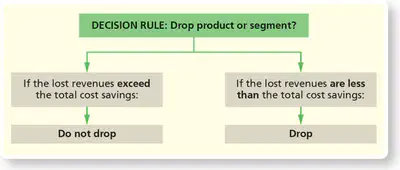
When deciding whether to drop products or segments, the
decision rule follows:
57


Copyright © 2024, 2020, 2017 Pearson Education, Inc. All Rights Reserved
Product Mix (1 of 6)
• Companies do not have unlimited resources.
• A constraint is a factor that restricts the production or
sale of a product.
• Managers should consider producing and selling the
products that offer the highest contribution margin per
unit of the constraint.
58


Copyright © 2024, 2020, 2017 Pearson Education, Inc. All Rights Reserved
Product Mix (2 of 6)
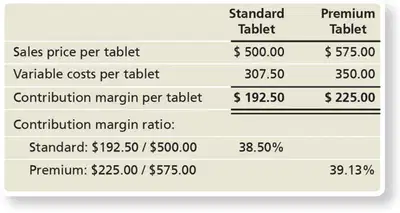
Calculate the contribution margin per unit and the contribution
margin ratio to compare products.
Exhibit M:10-9 Smart Touch Learning’s Contribution Margin per
Unit
59


Copyright © 2024, 2020, 2017 Pearson Education, Inc. All Rights Reserved
Product Mix (3 of 6)
To determine which product to emphasize, the decision rule
follows:
60


Copyright © 2024, 2020, 2017 Pearson Education, Inc. All Rights Reserved
Product Mix (4 of 6)
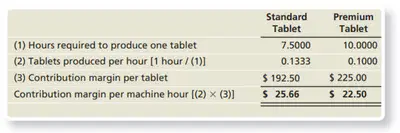
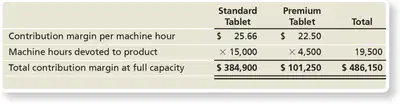
Take into consideration the constraint to determine the true
contribution margin per unit.
Exhibit M:10-10 Smart Touch Learning’s Contribution Margin per
Machine Hour
61


Copyright © 2024, 2020, 2017 Pearson Education, Inc. All Rights Reserved
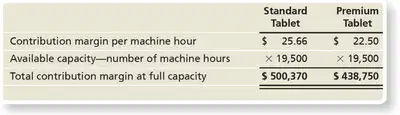
Product Mix (5 of 6)
Exhibit M:10-11 Total Contribution Margin with Machine
Hour Constraint
62


Copyright © 2024, 2020, 2017 Pearson Education, Inc. All Rights Reserved
Product Mix (6 of 6)
Maximize profitability by combining the constraint limitations
with the limited market.
Exhibit M:10-12 Total Contribution Margin with Machine
Hour Constraint and Limited Market
63


Copyright © 2024, 2020, 2017 Pearson Education, Inc. All Rights Reserved
Sales Mix (1 of 3)
• Merchandising companies also have constraints, display
space being the most common constraint.
• Managers must choose which products to display.
• Managers consider space constraints along with the
contribution margin per unit.
64


Copyright © 2024, 2020, 2017 Pearson Education, Inc. All Rights Reserved
Sales Mix (2 of 3)
• Bragg Company operates gift shops in airports and has
only 48 linear feet of bookshelves in each store.
• The following chart shows the average sales price; cost of
purchasing the books, which is a variable cost; and
contribution margin for hardcover and paperback books:
Blank
Hardcover Books
Paperback Books
Sales Price
$ 28.00
$ 12.00
Variable Cost
19.60
7.20
Contribution Margin
$ 8.40
$ 4.80
65


Copyright © 2024, 2020, 2017 Pearson Education, Inc. All Rights Reserved
Sales Mix (3 of 3)
When considering the constraint, we see that Bragg can
generate more profits per foot of shelving if paperback
books are displayed:
Exhibit M:10-13 Total Contribution Margin with Display
Space Constraint
66



Copyright © 2024, 2020, 2017 Pearson Education, Inc. All Rights Reserved
Learning Objective 10.4
Make outsourcing and
processing further decisions
67


Copyright © 2024, 2020, 2017 Pearson Education, Inc. All Rights Reserved
How Do Managers Make Outsourcing
and Processing Further Decisions?
• Short-term management decisions include how products
are produced.
• Two questions are:
– Should the company outsource a component of the
finished product or make it?
– Should a company sell a product as it is or process it
further?
68


Copyright © 2024, 2020, 2017 Pearson Education, Inc. All Rights Reserved
Outsourcing (1 of 9)
• Outsourcing allows a company to take advantage of
another company’s expertise, which allows it to focus on
its core business functions.
• Outsourcing decisions are often called make-or-buy
decisions because managers must decide whether to buy
a component product or service or produce it in-house.
• The heart of these decisions is how best to use available
resources.
69


Copyright © 2024, 2020, 2017 Pearson Education, Inc. All Rights Reserved
Outsourcing (2 of 9)
• Smart Touch Learning is deciding whether to make the casings
for its tablet computers in-house or to outsource them.
• Smart Touch Learning’s cost to produce 2,400 casings is as
follows:
Direct materials
$ 15,600
Direct labor
7,200
Variable manufacturing overhead
13,200
Fixed manufacturing overhead
19,200
Total manufacturing cost
$ 55,200
Number of casings
divided by 2,400
Cost per casing
$ 23
2,400
70


Copyright © 2024, 2020, 2017 Pearson Education, Inc. All Rights Reserved
Outsourcing (3 of 9)
• In deciding whether to outsource, managers must assess fixed
and variable costs separately.
• Management considers the following:
– How do the company’s variable costs compare to the
outsourcing costs?
– Are any fixed costs avoidable if the company outsources?
– What could the company do with the freed manufacturing
capacity?
71


Copyright © 2024, 2020, 2017 Pearson Education, Inc. All Rights Reserved
Outsourcing (4 of 9)
Exhibit M:10-15 Differential Analysis for Outsourcing Decision When
Fixed Costs Will Not Change
72


Copyright © 2024, 2020, 2017 Pearson Education, Inc. All Rights Reserved
Outsourcing (5 of 9)
Exhibit M:10-16 Differential Analysis for Outsourcing Decision When
Fixed Costs Will Change
73


Copyright © 2024, 2020, 2017 Pearson Education, Inc. All Rights Reserved
Outsourcing (6 of 9)
The decision rule for outsourcing follows:
74


Copyright © 2024, 2020, 2017 Pearson Education, Inc. All Rights Reserved
Outsourcing (7 of 9)
• Suppose Smart Touch Learning has an opportunity to use
its freed-up facilities to make another product, which has
an expected profit of $30,000.
• Smart Touch Learning must consider its opportunity
cost—the benefit given up by choosing an alternative
course of action.
• In this case, Smart Touch Learning’s opportunity cost of
making the casings is the $30,000 profit it gives up if it
does not free its production facilities to make the new
product.
75


Copyright © 2024, 2020, 2017 Pearson Education, Inc. All Rights Reserved
Outsourcing (8 of 9)
Smart Touch Learning has three alternatives to consider:
1. Use the facilities to make the casings.
2. Buy the casings and leave facilities idle (continue to
assume $12,000 of avoidable fixed costs from
outsourcing casings).
3. Buy the casings and use facilities to make the new
product (continue to assume $12,000 of avoidable fixed
costs from outsourcing casings).
76


Copyright © 2024, 2020, 2017 Pearson Education, Inc. All Rights Reserved
Outsourcing (9 of 9)
Exhibit M:10-17 Differential Analysis for Outsourcing Decision When
Fixed Costs Will Change and Opportunity Cost Exists
77


Copyright © 2024, 2020, 2017 Pearson Education, Inc. All Rights Reserved
Sell or Process Further (1 of 4)
• At what point in processing should a company sell its
product?
• Managers must determine:
– How much revenue will the company receive if it sells
the product as is?
– How much revenue will the company receive if it sells
the product after processing it further?
– How much will it cost to process the product further?
78


Copyright © 2024, 2020, 2017 Pearson Education, Inc. All Rights Reserved
Sell or Process Further (2 of 4)
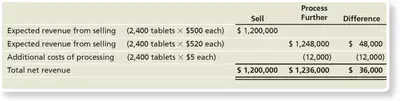
• Smart Touch Learning can sell its tablet computers as is or add
front-accessible USB ports to the tablets.
• The cost to add the USB ports is $5.
• Tablets with the USB port sell for $20 more than tablets without
the USB port.
Exhibit M:10-18 Differential Analysis for Sell or Process Further Decision
79


Copyright © 2024, 2020, 2017 Pearson Education, Inc. All Rights Reserved
Sell or Process Further (3 of 4)
Joint costs are costs of a production process that yields
multiple products.
Exhibit M:10-19 Joint Costs
80


Copyright © 2024, 2020, 2017 Pearson Education, Inc. All Rights Reserved
Sell or Process Further (4 of 4)
The decision rule when deciding whether to sell or process
further follows:
81


Copyright © 2024, 2020, 2017 Pearson Education, Inc. All Rights Reserved
Copyright
This work is protected by United States copyright laws and is
provided solely for the use of instructors in teaching their
courses and assessing student learning. Dissemination or sale of
any part of this work (including on the World Wide Web) will
destroy the integrity of the work and is not permitted. The work
and materials from it should never be made available to students
except by instructors using the accompanying text in their
classes. All recipients of this work are expected to abide by these
restrictions and to honor the intended pedagogical purposes and
the needs of other instructors who rely on these materials.
Horngren’s Financial & Managerial
Accounting
Eighth Edition
Chapter 10
Short-Term Business
Decisions
Copyright © 2024, 2020, 2017 Pearson Education, Inc. All Rights Reserved
Show answer
Auto Play
Slide 1 / 81
SLIDE
Similar Resources on Wayground

79 questions
Q4_w4_m4_Pagbása at Pagsusuri
Presentation
•
11th Grade
67 questions
M9 Masalah
Presentation
•
University
81 questions
Physical Science Q3 Benchmark Review
Presentation
•
9th - 12th Grade
76 questions
Conjunto de Instrucciones - Parte 1
Presentation
•
University
69 questions
El Nino nov 10 Lesson
Presentation
•
12th Grade
73 questions
Racial Injustice and Stereotypes
Presentation
•
KG - University
79 questions
Statement of Financial Position and Cash Flows
Presentation
•
11th Grade
81 questions
1- Unit A Careers- Safeguarding
Presentation
•
12th Grade
Popular Resources on Wayground
10 questions
Safety Day 2026 – Student Review

Quiz
•
9th Grade
21 questions
Continents and Oceans
Quiz
•
6th Grade
20 questions
Parts of Speech
Quiz
•
5th Grade
16 questions
Subject & Predicate
Quiz
•
5th Grade
25 questions
Multiplication Facts
Quiz
•
5th Grade
12 questions
Map Skills
Quiz
•
3rd Grade
22 questions
Continents and Oceans
Quiz
•
5th Grade
15 questions
Rounding Decimals
Quiz
•
5th Grade