

Classification and Cladistics

Presentation
•
Science
•
12th Grade
•
Easy
+11
Standards-aligned

Adrien Nolley
Used 11+ times
FREE Resource
20 Slides • 11 Questions
1
Discuss the importance and challenges of classification
Describe introgression
Discuss the importance of classification based of evolution
2
Poll
Which is more important when classifying species: observable traits or genetic similarity?
Observable traits
Genetic similarity
Both equally important
3

Needed due to the large amount of diversity of species.
Currently 1,200,000 -1, 800,000 cataloged based on binomial nomenclature.
A more efficient way to see:
If a species has already been discovered.
Similarities between species
Deduce common ancestry
Predict features that undiscovered but related species should have
Why is classification important?
4

Classifying organisms in the traditional hierarchy can be difficult
Challenges:
Subjective and arbitrary
Doesn’t reflect common ancestry or genetic links
Ranked system that must be followed
Same genus = same family
What if an organism is moved to a different genus?
Classification Challenges
5

Hierarchy system can fail as more organisms are discovered
Examples:
Hybridization in plants:
Crossbreeding two species to produce a hybrid
If hybrids can reproduce, a new species may form
Plant cloning:
Should cloned plants be considered a new species?
Classification Challenges Continued
6
Poll
Should hybrid plants that can reproduce be considered a new species?
Yes, they should
No, they should not
I’m not sure
7
Introgression - a process by which hybrids form over many generations but , instead of having an equal share of the original two species’ genetic information, there is an unequal contribution from each species.
8


Coyote mating with wolf
The hybrid is 50% coyote and 50% wolf
If hybrid mates with another wolf, offspring would be 75% wolf and 25% coyote (unequal sharing)
Backcrossing - the mating of a hybrid organism (offspring of genetically unlike parents) with one of its parents or with an organism genetically similar to the parent.
9
Multiple Choice
What is introgression?
The process of creating new species by hybridization
A way to classify plants based on flower structure
The unequal genetic contribution of two species in hybrids over generations
A type of genetic mutation in animals
10
Why might traditional classification systems based on traits sometimes misgroup organisms?
11
Ideal classification system follows evolutionary relationships, grouping species with a common ancestor (as shown in Darwin's tree of life)
Traditional classification based on traits may not group organisms by common ancestry
Examples: Birds and Reptiles (feathers vs scales), Sugar gliders and flying squirrels

12
Phylogeny: Study of a species' evolutionary history
Greater similarity = species are more likely related
Greater differences = species are less likely related
Comparing genetic profiles creates a phylogenetic tree
A phylogenetic tree shows evolutionary relationships among organisms

13
14
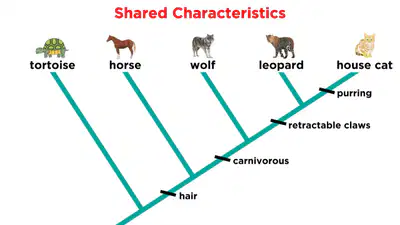
Cladistics - method of classifying organisms into groups called clades, based on shared traits.
A clade - group of organisms (or viruses) that have all evolved from a common ancestor.
Characteristics of organisms can be predicted according to the clades that they are classified into.
Clades can be organized into cladograms, which are tree diagrams that show the most probably divergence between species.
15

The most objective evidence for placing organisms in the same clade comes from base sequences of genes or amino acid sequences of proteins.
Scientists can estimate these relationships by comparing DNA, RNA or protein sequences.
16
As the organisms evolve and diverge, their DNA sequences accumulate mutations. Scientists compare these mutations using sequence alignments to reconstruct evolutionary history
17
Differences in the base sequence of DNA (and therefore proteins) are the result of mutations.
Mutations accumulate gradually over long periods of time at a constant rate, so they can be used as molecular clocks.
18
Molecular clocks only allow scientists to estimate when species diverged as the following factors affect mutation rates within a population.
Limitations of molecular clocks include:
Generation time - Species with shorter generation times provide more opportunities for mutations to occur, resulting in faster molecular clocks than species with longer generation times.
Population size - Mutations are more likely to be fixed in small populations, resulting in faster molecular clocks.
Selective pressure - Under strong selective pressure (high intraspecies competition), mutations are more likely to be fixed in a population.
19
Cladograms are tree diagrams which show the most probable sequence of divergence between clades.
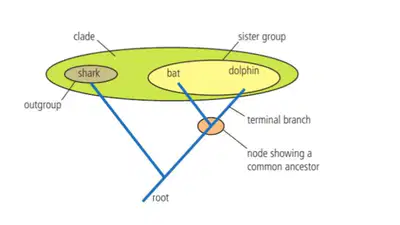
Comparing base sequences of genes or amino acid sequences in proteins is the preferred method of constructing cladograms, as the data is objective.
The fewer differences in the sequence, the more closely related two species are.
20
node = a split in a cladogram where one branch goes in one direction and the other branch in another direction, representing a hypothetical common ancestor.
root = the base of the cladogram showing the common ancestor to all the clades in the cladogram.
21
terminal branch = the end of a branch representing the most recently evolved of the organisms in the clade.
sister group = a group of the closest relatives.
outgroup = a group that is less closely related to the others in the cladogram.
22
Primitive traits (plesiomorphic traits) = characteristics that have evolved early in the history of the organisms being studied.

Derived traits = characteristics that have evolved more recently.
23
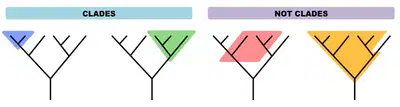
A clade is a group of organisms which have evolved from a common ancestor.
A branch on a cladogram that includes a single common ancestor, a node, and all of its descendants represents a clade.

24
Multiple Choice

What number is the common ancestor of C and D
1
2
4
25
Multiple Choice

Which letter represents the most recent common ancestor of sponges and mushrooms?
A
B
C
D
E
26
Multiple Choice
A clade contains
all the organisms with similar appearances
organisms living within the same ecosystem
an ancestral species and all the organisms that came before it
an ancestral species and all its descendants
27
Multiple Choice
28
Multiple Choice
Which order of classification is correct?
family, species, phylum, class, order, genus, kingdom
Kingdom, phylum, class, order, family, genus, species
kingdom, phylum, order, class, family, genus, species
species, kingdom, phylum, class, order, family, genus
29
Multiple Choice
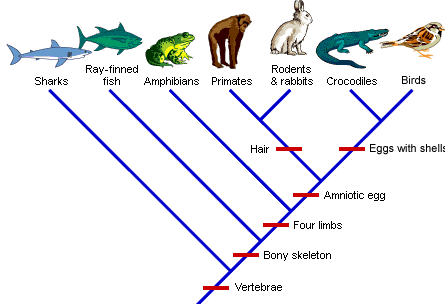
30
Multiple Choice

Where is the alligator and T. rex's common ancestor?
Point A
Point B
Point C
Point D
31
Multiple Choice
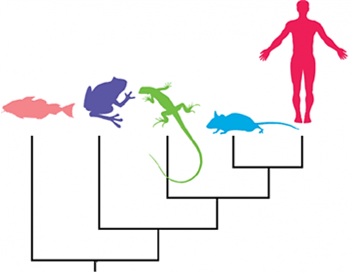
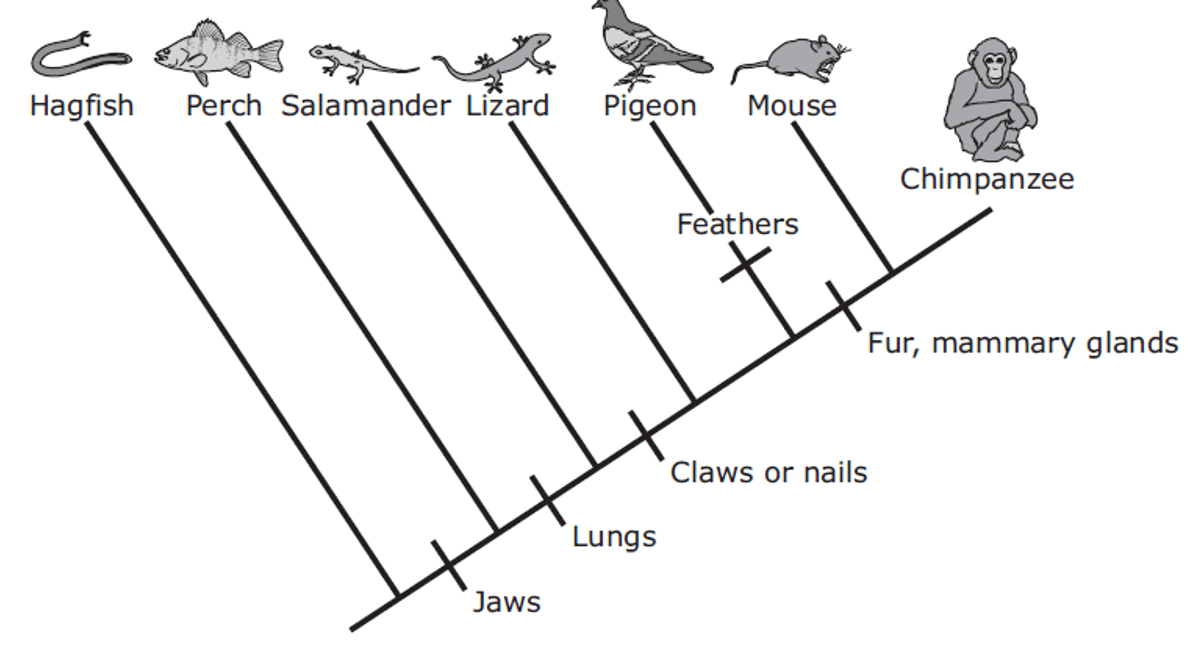
What is the human most closely related to?
Fish
mouse
Salamander
Human
Discuss the importance and challenges of classification
Describe introgression
Discuss the importance of classification based of evolution
Show answer
Auto Play
Slide 1 / 31
SLIDE
Similar Resources on Wayground

27 questions
Proteins- Notes
Presentation
•
12th Grade
25 questions
Physical and Chemical Changes Review
Presentation
•
8th Grade
22 questions
Free Body Diagrams
Presentation
•
11th Grade
21 questions
Light waves
Presentation
•
12th Grade
26 questions
Unit 4: Appendicular Skeleton, Part 1
Presentation
•
11th - 12th Grade
24 questions
Government Response to the Great Depression
Presentation
•
11th Grade
24 questions
ECONOMICS TOPIC 2 LESSON 3
Presentation
•
12th Grade
28 questions
Folding Activity
Presentation
•
12th Grade
Popular Resources on Wayground
10 questions
Safety Day 2026 – Student Review

Quiz
•
9th Grade
21 questions
Continents and Oceans
Quiz
•
6th Grade
20 questions
Parts of Speech
Quiz
•
5th Grade
16 questions
Subject & Predicate
Quiz
•
5th Grade
25 questions
Multiplication Facts
Quiz
•
5th Grade
12 questions
Map Skills
Quiz
•
3rd Grade
22 questions
Continents and Oceans
Quiz
•
5th Grade
15 questions
Rounding Decimals
Quiz
•
5th Grade
Discover more resources for Science
7 questions
Newton's Laws Video Quiz

Interactive video
•
9th - 12th Grade
35 questions
Cell Transport/Enzyme/Cell/Macro Review
Quiz
•
9th - 12th Grade
13 questions
Explore Enzyme Functions and Interactions
Quiz
•
9th - 12th Grade
10 questions
Fact or Fiction: Microbes
Quiz
•
9th - 12th Grade
10 questions
Understand Cell Functions and Organelles
Quiz
•
9th - 12th Grade
19 questions
Explore Macromolecules in Living Organisms
Quiz
•
9th - 12th Grade
15 questions
Layers of Atmosphere passage

Passage
•
9th - 12th Grade
22 questions
Quiz Review Day 5 Water and Macromolecules
Quiz
•
9th - 12th Grade