

Observing cells

Presentation
•
Biology
•
10th Grade
•
Practice Problem
•
Hard

Marina Vin
Used 1+ times
FREE Resource
25 Slides • 0 Questions
1
Discovering cells
In the early 1600s in the Netherlands there was a spectacle maker - Zacharias Jansen
He discovered the first compound microscope

2
The microscope soon became a hot item that every scientist wanted to work (play) with.
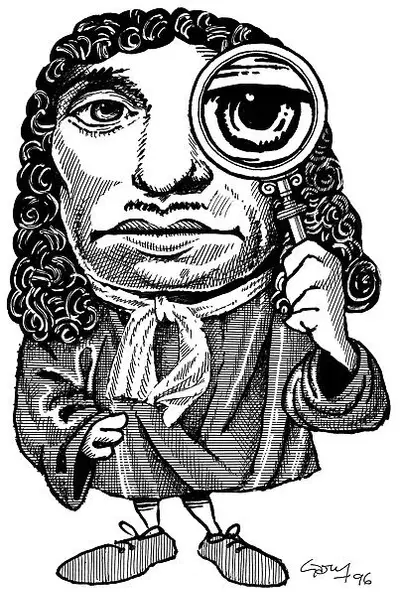
Anton van Leeuwenhoek instead of buying one of them made his own.
It was successful! So he started to discover the world around him including the gunk on his teeth :)
3

He discovered bacteria and called these organisms ‘animalcules’
4
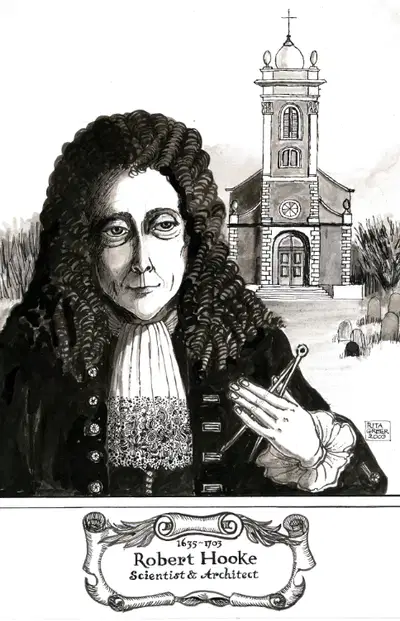
In 1665, Robert Hooke, an English architect and natural philosopher, designed and made working optical microscope.
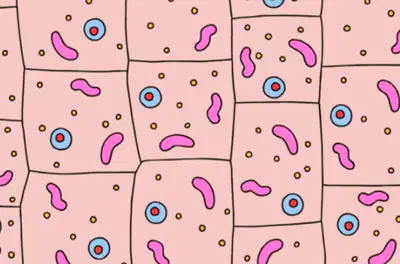
He examined sections of cork, illustrated the smallest complete parts of an organism, which he called cells, because they were made up of regular compartments.
To examine - to consider or study an idea, a subject, etc. very carefully
5
He called these small compartments cells, as they reminded him of the monks’ cells in a monastery.

6
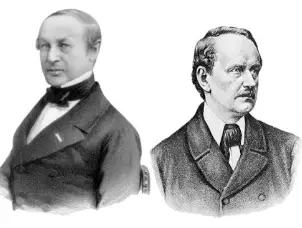
In 1839 Matthias Schleiden and Theodor Schwann introduced their cell theory:
-
-
-
7
In 1839 Matthias Schleiden and Theodor Schwann introduced their cell theory:
- All organisms are composed of one or more cells
- The cell is the smallest and basic unit of living organisms
- All cells come from preexisting cells
8

The idea is: cells and their structures are extremely small, to study them we need to magnify them
Magnification - is a measure of how much bigger the image is than the actual object
9
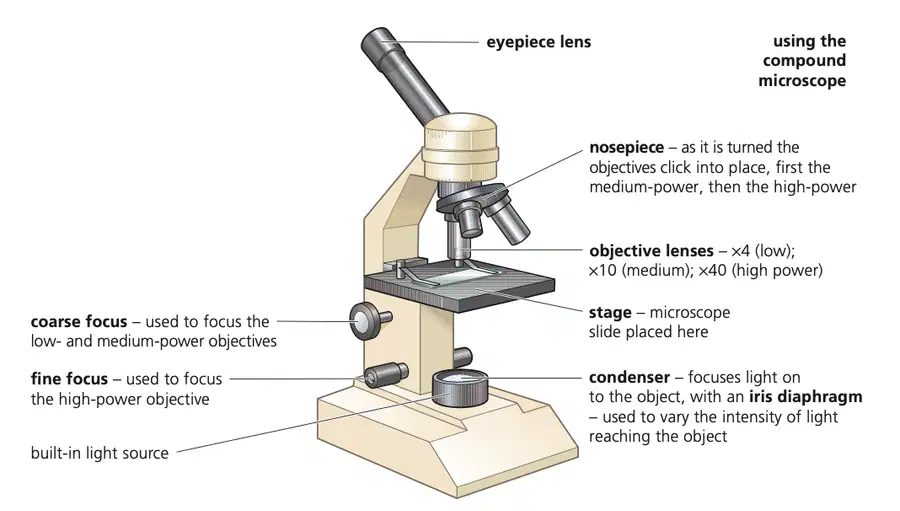
A compound light microscope; Specimen = object
10
The total magnification of the specimen is calculated as follows:
magnification of objective lens × magnification of eyepiece lens = total magnification
objective magnification | eyepiece magnification | total magnification |
|---|---|---|
low - 4x | 10x | |
middle - 10x | 10x | |
high - 40x | 10x | |
oil immersion - 100x | 10x | |
Magnification - is a measure of how much bigger the image is than the actual object
11
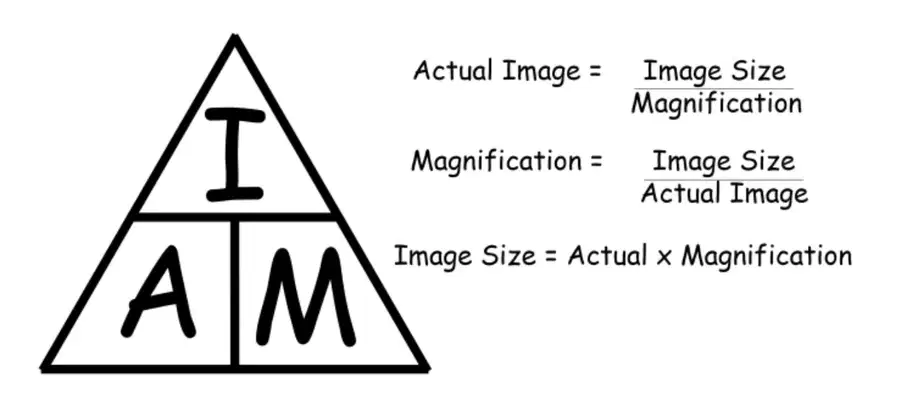
We can find a magnification using a formula (magnification triangle)
Specimen = object
12
Resolution determine how clear the image is.
Resolution - is a measure of how far apart two objects must be before we see them separately = the ability to distinguish between 2 objects
The limit of resolution of light microscope is about 0.2 micrometers. This means that 2 object less than 0.2 μm apart will always be seen as 1 object
Calculate the limit of resolution in nanometers
13
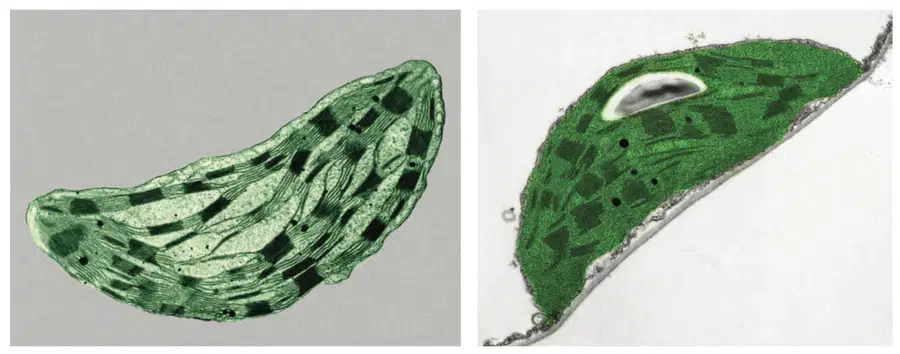
The resolving power of an electron microscope is much higher than than of a light microscope
14
What is the difference between magnification and resolution?
15
Under the light microscope we can look at living organisms, tissues and cells.
But sometimes it can be difficult to identify some structures in 3D objects, so most of the specimens will be stained, specially sectioned (very thinly sliced) before they are mounted on a slide to get a better image
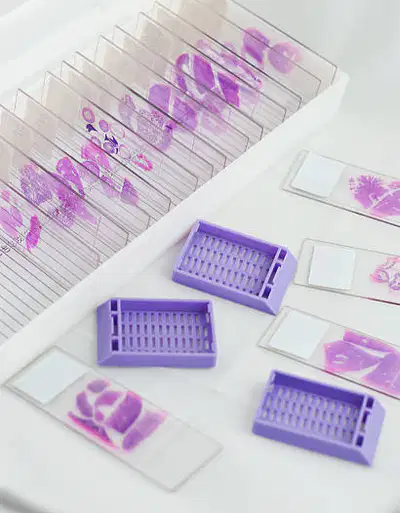
to stain - to colour (a material or object) by applying a dye or chemical.
16
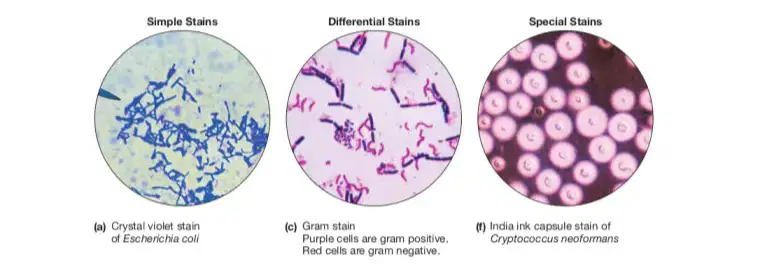
So what is the purpose of using stains?
17
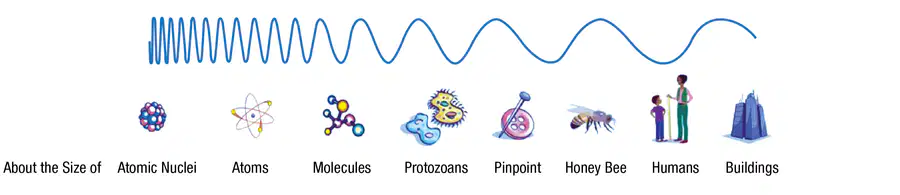
Light microscope VS Electron microscope
Wavelength - 400 nm
Wavelength - 1 nm
18
The electron microscope can resolve detail down to less than 1 nm or 0.0001 μm, about 1000 times better than the light microscope
For the electron microscope to work, the specimens must be in a vacuum, so they are always dead. The preparation of a specimen for the electron microscope is a very complex process
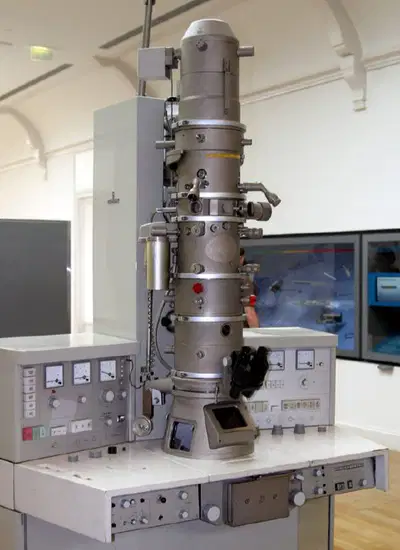
vacuum is space without matter and air
19
2 main types of electron micrograph:
TEM (transmission electron micrograph) - analysis 2D internal structures
SEM (scanning electron micrograph) - analysis 3D surface of the sample
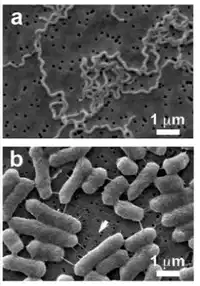
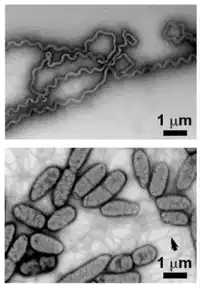
20
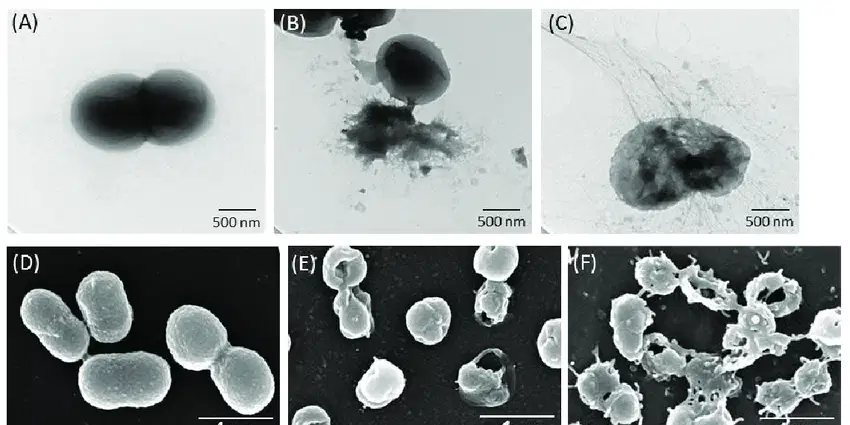
21
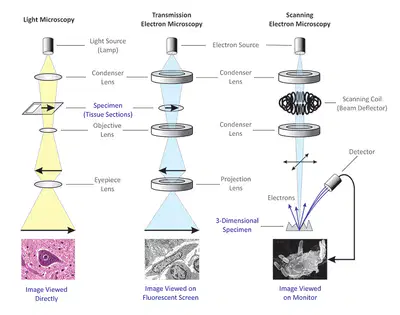
Electron beam
22
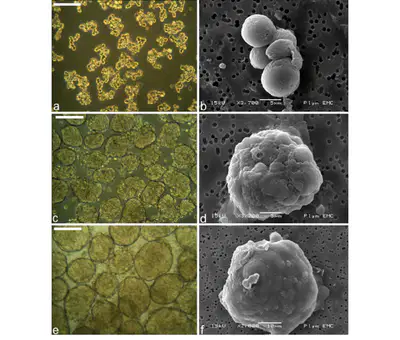
Let's compare light and electron microscopes on these points:
Cost/size/usage
Magnification
Resolution
Illumination source
Vacuum space
Colour
23
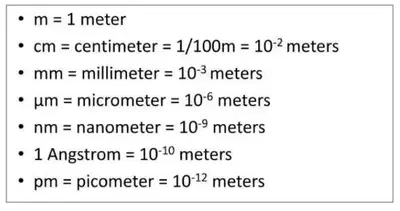
Different units of length:
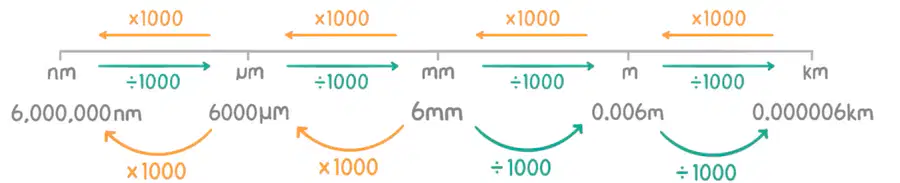
24
Converting between m, cm, mm, μm, nm:
Convert 0,036 cm to mm
Convert 0,0578 cm to µm
Convert 0,0005584 mm to nm
Convert 191.000 µm to mm
Convert 63.700.000.000 nm to cm
Convert 2300 nm to µm
25
Converting between m, cm, mm, μm, nm:
Convert 0.036 cm to mm = 0.36 mm
Convert 0.0578 cm to µm = 578 µm
Convert 0.0005584 mm to nm = 558.4 nm
Convert 191.000 µm to mm = 191 mm
Convert 63.700.000.000 nm to cm = 6370 cm
Convert 2300 nm to µm = 2.3 µm
Discovering cells
In the early 1600s in the Netherlands there was a spectacle maker - Zacharias Jansen
He discovered the first compound microscope
Show answer
Auto Play
Slide 1 / 25
SLIDE
Similar Resources on Wayground

17 questions
Electricity
Presentation
•
10th Grade
19 questions
WHAP Unit 3 Review
Presentation
•
10th Grade
19 questions
Cellular Respiration
Presentation
•
10th Grade
18 questions
Lesson 9: 3 Ways to Solve Linear Systems
Presentation
•
10th Grade
19 questions
Adaptations Structure and Function
Presentation
•
10th Grade
19 questions
Cell Theory History
Presentation
•
10th Grade
18 questions
Build an Atom
Presentation
•
10th Grade
23 questions
Unit 8- Lesson 4 (Aerobic Respiration)
Presentation
•
10th Grade
Popular Resources on Wayground
5 questions
A Home on the Shore

Quiz
•
3rd Grade
28 questions
US History Regents Review
Quiz
•
11th Grade
6 questions
A Horse Tale
Quiz
•
3rd Grade
20 questions
Math Review
Quiz
•
3rd Grade
10 questions
Juneteenth History and Significance

Interactive video
•
5th - 8th Grade
20 questions
Dividing Fractions
Quiz
•
5th Grade
55 questions
A Long Walk to Water Final Review
Quiz
•
6th - 8th Grade
10 questions
Equation Word Problems
Quiz
•
7th Grade
Discover more resources for Biology
20 questions
Insurance
Quiz
•
9th - 12th Grade
10 questions
Juneteenth: History and Significance
Interactive video
•
7th - 12th Grade
6 questions
Mayan Mathematics part 1
Presentation
•
9th - 12th Grade
40 questions
Flags of the World
Quiz
•
KG - Professional Dev...
10 questions
Unit 9 Quiz
Quiz
•
9th - 12th Grade