untitled
Presentation
•
•
Practice Problem
•
Hard
Leslie Joy Sidon
FREE Resource
5 Slides • 128 Questions
1
Multiple Choice
What are observations that are measured or counted called?
qualitative data
quantitative data
2
Multiple Choice
What are observations that are measured or counted called?
qualitative data
quantitative data
3
Multiple Choice
What are observations made using our five senses called?
qualitative data
quantitative data
4
Multiple Choice
I use rulers, scales and calculators to make these observations.
qualitative data
quantitative data
5
Multiple Choice
The flower is 8 cm tall.
qualitative data
quantitative data
6
Multiple Choice
The center of the flower is yellow and fuzzy.
qualitative data
quantitative data
7
Multiple Choice
The flower has 25 petals.
qualtitative data
quantitative data
8
Multiple Choice
The rose has three leaves.
qualitative data
quantitative data
9
Multiple Choice
The bearded iris smells sweet.
qualitative data
quantitative data
10
Multiple Choice
11
Multiple Choice
12
Multiple Choice
What words would be most appropriate to see if a student was describing the QUANTITATIVE properties of a classmate?
He is nice
He is tall
He is 5 foot 11
He is quiet
13
Multiple Choice
These kind of observation use your senses to observe results.
qualitative
quantitative
14
Multiple Choice
These kind of observations are made using instruments such as rulers, balances and thermometers.
qualitative
quantitative
15
Multiple Choice
What are observations that are measured or counted called?
qualitative data
quantitative data
16
Multiple Choice
What are observations made using our five senses called?
qualitative data
quantitative data
17
Multiple Choice
I use rulers, scales and calculators to make these observations.
qualitative data
quantitative data
18
Multiple Choice
The flower is 8 cm tall.
qualitative data
quantitative data
19
Multiple Choice
The center of the flower is yellow and fuzzy.
qualitative data
quantitative data
20
Multiple Choice
The flower has 25 petals.
qualtitative data
quantitative data
21
Multiple Choice
The rose has three leaves.
qualitative data
quantitative data
22
Multiple Choice
The bearded iris smells sweet.
qualitative data
quantitative data
23
Multiple Choice
24
Multiple Choice
25
Multiple Choice
What words would be most appropriate to see if a student was describing the QUANTITATIVE properties of a classmate?
He is nice
He is tall
He is 5 foot 11
He is quiet
26
Multiple Choice
These kind of observation use your senses to observe results.
qualitative
quantitative
27
Multiple Choice
These kind of observations are made using instruments such as rulers, balances and thermometers.
qualitative
quantitative
28
Quantitative and Qualitative Data (Fieldwork)
This isn't the original Quantitative and Qualitative Lesson
29
Click on the link
The link isn't a rickroll
https://www.bbc.co.uk/bitesize/topics/z27gf82/articles/zdhj96f
Just watch the video and after you've watched it, go back onto this Quiz and we will see if you paid attention. Or, read the transcript! But, you cannot do the quiz on the link because I've made a quiz already so, please follow the rules that I just said! Oh yeah, also, don't skip to the next slide otherwise you will not know anything. You can give it a try, but there is 20% accuracy of getting everything right with out clicking the link.
30
Multiple Choice
You saw Ayesha and James in the park asking questions, what type of question what he asking?
Qualitative
Open
Quantitative
Closed
31
Fill in the Blanks
Type answer...
32
Multiple Choice
What type of question did Ayesha ask?
Qualitative
Open
Quantitative
Closed
33
Multiple Choice
What did James warn Ayesha about?
Farting out loud
Being emo
Staying Safe
Touching the teacher's face
34
Fill in the Blanks
Type answer...
35
Multiple Choice
In the video, Ayesha and James were talking about the difficulties they got in the results. Speaking of results, what type of result did Ayesha get?
Qualitative Data
Closed Data
Quantitative Data
Open Data
36
Fill in the Blanks
Type answer...
37
Multiple Choice
What type of result did James get?
Qualitative Data
Closed Data
Quantitative Data
Open Data
38
Fill in the Blanks
Type answer...
39
Multiple Choice
How do you get quantitative data?
By asking closed questions
By asking open questions
40
Multiple Choice
How do get qualitative data?
By asking closed questions
By asking open questions
41
Multiple Choice
What does quantitative mean?
Nothing
Easy information from closed questions
Hard information from open questions
42
Multiple Choice
What does qualitative mean?
Nothing
Easy information from closed questions
Hard information from open questions
43
I'm surprised! All those questions in 1 video and transcript, you still tried! If you didn't get any right, that's ok! It was only a test. I will make more quizzes and lessons if you keep doing my quizzes/lessons! Bye bye! Also, sponsor time!
Wow!
44
Sponsor Time!
Thanking the creators of Quizizz of being hard workers and I didn't even know this is Indian! Anyway, thank you so much for letting everyone share their ideas to make everyone test themselves and try their games. It is a honour to make everyone try see if they are good at that subject and also! People have made 11+ quizzes and lessons for a revision to try! So, big, massive thank you!
Quantitative ad Qualitative Data | Geography
45
Made from Quizizz
46
Multiple Choice
Which of the following is quantative data?
Pictures
Stories
Test score
Vignettes
47
Multiple Choice
Which of the following is descriptive statistics?
T-test
Z-test
Standard deviation
Chi-square test
48
Multiple Choice
Which of the following is used to test hypothesis of two means?
T-test
Mean
Median
Mode
49
Multiple Choice
Which of the following is not the measures of central tendency?
Mean
Median
Mode
Variance
50
Multiple Choice
Which of the following is used to test the relationship between two variables?
Mean
Median
Mode
Correlation coefficient
51
Multiple Choice
which of the following is not the formula of degree of freedom
N-1
N+1
N1+N2-2
52
Multiple Choice
which of the following is not the software of quantitative data analysis?
SPSS
MS Excel
ATLAS.ti
Compare
53
Multiple Choice
which of the following is the qualitative data analysis software?
ATLAS.ti
Compare
SPSS
MS Excel
54
Multiple Choice
Which of the following is major technique of mantaining quality and creadibility of qualitative data?
Triangulation
validity
reliability
norms
55
Multiple Choice
the inquiry form that attempts to assess belief of an individual is called..
Rating Scale
Interview
Attitude scale
Checklist
56
Multiple Choice
57
Multiple Choice
58
Multiple Choice
59
Multiple Choice
60
Multiple Choice
61
Multiple Choice
62
Multiple Choice
63
Multiple Choice
64
Multiple Choice
65
Multiple Choice
66
Multiple Choice
67
Multiple Choice
68
Multiple Choice
69
Multiple Choice
70
Multiple Choice
71
Multiple Choice
72
Multiple Choice
73
Multiple Choice
74
Multiple Choice
75
Multiple Choice
76
Multiple Choice
77
Multiple Choice
78
Multiple Choice
79
Multiple Choice
80
Multiple Choice
81
Multiple Choice
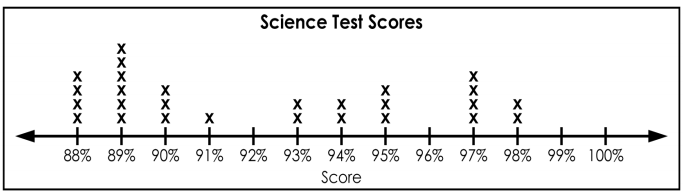
What shape is the data shown in the dot plot?
symmetrical
skewed left
skewed right
82
Multiple Choice
83
Multiple Choice
84
Multiple Choice
Part/total= %/100
85
Multiple Choice
Based on a recent survey of 500 students, the circle graph below shows how students communicate
with friends.
How many more students chose social media apps than phone calls to communicate with friends?
36 students
12 students
180 students
300 students
86
Multiple Choice
87
Multiple Choice
What is the third quartile (UQ) of the data?
88
Multiple Choice
89
Multiple Choice
90
Multiple Choice
91
Multiple Choice
The process of collecting, analyzing, and interpreting non-numerical data.
Interview
Qualitative
Quantitative
92
Multiple Choice
Is information that has been translated into a form that is efficient for movement or processing.
Statistics
Details
Data
93
Multiple Choice
The process of breaking a complex topic or substance into smaller parts in order to gain a better understanding?
Investigation
Analysis
Inquiry
94
Multiple Choice
A piece of information that is discovered during an official examination of a problem, situation.
Findings
Interpretation
Conclusion
95
Multiple Choice
A structured conversation where one participant asks questions, and the other provides answers.
Interview
Examination
Interrogation
96
Multiple Choice
Refers to how accurately a method measures what it is intended to measure.
Plausibility
Viability
Validity
97
Multiple Choice
Is defined as the probability that a product, system, or service will perform its intended function adequately for a specified period of time.
Accuracy
Authenticity
Reliability
98
Multiple Choice
Is a regularity in the world, in human-made design, or in abstract ideas?
Method
Model
Pattern
99
Multiple Choice
A reaction to a question, experience, or some other type of stimulus.
Answer
Acknowledgement
Response
100
Multiple Choice
A method used to increase the credibility and validity of research findings.
Qualitative Data
Triangulation
Quantitative Data
101
Multiple Choice
What is the purpose of using tables to organize data?
Tables are used to make data more confusing and difficult to understand.
Tables are used to randomly arrange data without any structure.
Tables are used to hide and obscure information.
The purpose of using tables to organize data is to provide a structured and organized format for presenting and managing information.
102
Multiple Choice
How can you interpret data from a line graph?
Only consider the highest point on the graph
Ignore the units and scale
Do not compare different lines or data sets
Analyze the relationship between variables, look for trends and patterns, consider units and scale, compare different lines or data sets, draw conclusions and make inferences.
103
Multiple Select
What are the different types of graphs used to represent data?
bar graphs, line graphs, pie charts, scatter plots, and histograms
bar graphs, line graphs, pie charts, and histograms
bar graphs, line graphs, pie charts, and scatter plots
bar graphs, line graphs, pie charts, scatter plots, and histograms
104
Multiple Choice
When analyzing data from figures, what should you look for?
Colors, shapes, and sizes
Personal opinions and biases
Random data points
Patterns, trends, relationships, and significant observations
105
Multiple Choice
What are the advantages of using tables to present data?
Tables do not allow for easy comparison of data
Tables make data difficult to read and understand
Tables are not visually appealing
Tables provide easy comparison, clear organization, sorting and filtering capabilities, and improved readability of data.
106
Multiple Choice
How can you analyze data from a bar graph?
Guess the meaning of the bars, compare the thickness of the bars, focus on the background of the graph, calculate the area of each bar, analyze the font style of the labels, interpret the data verbally, and draw conclusions.
Measure the length of the bars, identify the shortest bar, disregard the scale and labels, calculate the median of the bar heights, analyze the spacing between the bars, interpret the data textually, and draw conclusions.
Count the number of bars, identify the tallest bar, ignore the labels and scale, calculate the average of the bar heights, analyze the colors of the bars, look for hidden messages in the graph, interpret the data numerically, and draw conclusions.
Observe the bars, look for patterns and trends, compare different bars, pay attention to the scale and labels, calculate percentages or ratios, interpret the data visually, and draw conclusions.
107
Multiple Choice
What are the key components of a table?
chairs and plates
legs and top
forks and knives
columns and rows
108
Multiple Choice
What are the steps involved in interpreting data from a pie chart?
Look at the colors of the slices
Count the number of slices
Calculate the average of the data
The steps involved in interpreting data from a pie chart are: Read the title and labels, analyze the size of each slice, compare the sizes, use the legend, and draw conclusions.
109
Multiple Choice
Why is it important to label the axes in a graph?
To provide clarity and understanding of the data being presented.
To confuse the audience.
To save space on the graph.
To make the graph look more professional.
110
Multiple Choice
How can you compare data using tables and figures?
Look for the largest value in the tables and figures.
Analyze the values and patterns in the tables and figures to identify similarities, differences, trends, or relationships between the data points.
Count the number of tables and figures.
Compare the colors used in the tables and figures.
111
Multiple Choice
1. Which among the following research terms presents background information, scope and focus of research?
A. Introduction
B. Literature Review
C. Methodology
D. Results
112
Multiple Choice
2. The research term that provides a review of what others have written or researched concerning the topic is referred to as ________.
A. Introduction
B. Literature Review
C. Methodology
D. Results
113
Multiple Choice
3. What research term explains how the research was being conducted?
A. Introduction
B. Literature Review
C. Methodology
D. Results
114
Multiple Choice
4. Among the following, which one presents the information gathered through the research?
A. Introduction
B. Literature Review
C. Methodology
D. Results
115
Multiple Choice
5. Which of these evaluates the results of the study?
A. Conclusion
B. Discussion
C. Reference
D. Appendix
116
Multiple Choice
6. What research term provides the summary of the research?
A. Conclusion
B. Discussion
C. Reference
D. Appendix
117
Multiple Choice
7. The research term that lists all the sources used in research is__________.
A. Conclusion
B. Discussion
C. Reference
D. Appendix
118
Multiple Choice
8. Which of these contains other related information such as graphs, charts tables and lists of figures?
A. Conclusion
B. Discussion
C. Reference
D. Appendix
119
Multiple Choice
8. Which of these contains other related information such as graphs, charts tables and lists of figures?
A. Conclusion
B. Discussion
C. Reference
D. Appendix
120
Multiple Choice
9. Which one summarizes all sections and helps readers decide whether or not to read the entire report?
A. Conclusion
B. Discussion
C. Abstract
D. Research
121
Multiple Choice
10. It is a systematic investigation to contribute to an existing body of knowledge.
A. Conclusion
B. Discussion
C. Abstract
D. Research
122
Multiple Choice
123
Multiple Choice
124
Multiple Choice
125
Multiple Choice
126
Multiple Choice
127
Multiple Choice
128
Multiple Choice
129
Multiple Choice
130
Multiple Choice
131
Multiple Choice
132
Multiple Choice
133
Multiple Choice
What are observations that are measured or counted called?
qualitative data
quantitative data
Show answer
Auto Play
Slide 1 / 133
MULTIPLE CHOICE

Similar Resources on Wayground
125 questions
FIGURATIVE LANGUAGE 2
Presentation
•
11th Grade - University
128 questions
APHG Language
Presentation
•
12th Grade
126 questions
Reading SOL Review
Presentation
•
11th Grade
130 questions
2nd Semester Spanish I Review (includes Preterite)
Presentation
•
9th - 12th Grade
127 questions
ipA KLS 7
Presentation
•
7th Grade
126 questions
Basic Principles of Insurance 2025
Presentation
•
University - Professi...
126 questions
Events Leading Up To Civil War
Presentation
•
8th Grade
130 questions
Math TCAP
Presentation
•
4th Grade
Popular Resources on Wayground
20 questions
"What is the question asking??" Grades 3-5
Quiz
•
1st - 5th Grade
20 questions
“What is the question asking??” Grades 6-8
Quiz
•
6th - 8th Grade
10 questions
Fire Safety Quiz
Quiz
•
12th Grade
20 questions
Equivalent Fractions
Quiz
•
3rd Grade
34 questions
STAAR Review 6th - 8th grade Reading Part 1
Quiz
•
6th - 8th Grade
20 questions
“What is the question asking??” English I-II
Quiz
•
9th - 12th Grade
20 questions
Main Idea and Details
Quiz
•
5th Grade
47 questions
8th Grade Reading STAAR Ultimate Review!
Quiz
•
8th Grade
Discover more resources for
20 questions
"What is the question asking??" Grades 3-5
Quiz
•
1st - 5th Grade
20 questions
“What is the question asking??” Grades 6-8
Quiz
•
6th - 8th Grade
10 questions
Fire Safety Quiz
Quiz
•
12th Grade
20 questions
Equivalent Fractions
Quiz
•
3rd Grade
34 questions
STAAR Review 6th - 8th grade Reading Part 1
Quiz
•
6th - 8th Grade
20 questions
“What is the question asking??” English I-II
Quiz
•
9th - 12th Grade
20 questions
Main Idea and Details
Quiz
•
5th Grade
47 questions
8th Grade Reading STAAR Ultimate Review!
Quiz
•
8th Grade